














 The selloff intensified in November as South Korea's benchmark KOSPI plunged more than 8% in early trading, triggering a circuit breaker and temporarily halting stock and derivatives trading.
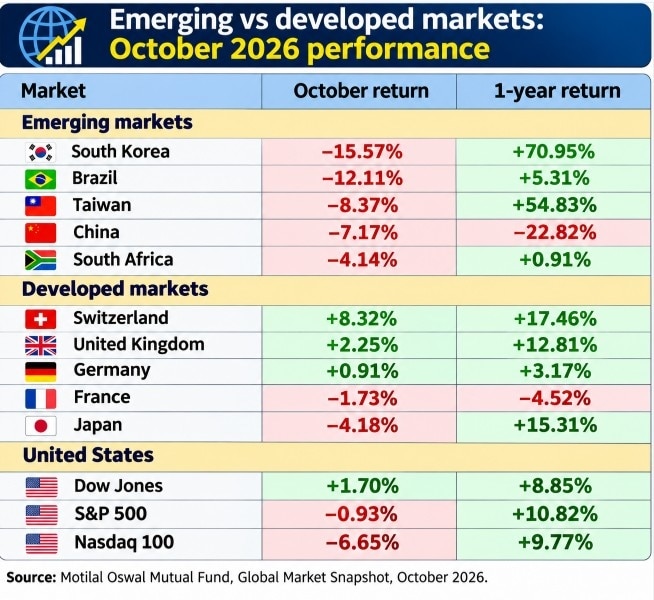
Emerging-market equities faced a sharp selloff in October 2026, with South Korea, Brazil, Taiwan and China recording substantial losses. The correction has raised questions about whether investors should reconsider exposure to emerging-market funds, particularly those concentrated in Asian economies.
According to Motilal Oswal Mutual Fund's Global Market Snapshot – October 2026, South Korea recorded the steepest monthly decline of 15.57%, followed by Brazil at 12.11%, Taiwan at 8.37%, China at 7.17% and South Africa at 4.14%.

 Coca-Cola India bottler files IPO papers with SEBI; nearly 100 crore shares on offer, revenue rises 20%
 E20 petrol row: Centre rejects Karnataka's 31% ethanol claim, says all 893 samples passed quality tests
 DA hike before Diwali: Gujarat, Uttarakhand, Arunachal Pradesh raise allowance to 63%
 'Humanity’s last personal device': Temple founder Deepinder Goyal shares vision for AI wearable
 As GRAP III kicks in, Delhi-NCR schools directed to shift classes 1-5 to hybrid mode
 Agniveer Scheme Gets 2-Year Extension | What Changes For Agniveers?
 Gold Price Target ₹2 Lakh By Next Dhanteras? Ajay Kedia Expects Fresh Rally Despite Volatility
 Gold Prices Down 30%: Why Ajay Kedia Sees A New Bull Run Ahead | Gold & Silver Outlook
 Samvat 2083 Outlook: Why Investors Should Focus on the Next 10 Years, Not 6 Months
 Nilesh Shah On Why Earnings Growth Matters More Than FII Flows For India's New-Age Stocks

 South Korea crashes 15.57%, China falls 7.17%: Are emerging-market funds becoming riskier?Coca-Cola India bottler files IPO papers with SEBI; nearly 100 crore shares on offer, revenue rises 20%
 SEBI's new settlement rules effective November 7: Online applications, revised fees, fast-track process explained
 Zerodha Fund House becomes Zerodha CASE Funds as investor base crosses 12 lakh in three years
 Gold, silver or stocks this Dhanteras? Nifty 500 won 9 years, gold 7 and silver 5 since 2006South Korea crashes 15.57%, China falls 7.17%: Are emerging-market funds becoming riskier?Agniveer Scheme Gets 2-Year Extension | What Changes For Agniveers?
 Diwali 2026: Lakshmi puja timings in Delhi, Mumbai, Kolkata, Chennai and other cities
 Diwali 2026: Jodhpur company gifts four cars to employees, including Tata Harrier and Hyundai i20Coca-Cola India bottler files IPO papers with SEBI; nearly 100 crore shares on offer, revenue rises 20%


