
What happens if a bank loses your original property papers? Here's what you should know as houseowner
A home loan borrower’s legal battle after a bank allegedly lost original property documents has spotlighted critical consumer rights and lender responsibilities. The case, highlighted by CA Kanan Bahl, raises important questions around accountability when banks mishandle borrowers' original papers.
- May 26, 2026,
- Updated May 26, 2026 3:10 PM IST
Handing over original property documents to a bank is a standard part of the home loan process. Borrowers routinely submit sale deeds, tax records and ownership papers as collateral against housing loans, trusting banks to securely safeguard them. But what happens if those documents go missing while in the bank’s custody?
According to CA Kanan Bahl, Founder of Fingrowth Media, a case involving a Bengaluru borrower has highlighted important legal principles and consumer rights that could affect home loan customers across India.
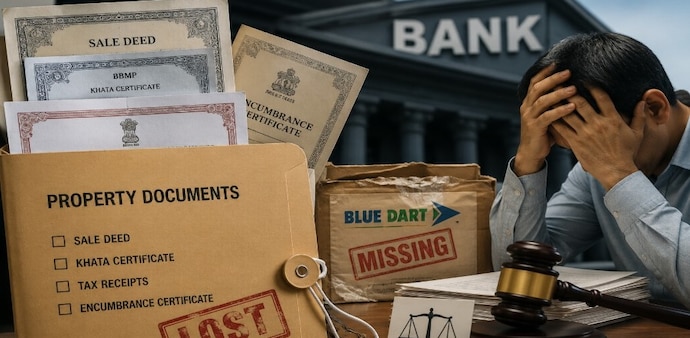
The case concerns Manoj Madhusudhanan, who took a ₹1.86 crore home loan from a private bank in 2016 for a property in Bengaluru. As part of the loan process, he deposited original documents, including sale deeds, khata papers, tax receipts and the encumbrance certificate with the lender as collateral.
MUST READ: Buying a house with your spouse? Here’s how it can reduce your tax bill
Such documentation is standard practice in secured home loans, where banks retain original ownership papers until the loan obligations are fulfilled.
However, the dispute began after the bank transferred the documents from Bengaluru to Hyderabad through courier service Blue Dart, and the file reportedly never reached its destination.
According to Bahl, the bank maintained that the issue arose due to the courier company and argued that responsibility rested with the logistics provider rather than the lender itself.
Banking ombudsman
Following the loss of documents, Manoj approached the Banking Ombudsman, seeking redressal.
The Ombudsman directed the bank to issue duplicate documents, publish a public notice and pay compensation of ₹25,000.
However, the compensation amount became a major point of contention.
For a property reportedly valued at approximately ₹5 crore, Manoj believed the amount was inadequate considering the seriousness of losing original title documents. Original property papers play a critical role in proving ownership and are often required in future transactions, resale, legal verification and financing activities.
Rather than accepting the outcome, Manoj escalated the matter further.
MUST READ: Should you take a home loan in a high-interest economy?
Is your bank responsible?
The matter eventually reached the National Consumer Disputes Redressal Commission (NCDRC), India's apex consumer forum.
According to Bahl, the NCDRC adopted a different view of liability. The commission reportedly observed that once the documents were deposited, they remained under the bank’s custody.
The forum further reasoned that the bank itself had selected the courier agency and therefore could not transfer responsibility to a third party.
The commission held that liability cannot simply be outsourced.
The NCDRC directed the bank to reconstruct the missing documents at its own cost, execute an indemnity bond and pay ₹25 lakh compensation to the borrower.
MUST READ: Should you choose under-construction property for better tax efficiency?
Key lessons
The legal matter, however, has not ended. According to Bahl, the bank has challenged the NCDRC ruling before the Supreme Court.
Until a final ruling emerges, the broader legal principle cited by the NCDRC continues to carry significance in consumer forums.
Bahl highlighted several lessons for borrowers handing over original documents to lenders.
He advised borrowers to maintain a detailed written record of every original document submitted, insist on formal acknowledgment from the bank, and keep scanned copies for reference.
He added that once papers are deposited, they fall under the bank’s custody, and explanations such as "the courier company lost them" may not necessarily absolve lenders of responsibility.
Handing over original property documents to a bank is a standard part of the home loan process. Borrowers routinely submit sale deeds, tax records and ownership papers as collateral against housing loans, trusting banks to securely safeguard them. But what happens if those documents go missing while in the bank’s custody?
According to CA Kanan Bahl, Founder of Fingrowth Media, a case involving a Bengaluru borrower has highlighted important legal principles and consumer rights that could affect home loan customers across India.
The case concerns Manoj Madhusudhanan, who took a ₹1.86 crore home loan from a private bank in 2016 for a property in Bengaluru. As part of the loan process, he deposited original documents, including sale deeds, khata papers, tax receipts and the encumbrance certificate with the lender as collateral.
MUST READ: Buying a house with your spouse? Here’s how it can reduce your tax bill
Such documentation is standard practice in secured home loans, where banks retain original ownership papers until the loan obligations are fulfilled.
However, the dispute began after the bank transferred the documents from Bengaluru to Hyderabad through courier service Blue Dart, and the file reportedly never reached its destination.
According to Bahl, the bank maintained that the issue arose due to the courier company and argued that responsibility rested with the logistics provider rather than the lender itself.
Banking ombudsman
Following the loss of documents, Manoj approached the Banking Ombudsman, seeking redressal.
The Ombudsman directed the bank to issue duplicate documents, publish a public notice and pay compensation of ₹25,000.
However, the compensation amount became a major point of contention.
For a property reportedly valued at approximately ₹5 crore, Manoj believed the amount was inadequate considering the seriousness of losing original title documents. Original property papers play a critical role in proving ownership and are often required in future transactions, resale, legal verification and financing activities.
Rather than accepting the outcome, Manoj escalated the matter further.
MUST READ: Should you take a home loan in a high-interest economy?
Is your bank responsible?
The matter eventually reached the National Consumer Disputes Redressal Commission (NCDRC), India's apex consumer forum.
According to Bahl, the NCDRC adopted a different view of liability. The commission reportedly observed that once the documents were deposited, they remained under the bank’s custody.
The forum further reasoned that the bank itself had selected the courier agency and therefore could not transfer responsibility to a third party.
The commission held that liability cannot simply be outsourced.
The NCDRC directed the bank to reconstruct the missing documents at its own cost, execute an indemnity bond and pay ₹25 lakh compensation to the borrower.
MUST READ: Should you choose under-construction property for better tax efficiency?
Key lessons
The legal matter, however, has not ended. According to Bahl, the bank has challenged the NCDRC ruling before the Supreme Court.
Until a final ruling emerges, the broader legal principle cited by the NCDRC continues to carry significance in consumer forums.
Bahl highlighted several lessons for borrowers handing over original documents to lenders.
He advised borrowers to maintain a detailed written record of every original document submitted, insist on formal acknowledgment from the bank, and keep scanned copies for reference.
He added that once papers are deposited, they fall under the bank’s custody, and explanations such as "the courier company lost them" may not necessarily absolve lenders of responsibility.