
Has your SIP given FIIs an exit? Capitalmind CEO disagrees with the logic. Here's why
Stopping SIP is a weird way to say that we'll reverse the flows - it just almost ensures that new flows won't enter, says Capitalmind CEO Deepak Shenoy
- May 25, 2026,
- Updated May 25, 2026 6:34 PM IST
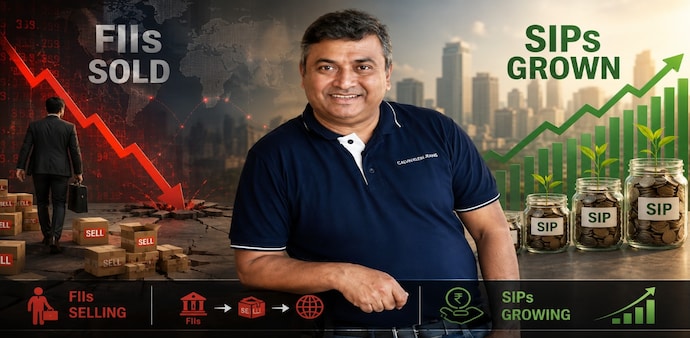
Capitalmind CEO Deepak Shenoy has disagreed with claims that the surge in domestic mutual fund SIP inflows has effectively provided foreign institutional investors (FIIs) with an easy exit route from Indian equities, arguing that the narrative misunderstands how capital markets function.
He rejected the view that domestic investors and systematic investment plans (SIPs) are somehow responsible for foreign investors reducing their exposure to India.
Don't Miss: How is your multi-asset SIP performing in this volatile market?
"I disagree with the notion that SIPs and domestic equity investors are what creates a negative in that foreign investors will leave. If all they were looking for is liquidity, then it's fine, they have it now, and they're leaving; but it's only a market that gives you the freedom and liquidity to leave that attracts future inflows," Shenoy wrote on X.
He argued that calls to reduce or stop SIP investments in response to FII selling were misplaced. "Stopping SIP is a weird way to say that we'll reverse the flows - it just almost ensures that new flows won't enter," he said.
Shenoy's comments come at a time when foreign investors have remained persistent sellers in Indian markets. FIIs have offloaded domestic equities worth Rs 2.22 lakh crore so far in 2026 and have remained net sellers for the third consecutive month. They have sold shares worth Rs 30,374 crore this month alone.
On Friday, FIIs sold equities worth Rs 4,440.47 crore, while domestic institutional investors (DIIs) purchased shares worth Rs 6,003.53 crore.
The Capitalmind founder argued that greater domestic ownership of Indian companies should be viewed as a positive development rather than a risk.
"Foreign investors owned most of the non-promoter shares of Indian companies this far. That means when we spend, and our companies earn a profit, that profit goes mostly to investors from abroad - there's no reason why India shouldn't want that share too, especially as we get richer," he said.
Don't Miss: How To Build Wealth In This Market | Market Guru George Thomas On Portfolio Strategy
The investor also suggested that increased domestic participation could gradually erode valuation premiums created by limited free float and low liquidity in some stocks. "There are many companies where a 'premium' was given primarily due to a lack of liquidity. Promoters owned too much, and the rest was with a controlled set of people, including FPIs," he said, adding that such "illiquidity premium" would likely fade over time.
According to Shenoy, the broader economic benefit of equity investing extends beyond stock market returns. "Investing in India is what's made a lot of Indians richer. They spend when they feel richer, and that promotes more of our own economy," he said.
He argued that India's growth model remains driven primarily by domestic consumption and investment rather than exports, making local participation in capital markets increasingly important.
Shenoy also compared the criticism of SIP-driven flows to resistance that often accompanies structural economic changes. "More GLP-1 means less sugar usage. Bad for sugar farmers...More EV means less petrol/diesel and thus, less state taxes collected... But we'll all understand it's better for the environment and for eventually lower crude oil imports," he wrote.
Drawing a parallel with domestic investing, he concluded that larger SIP inflows may create challenges for some market participants but ultimately strengthen the economy.
"More SIP isn't bad for us even if it allows more free outflows, in the longer term. It creates a richer India and already has, and the benefits of that will mean both greater longer-term inflows and more domestic participation in an environment that requires investment," Shenoy said.
Capitalmind CEO Deepak Shenoy has disagreed with claims that the surge in domestic mutual fund SIP inflows has effectively provided foreign institutional investors (FIIs) with an easy exit route from Indian equities, arguing that the narrative misunderstands how capital markets function.
He rejected the view that domestic investors and systematic investment plans (SIPs) are somehow responsible for foreign investors reducing their exposure to India.
Don't Miss: How is your multi-asset SIP performing in this volatile market?
"I disagree with the notion that SIPs and domestic equity investors are what creates a negative in that foreign investors will leave. If all they were looking for is liquidity, then it's fine, they have it now, and they're leaving; but it's only a market that gives you the freedom and liquidity to leave that attracts future inflows," Shenoy wrote on X.
He argued that calls to reduce or stop SIP investments in response to FII selling were misplaced. "Stopping SIP is a weird way to say that we'll reverse the flows - it just almost ensures that new flows won't enter," he said.
Shenoy's comments come at a time when foreign investors have remained persistent sellers in Indian markets. FIIs have offloaded domestic equities worth Rs 2.22 lakh crore so far in 2026 and have remained net sellers for the third consecutive month. They have sold shares worth Rs 30,374 crore this month alone.
On Friday, FIIs sold equities worth Rs 4,440.47 crore, while domestic institutional investors (DIIs) purchased shares worth Rs 6,003.53 crore.
The Capitalmind founder argued that greater domestic ownership of Indian companies should be viewed as a positive development rather than a risk.
"Foreign investors owned most of the non-promoter shares of Indian companies this far. That means when we spend, and our companies earn a profit, that profit goes mostly to investors from abroad - there's no reason why India shouldn't want that share too, especially as we get richer," he said.
Don't Miss: How To Build Wealth In This Market | Market Guru George Thomas On Portfolio Strategy
The investor also suggested that increased domestic participation could gradually erode valuation premiums created by limited free float and low liquidity in some stocks. "There are many companies where a 'premium' was given primarily due to a lack of liquidity. Promoters owned too much, and the rest was with a controlled set of people, including FPIs," he said, adding that such "illiquidity premium" would likely fade over time.
According to Shenoy, the broader economic benefit of equity investing extends beyond stock market returns. "Investing in India is what's made a lot of Indians richer. They spend when they feel richer, and that promotes more of our own economy," he said.
He argued that India's growth model remains driven primarily by domestic consumption and investment rather than exports, making local participation in capital markets increasingly important.
Shenoy also compared the criticism of SIP-driven flows to resistance that often accompanies structural economic changes. "More GLP-1 means less sugar usage. Bad for sugar farmers...More EV means less petrol/diesel and thus, less state taxes collected... But we'll all understand it's better for the environment and for eventually lower crude oil imports," he wrote.
Drawing a parallel with domestic investing, he concluded that larger SIP inflows may create challenges for some market participants but ultimately strengthen the economy.
"More SIP isn't bad for us even if it allows more free outflows, in the longer term. It creates a richer India and already has, and the benefits of that will mean both greater longer-term inflows and more domestic participation in an environment that requires investment," Shenoy said.