
US-Israel-Iran conflict: How Rupee stability, gold-silver, your investment portfolio are at stake
Escalating tensions between the US, Israel and Iran have rattled global markets, pushing crude higher and strengthening safe-haven assets like gold. For India, the real question is how this geopolitical flashpoint could impact the rupee, inflation and long-term investment portfolios.
- Mar 3, 2026,
- Updated Mar 3, 2026 8:56 AM IST
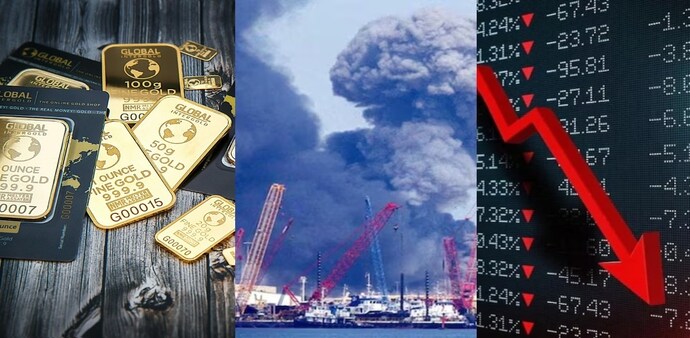
The escalation of hostilities between the US, Israel and Iran has pushed geopolitics back to the centre of global financial markets. Missile strikes, retaliatory actions and concerns over a wider Middle East conflict have unsettled risk assets, triggered safe-haven flows into gold and lifted crude oil prices.
As highlighted in the report US-Israel-Iran Conflict: Impact on India, Rupee Stability and Your Investment Portfolio by Axis Mutual Funds, the key question for India is not whether short-term volatility will rise — it already has — but whether such geopolitical episodes materially alter the country’s long-term economic and investment trajectory.
Oil and the Economy
Oil remains the most immediate transmission mechanism. India imports more than 80% of its crude requirements, making it vulnerable to Middle East instability. Brent crude has risen sharply amid fears that Iran could disrupt traffic through the Strait of Hormuz — a strategic chokepoint that accounts for roughly 20% of global crude flows and 30% of LNG trade.
More than 50% of India’s energy imports transit through this route. Any sustained disruption would push up input costs, widen the current account deficit and add to inflationary pressures. Oil-sensitive sectors such as aviation, paints, chemicals and cement could see margin pressure if crude remains elevated.
However, as the report US-Israel-Iran Conflict: Impact on India, Rupee Stability and Your Investment Portfolio notes, oil shocks alone have historically failed to derail Indian equities unless they persist long enough to impair growth and monetary stability. Even during the Russia–Ukraine war in 2022, when Brent crossed $100 per barrel, markets recovered after the initial sell-off and ended the year in positive territory.
Rupee and fluctuations
Geopolitical stress typically strengthens the US dollar, leading to pressure on emerging-market currencies. The rupee could face near-term depreciation, particularly if foreign institutional investors reduce risk exposure.
That said, India’s macro buffers are stronger today. Foreign-exchange reserves remain sizeable, and both the current account and fiscal deficit are relatively contained. Past episodes such as the 2013 taper tantrum, the 2020 pandemic shock and the 2022 Ukraine crisis led to temporary rupee weakness but not structural damage to equities.
The RBI’s policy stance is another stabilising anchor. The central bank has typically looked through temporary, geopolitically driven inflation spikes and focused on core inflation and growth durability. Active liquidity management has helped smooth volatility during previous global shocks.
Equity markets
Indian equity history over the past 15 years shows a consistent pattern: short-term drawdowns followed by recovery once economic disruption proves manageable.
From the Arab Spring (2011) to Crimea (2014), Uri (2016), Balakot (2019), the Russia–Ukraine war (2022), the Israel–Hamas conflict (2023) and Operation Sindoor (2025), market declines were generally shallow and temporary. Longer-term returns were dictated by earnings growth, liquidity cycles and domestic demand — not geopolitical headlines.
Markets price duration and economic impact, not emotion. Once it becomes evident that supply disruptions are contained and policy frameworks remain intact, risk premiums compress.
Gold and silver
Precious metals typically benefit during periods of geopolitical uncertainty, and the current escalation is no exception. Gold has seen strong safe-haven inflows as investors hedge against currency volatility, oil-driven inflation and broader market risk. For Indian investors, a weaker rupee further amplifies domestic gold prices even if global prices stabilise.
Silver is moving in tandem but with higher volatility due to its dual role as a precious and industrial metal. While gold acts as a portfolio stabiliser, silver tends to outperform in percentage terms during strong risk-off rallies. Maintaining a 5–10% strategic allocation to gold — through ETFs, sovereign gold bonds or systematic accumulation — can help cushion equity volatility without materially diluting long-term growth potential.
Portfolio strategy
For Indian investors, the implications are tactical rather than structural. Near-term volatility in equities, a softer rupee and elevated crude are plausible. Defensive and energy-linked sectors may see relative outperformance, while oil-intensive industries could lag.
As underscored in US-Israel-Iran Conflict: Impact on India, Rupee Stability and Your Investment Portfolio, exiting equities during conflict-driven corrections has historically proven counterproductive. Investors who sold during earlier geopolitical sell-offs often missed swift recoveries.
The prudent response is disciplined asset allocation: maintain diversification, rebalance periodically, and use corrections to accumulate quality businesses aligned with India’s structural growth drivers — consumption, manufacturing realignment, digitisation and capex revival.
The US-Israel-Iran conflict is serious, but for India, it is unlikely to mark a structural inflection point unless energy supply disruptions become prolonged. Volatility may rise, but fundamentals remain the dominant force shaping long-term portfolio returns.
The escalation of hostilities between the US, Israel and Iran has pushed geopolitics back to the centre of global financial markets. Missile strikes, retaliatory actions and concerns over a wider Middle East conflict have unsettled risk assets, triggered safe-haven flows into gold and lifted crude oil prices.
As highlighted in the report US-Israel-Iran Conflict: Impact on India, Rupee Stability and Your Investment Portfolio by Axis Mutual Funds, the key question for India is not whether short-term volatility will rise — it already has — but whether such geopolitical episodes materially alter the country’s long-term economic and investment trajectory.
Oil and the Economy
Oil remains the most immediate transmission mechanism. India imports more than 80% of its crude requirements, making it vulnerable to Middle East instability. Brent crude has risen sharply amid fears that Iran could disrupt traffic through the Strait of Hormuz — a strategic chokepoint that accounts for roughly 20% of global crude flows and 30% of LNG trade.
More than 50% of India’s energy imports transit through this route. Any sustained disruption would push up input costs, widen the current account deficit and add to inflationary pressures. Oil-sensitive sectors such as aviation, paints, chemicals and cement could see margin pressure if crude remains elevated.
However, as the report US-Israel-Iran Conflict: Impact on India, Rupee Stability and Your Investment Portfolio notes, oil shocks alone have historically failed to derail Indian equities unless they persist long enough to impair growth and monetary stability. Even during the Russia–Ukraine war in 2022, when Brent crossed $100 per barrel, markets recovered after the initial sell-off and ended the year in positive territory.
Rupee and fluctuations
Geopolitical stress typically strengthens the US dollar, leading to pressure on emerging-market currencies. The rupee could face near-term depreciation, particularly if foreign institutional investors reduce risk exposure.
That said, India’s macro buffers are stronger today. Foreign-exchange reserves remain sizeable, and both the current account and fiscal deficit are relatively contained. Past episodes such as the 2013 taper tantrum, the 2020 pandemic shock and the 2022 Ukraine crisis led to temporary rupee weakness but not structural damage to equities.
The RBI’s policy stance is another stabilising anchor. The central bank has typically looked through temporary, geopolitically driven inflation spikes and focused on core inflation and growth durability. Active liquidity management has helped smooth volatility during previous global shocks.
Equity markets
Indian equity history over the past 15 years shows a consistent pattern: short-term drawdowns followed by recovery once economic disruption proves manageable.
From the Arab Spring (2011) to Crimea (2014), Uri (2016), Balakot (2019), the Russia–Ukraine war (2022), the Israel–Hamas conflict (2023) and Operation Sindoor (2025), market declines were generally shallow and temporary. Longer-term returns were dictated by earnings growth, liquidity cycles and domestic demand — not geopolitical headlines.
Markets price duration and economic impact, not emotion. Once it becomes evident that supply disruptions are contained and policy frameworks remain intact, risk premiums compress.
Gold and silver
Precious metals typically benefit during periods of geopolitical uncertainty, and the current escalation is no exception. Gold has seen strong safe-haven inflows as investors hedge against currency volatility, oil-driven inflation and broader market risk. For Indian investors, a weaker rupee further amplifies domestic gold prices even if global prices stabilise.
Silver is moving in tandem but with higher volatility due to its dual role as a precious and industrial metal. While gold acts as a portfolio stabiliser, silver tends to outperform in percentage terms during strong risk-off rallies. Maintaining a 5–10% strategic allocation to gold — through ETFs, sovereign gold bonds or systematic accumulation — can help cushion equity volatility without materially diluting long-term growth potential.
Portfolio strategy
For Indian investors, the implications are tactical rather than structural. Near-term volatility in equities, a softer rupee and elevated crude are plausible. Defensive and energy-linked sectors may see relative outperformance, while oil-intensive industries could lag.
As underscored in US-Israel-Iran Conflict: Impact on India, Rupee Stability and Your Investment Portfolio, exiting equities during conflict-driven corrections has historically proven counterproductive. Investors who sold during earlier geopolitical sell-offs often missed swift recoveries.
The prudent response is disciplined asset allocation: maintain diversification, rebalance periodically, and use corrections to accumulate quality businesses aligned with India’s structural growth drivers — consumption, manufacturing realignment, digitisation and capex revival.
The US-Israel-Iran conflict is serious, but for India, it is unlikely to mark a structural inflection point unless energy supply disruptions become prolonged. Volatility may rise, but fundamentals remain the dominant force shaping long-term portfolio returns.