
Blue Aadhaar card: What is it, who is eligible, and how it differs from your regular Aadhaar?
The biggest distinction between the Blue Aadhaar card and a regular Aadhaar card lies in biometric data.
- Jul 7, 2026,
- Updated Jul 7, 2026 3:07 PM IST
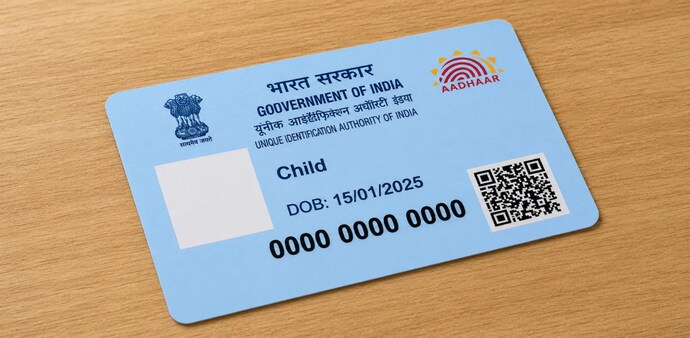
While most Indians are familiar with the standard white Aadhaar card, many are unaware that children below the age of five receive a different version altogether—the Blue Aadhaar card, also known as Bal Aadhaar.
Issued by the Unique Identification Authority of India (UIDAI), the blue-coloured card gives infants and toddlers a unique identity without collecting their biometric details. However, parents need to remember one crucial rule: the card must be updated with biometrics once the child turns five, failing which it may become inactive.
What is a Blue Aadhaar card?
The Blue Aadhaar card is a special Aadhaar issued exclusively to children below the age of five. It is popularly known as Bal Aadhaar because of its distinctive blue colour.
Unlike the regular Aadhaar card issued to adults, the Blue Aadhaar is created using only the child's demographic details, such as their name, date of birth, and photograph. Since the biometric features of young children are still developing, fingerprints and iris scans are not collected during enrolment.
Don't Miss: 'Dumbest thing I've ever done': Man who quit $200,000 job at Microsoft to become content creator
Instead, the child's Aadhaar is linked to the Aadhaar number of one parent or legal guardian.
How is it different from a regular Aadhaar card?
The biggest distinction between the Blue Aadhaar card and a regular Aadhaar card lies in biometric data.
A regular Aadhaar card contains the holder's fingerprints, iris scans, and photograph. In contrast, the Blue Aadhaar card carries only the child's photograph and demographic information because biometric traits are not stable in children under five.
The card includes the child's unique 12-digit Aadhaar number and a QR code, making it a valid identity document for several services.
How to apply for a Blue Aadhaar card
Parents or guardians can enrol their child for a Blue Aadhaar card by following these steps:
- Visit the nearest Aadhaar Enrolment Centre with the child.
- Fill out the Aadhaar enrolment form.
- Submit the child's birth certificate or another valid proof of date of birth, such as a vaccination card.
- Provide the Aadhaar card and address proof of one parent or guardian.
- The child's photograph will be captured at the enrolment centre.
- After the documents are submitted, an acknowledgement slip will be issued, which can be used to track the application status.
The Blue Aadhaar card is typically delivered to the registered address within 90 days.
Documents required
Parents need to carry the following documents while applying:
- Child's birth certificate or another valid proof of date of birth
- Aadhaar card of one parent or guardian
- Address proof of the parent or guardian, such as a ration card or electricity bill
Why are no biometrics collected?
Children below the age of five are not required to provide fingerprints or iris scans because these biometric features change as they grow. As a result, the Blue Aadhaar is generated using only demographic details and a photograph.
However, once the child turns five, biometric details must be updated to keep the Aadhaar active.
Important rules parents should know
The Blue Aadhaar card is issued free of cost.
It remains valid only until the child turns five years old. After that, parents must get the child's fingerprints, iris scan, and photograph updated.
If the biometric details are not updated after the child turns five, the Aadhaar card may become inactive.
Another mandatory biometric update is required when the child turns 15 years old.
Fees and charges
The following Aadhaar services for children are free:
- New Aadhaar enrolment for children of all ages
- Mandatory biometric updates at ages 5 and 15
The following services are chargeable:
- Demographic updates, such as a name change during childhood: ₹50
- Biometric update (if required later): ₹100
- Colour printout of the Aadhaar card: ₹30
Why is the Blue Aadhaar card important?
The Blue Aadhaar card serves as an official identity document for children and can be used for several essential services, including:
- School admissions
- Access to government welfare schemes
- Healthcare services
- Passport applications
- Opening bank accounts
- Scholarships and other child-focused benefits
It also helps authorities verify a child's identity and relationship with their parents or guardians, and plays a role in preventing child trafficking, child labour, and other forms of abuse.
Parents can also link their mobile number to their child's Aadhaar and access it through the mAadhaar app, which allows users to store and manage up to five Aadhaar cards digitally on a single smartphone.
While most Indians are familiar with the standard white Aadhaar card, many are unaware that children below the age of five receive a different version altogether—the Blue Aadhaar card, also known as Bal Aadhaar.
Issued by the Unique Identification Authority of India (UIDAI), the blue-coloured card gives infants and toddlers a unique identity without collecting their biometric details. However, parents need to remember one crucial rule: the card must be updated with biometrics once the child turns five, failing which it may become inactive.
What is a Blue Aadhaar card?
The Blue Aadhaar card is a special Aadhaar issued exclusively to children below the age of five. It is popularly known as Bal Aadhaar because of its distinctive blue colour.
Unlike the regular Aadhaar card issued to adults, the Blue Aadhaar is created using only the child's demographic details, such as their name, date of birth, and photograph. Since the biometric features of young children are still developing, fingerprints and iris scans are not collected during enrolment.
Don't Miss: 'Dumbest thing I've ever done': Man who quit $200,000 job at Microsoft to become content creator
Instead, the child's Aadhaar is linked to the Aadhaar number of one parent or legal guardian.
How is it different from a regular Aadhaar card?
The biggest distinction between the Blue Aadhaar card and a regular Aadhaar card lies in biometric data.
A regular Aadhaar card contains the holder's fingerprints, iris scans, and photograph. In contrast, the Blue Aadhaar card carries only the child's photograph and demographic information because biometric traits are not stable in children under five.
The card includes the child's unique 12-digit Aadhaar number and a QR code, making it a valid identity document for several services.
How to apply for a Blue Aadhaar card
Parents or guardians can enrol their child for a Blue Aadhaar card by following these steps:
- Visit the nearest Aadhaar Enrolment Centre with the child.
- Fill out the Aadhaar enrolment form.
- Submit the child's birth certificate or another valid proof of date of birth, such as a vaccination card.
- Provide the Aadhaar card and address proof of one parent or guardian.
- The child's photograph will be captured at the enrolment centre.
- After the documents are submitted, an acknowledgement slip will be issued, which can be used to track the application status.
The Blue Aadhaar card is typically delivered to the registered address within 90 days.
Documents required
Parents need to carry the following documents while applying:
- Child's birth certificate or another valid proof of date of birth
- Aadhaar card of one parent or guardian
- Address proof of the parent or guardian, such as a ration card or electricity bill
Why are no biometrics collected?
Children below the age of five are not required to provide fingerprints or iris scans because these biometric features change as they grow. As a result, the Blue Aadhaar is generated using only demographic details and a photograph.
However, once the child turns five, biometric details must be updated to keep the Aadhaar active.
Important rules parents should know
The Blue Aadhaar card is issued free of cost.
It remains valid only until the child turns five years old. After that, parents must get the child's fingerprints, iris scan, and photograph updated.
If the biometric details are not updated after the child turns five, the Aadhaar card may become inactive.
Another mandatory biometric update is required when the child turns 15 years old.
Fees and charges
The following Aadhaar services for children are free:
- New Aadhaar enrolment for children of all ages
- Mandatory biometric updates at ages 5 and 15
The following services are chargeable:
- Demographic updates, such as a name change during childhood: ₹50
- Biometric update (if required later): ₹100
- Colour printout of the Aadhaar card: ₹30
Why is the Blue Aadhaar card important?
The Blue Aadhaar card serves as an official identity document for children and can be used for several essential services, including:
- School admissions
- Access to government welfare schemes
- Healthcare services
- Passport applications
- Opening bank accounts
- Scholarships and other child-focused benefits
It also helps authorities verify a child's identity and relationship with their parents or guardians, and plays a role in preventing child trafficking, child labour, and other forms of abuse.
Parents can also link their mobile number to their child's Aadhaar and access it through the mAadhaar app, which allows users to store and manage up to five Aadhaar cards digitally on a single smartphone.