
Artemis II launch on April 1: About the astronauts headed to NASA's Moon mission
For the first time, the Orion capsule will be fully pressurised and equipped with potable water, oxygen, and nitrogen storage systems to sustain the crew.
- Mar 31, 2026,
- Updated Mar 31, 2026 3:52 PM IST
NASA's Artemis II mission, the first crewed journey toward the Moon in over 50 years, is all set to launch on April 1. The crew will fly in the Orion capsule launched by the Space Launch System (SLS) rocket. For the first time, the Orion capsule will be fully pressurised and equipped with potable water, oxygen, and nitrogen storage systems to sustain the crew.
Who are the Artemis II astronauts heading to the Moon?
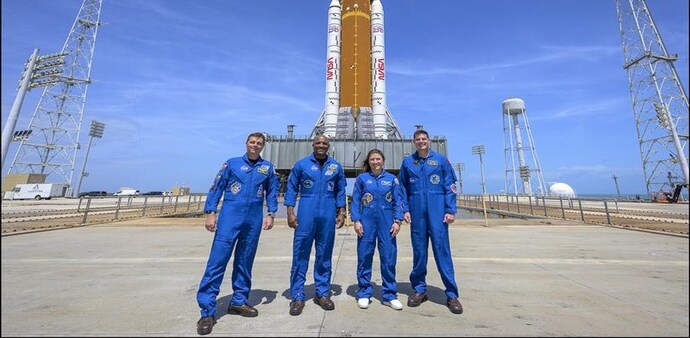
Artemis II will carry four astronauts — Reid Wiseman, Victor Glover, and Christina Koch of NASA and Jeremy Hansen of the Canadian Space Agency — on a 10-day-long journey.
Must Read: Artemis II launch time, crew, route: Everything you need to know
What roles do the Artemis II astronauts have?
- Reid Wiseman: As the Commander, he will lead the crew and hold the final decision-making authority. He is the primary link between the spacecraft and Mission Control. Wiseman will also monitor launch from the left seat and work with the pilot to manually fly Orion during ascent and entry.
- Victor Glover: Second-in-command after Wiseman, he is responsible for executing all spacecraft manoeuvres, including a critical proximity operations demo using the spent rocket stage as a target. Glover also oversees complex spacecraft systems while blending manual control with automated technology.
- Christina Koch: As Mission Specialist 1, she will take the lead on hatch systems and is seated closest to the side hatch for emergency egress. She will not only monitor the trans-lunar injection burn and other correction manoeuvres but is also responsible for setting up the spacecraft's toilet system for testing once in orbit.
- Jeremy Hansen: As the Mission Specialist 2, he will perform initial health checks on essential life support equipment, such as the potable water system, on the mission's first day. He will also assist in monitoring spacecraft systems and is responsible for operating the docking hatch after splashdown in emergency scenarios.
Must read: Artemis II launch on April 1: When and where to watch NASA's moon mission live
When will the Artemis II mission launch?
The launch window for Artemis II is 6:24 pm EDT on April 1 (03:24 am IST the next day and 10:24 pm UTC) from NASA's Kennedy Space Centre in Florida. The launch window is almost 2 hours, with backup opportunities in the following days if conditions are unfavourable.
What makes Artemis II different from Artemis I?
While Artemis I was a rigorous uncrewed test of the SLS and Orion capsule, Artemis II is the first mission to put humans on board. The Artemis I lasted 25.5 days, whereas Artemis II will last only around 10 days.
The primary goal of Artemis I was to test the rocket/capsule's integrity, whereas in the case of Artemis II, the goal is to test the rocket/capsule's life support and crew systems.
Since Artemis I spent weeks in a wide orbit around the Moon, Artemis II uses a free-return slingshot. After one day in Earth orbit to check systems, the crew will head to the Moon, loop around its far side and rely on gravity to pull them back toward Earth without a secondary engine burn for the return trip.
NASA's Artemis II mission, the first crewed journey toward the Moon in over 50 years, is all set to launch on April 1. The crew will fly in the Orion capsule launched by the Space Launch System (SLS) rocket. For the first time, the Orion capsule will be fully pressurised and equipped with potable water, oxygen, and nitrogen storage systems to sustain the crew.
Who are the Artemis II astronauts heading to the Moon?
Artemis II will carry four astronauts — Reid Wiseman, Victor Glover, and Christina Koch of NASA and Jeremy Hansen of the Canadian Space Agency — on a 10-day-long journey.
Must Read: Artemis II launch time, crew, route: Everything you need to know
What roles do the Artemis II astronauts have?
- Reid Wiseman: As the Commander, he will lead the crew and hold the final decision-making authority. He is the primary link between the spacecraft and Mission Control. Wiseman will also monitor launch from the left seat and work with the pilot to manually fly Orion during ascent and entry.
- Victor Glover: Second-in-command after Wiseman, he is responsible for executing all spacecraft manoeuvres, including a critical proximity operations demo using the spent rocket stage as a target. Glover also oversees complex spacecraft systems while blending manual control with automated technology.
- Christina Koch: As Mission Specialist 1, she will take the lead on hatch systems and is seated closest to the side hatch for emergency egress. She will not only monitor the trans-lunar injection burn and other correction manoeuvres but is also responsible for setting up the spacecraft's toilet system for testing once in orbit.
- Jeremy Hansen: As the Mission Specialist 2, he will perform initial health checks on essential life support equipment, such as the potable water system, on the mission's first day. He will also assist in monitoring spacecraft systems and is responsible for operating the docking hatch after splashdown in emergency scenarios.
Must read: Artemis II launch on April 1: When and where to watch NASA's moon mission live
When will the Artemis II mission launch?
The launch window for Artemis II is 6:24 pm EDT on April 1 (03:24 am IST the next day and 10:24 pm UTC) from NASA's Kennedy Space Centre in Florida. The launch window is almost 2 hours, with backup opportunities in the following days if conditions are unfavourable.
What makes Artemis II different from Artemis I?
While Artemis I was a rigorous uncrewed test of the SLS and Orion capsule, Artemis II is the first mission to put humans on board. The Artemis I lasted 25.5 days, whereas Artemis II will last only around 10 days.
The primary goal of Artemis I was to test the rocket/capsule's integrity, whereas in the case of Artemis II, the goal is to test the rocket/capsule's life support and crew systems.
Since Artemis I spent weeks in a wide orbit around the Moon, Artemis II uses a free-return slingshot. After one day in Earth orbit to check systems, the crew will head to the Moon, loop around its far side and rely on gravity to pull them back toward Earth without a secondary engine burn for the return trip.