
NASA's Artemis 2 mission: What happens after astronauts land on the Moon? Step-by-step guide to lunar operations
Once astronauts touch down on the lunar surface, every step that follows is carefully planned to maximise scientific output and ensure safety.
- Apr 4, 2026,
- Updated Apr 4, 2026 12:11 PM IST
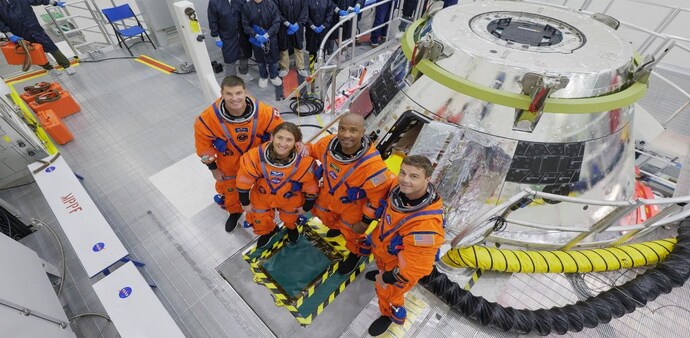
Four astronauts are headed towards the Moon right now as NASA's Artemis II, the first crewed lunar mission since 1972, is already beyond the Earth's orbit. The four astronauts in this mission are Reid Wiseman, Victor Glover, Christina Koch, and Jeremy Hansen. Most people think the Moon landing ends when astronauts touch down, but in fact, it starts from that very point.
Every checklist, every protocol, every bootprint is pre-planned to the minute. From depressurising the lander to collecting the first rock sample, lunar operations follow a precise, unforgiving sequence. Once astronauts touch down on the lunar surface, every step that follows is carefully planned to maximise scientific output and ensure safety. Miss a step, and you don't get a second chance.
Here's exactly how astronauts operate on the lunar surface, broken down step by step.
DON'T MISS | Artemis 2: iPhones hitch a ride on NASA’s Moon mission
1. Initial checks and system stabilisation
Immediately after landing, astronauts remain inside the spacecraft to assess its condition. They check fuel levels, power systems, communication links, and structural stability. Mission control on Earth also verifies telemetry data before giving the go-ahead for further steps.
2. Preparing for moonwalk (EVA)
Astronauts then begin preparations for an Extra-Vehicular Activity (EVA), commonly known as a moonwalk. This involves wearing pressurised spacesuits, checking oxygen supply, and depressurising the cabin before opening the hatch.
3. First steps and surface assessment
Once outside, astronauts conduct an initial inspection of the landing site. They evaluate terrain stability, surface dust (regolith), and nearby obstacles to ensure safe movement.
DON'T MISS | Artemis II now in space: Meet the four astronauts on NASA’s historic mission
4. Scientific experiments and sample collection
A major objective of lunar missions is scientific research. Astronauts deploy instruments such as seismometers and thermal probes, collect rock and soil samples, and document findings through photos and videos. These samples help scientists understand the Moon’s composition and history.
5. Equipment setup and data transmission
Special equipment is installed to transmit data back to Earth. This includes communication devices and experiments designed to operate even after astronauts leave the Moon.
DON'T MISS | From BBQ to Smoothies: What’s on the menu for NASA’s Artemis II moon mission crew
6. Mobility and exploration
In longer missions, astronauts may use rovers to travel further from the landing site, expanding the area of exploration and increasing the diversity of collected samples.
7. Return preparation and liftoff
Before departure, astronauts secure collected samples and equipment inside the spacecraft. The ascent module is then launched from the Moon's surface to rejoin an orbiting spacecraft, which will carry them back to Earth.
Four astronauts are headed towards the Moon right now as NASA's Artemis II, the first crewed lunar mission since 1972, is already beyond the Earth's orbit. The four astronauts in this mission are Reid Wiseman, Victor Glover, Christina Koch, and Jeremy Hansen. Most people think the Moon landing ends when astronauts touch down, but in fact, it starts from that very point.
Every checklist, every protocol, every bootprint is pre-planned to the minute. From depressurising the lander to collecting the first rock sample, lunar operations follow a precise, unforgiving sequence. Once astronauts touch down on the lunar surface, every step that follows is carefully planned to maximise scientific output and ensure safety. Miss a step, and you don't get a second chance.
Here's exactly how astronauts operate on the lunar surface, broken down step by step.
DON'T MISS | Artemis 2: iPhones hitch a ride on NASA’s Moon mission
1. Initial checks and system stabilisation
Immediately after landing, astronauts remain inside the spacecraft to assess its condition. They check fuel levels, power systems, communication links, and structural stability. Mission control on Earth also verifies telemetry data before giving the go-ahead for further steps.
2. Preparing for moonwalk (EVA)
Astronauts then begin preparations for an Extra-Vehicular Activity (EVA), commonly known as a moonwalk. This involves wearing pressurised spacesuits, checking oxygen supply, and depressurising the cabin before opening the hatch.
3. First steps and surface assessment
Once outside, astronauts conduct an initial inspection of the landing site. They evaluate terrain stability, surface dust (regolith), and nearby obstacles to ensure safe movement.
DON'T MISS | Artemis II now in space: Meet the four astronauts on NASA’s historic mission
4. Scientific experiments and sample collection
A major objective of lunar missions is scientific research. Astronauts deploy instruments such as seismometers and thermal probes, collect rock and soil samples, and document findings through photos and videos. These samples help scientists understand the Moon’s composition and history.
5. Equipment setup and data transmission
Special equipment is installed to transmit data back to Earth. This includes communication devices and experiments designed to operate even after astronauts leave the Moon.
DON'T MISS | From BBQ to Smoothies: What’s on the menu for NASA’s Artemis II moon mission crew
6. Mobility and exploration
In longer missions, astronauts may use rovers to travel further from the landing site, expanding the area of exploration and increasing the diversity of collected samples.
7. Return preparation and liftoff
Before departure, astronauts secure collected samples and equipment inside the spacecraft. The ascent module is then launched from the Moon's surface to rejoin an orbiting spacecraft, which will carry them back to Earth.