
NASA’s Artemis II mission launches: Crew embarks on historic moon journey
The spacecraft, Orion, is now carrying four astronauts on a 10-day journey around the Moon, the first crewed mission to venture beyond Earth’s orbit in over five decades
- Apr 2, 2026,
- Updated Apr 2, 2026 7:29 AM IST
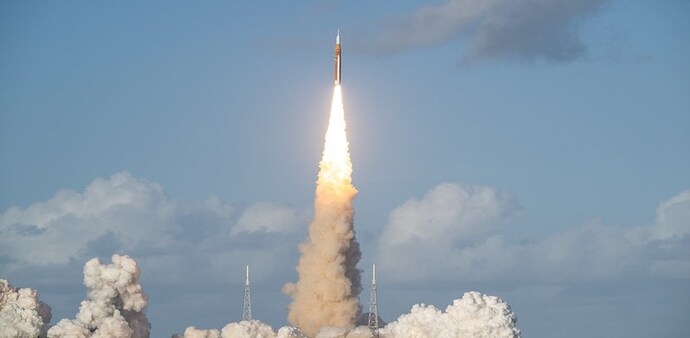
In a landmark moment for space exploration, NASA’s Artemis II mission has successfully launched from Kennedy Space Center, marking the first crewed flight of the Artemis program. The spacecraft, Orion, is now carrying four astronauts on a 10-day journey around the Moon, the first crewed mission to venture beyond Earth’s orbit in over five decades.
At 6:35 p.m. EDT on April 1, the Artemis II rocket, with its mighty solid rocket boosters and RS-25 engines, generated more than 8.8 million pounds of thrust, propelling the 5.75-million-pound spacecraft skyward and beyond Earth’s atmosphere. This marked the beginning of NASA’s next phase in lunar exploration.
The mission begins
As the rocket launched, the astronauts, Reid Wiseman, Victor Glover, and Christina Koch from NASA, alongside Canadian Space Agency astronaut Jeremy Hansen, began their journey. With their spacecraft, named Integrity, they will circle the Moon and return to Earth, testing vital systems and operations.
The launch involved meticulous preparation. The crew’s day began hours earlier, with NASA’s traditional rituals and checks, ensuring everything was in place before the critical moment. From communication tests to safety checks, the astronauts were ready.
The excitement surrounding this mission also included some light-hearted moments. Inside the White Room, the astronauts participated in a pre-launch card game, a time-honoured NASA tradition thought to bring good luck for the mission.
Technical aspects of the launch
The Artemis II mission saw smooth progress as the rocket ascended. After ignition, the twin solid rocket boosters ignited, and once they separated, the spacecraft's core stage continued its journey. The protective fairings of Orion were jettisoned as the spacecraft climbed, revealing it fully to the vast expanse of space.
Engineers had spent countless hours ensuring every stage of the rocket was prepared. This included fueling and pressurisation, as well as making sure the cryogenic propellants used in the SLS core were stored at the required low temperatures.
Next steps in the mission
The next major milestone will be the core stage separation, followed by the ignition of the Interim Cryogenic Propulsion Stage (ICPS). This step will send the spacecraft further on its journey to the Moon. With each step, Artemis II is not just testing equipment but also paving the way for future missions, including those aimed at Mars.
As Orion leaves Earth's atmosphere and moves toward its lunar destination, the mission signals the next steps for humanity’s return to the Moon. In addition to this milestone, Artemis II will test the ability of astronauts to function in deep space, preparing the crew and technology for long-duration missions.
A new era of space exploration
With Artemis II, NASA is moving closer to its goal of sustainable human presence on the Moon and eventual missions to Mars. The excitement surrounding this mission signals a future where space exploration becomes more routine, marking the beginning of a new era in space travel.
In a landmark moment for space exploration, NASA’s Artemis II mission has successfully launched from Kennedy Space Center, marking the first crewed flight of the Artemis program. The spacecraft, Orion, is now carrying four astronauts on a 10-day journey around the Moon, the first crewed mission to venture beyond Earth’s orbit in over five decades.
At 6:35 p.m. EDT on April 1, the Artemis II rocket, with its mighty solid rocket boosters and RS-25 engines, generated more than 8.8 million pounds of thrust, propelling the 5.75-million-pound spacecraft skyward and beyond Earth’s atmosphere. This marked the beginning of NASA’s next phase in lunar exploration.
The mission begins
As the rocket launched, the astronauts, Reid Wiseman, Victor Glover, and Christina Koch from NASA, alongside Canadian Space Agency astronaut Jeremy Hansen, began their journey. With their spacecraft, named Integrity, they will circle the Moon and return to Earth, testing vital systems and operations.
The launch involved meticulous preparation. The crew’s day began hours earlier, with NASA’s traditional rituals and checks, ensuring everything was in place before the critical moment. From communication tests to safety checks, the astronauts were ready.
The excitement surrounding this mission also included some light-hearted moments. Inside the White Room, the astronauts participated in a pre-launch card game, a time-honoured NASA tradition thought to bring good luck for the mission.
Technical aspects of the launch
The Artemis II mission saw smooth progress as the rocket ascended. After ignition, the twin solid rocket boosters ignited, and once they separated, the spacecraft's core stage continued its journey. The protective fairings of Orion were jettisoned as the spacecraft climbed, revealing it fully to the vast expanse of space.
Engineers had spent countless hours ensuring every stage of the rocket was prepared. This included fueling and pressurisation, as well as making sure the cryogenic propellants used in the SLS core were stored at the required low temperatures.
Next steps in the mission
The next major milestone will be the core stage separation, followed by the ignition of the Interim Cryogenic Propulsion Stage (ICPS). This step will send the spacecraft further on its journey to the Moon. With each step, Artemis II is not just testing equipment but also paving the way for future missions, including those aimed at Mars.
As Orion leaves Earth's atmosphere and moves toward its lunar destination, the mission signals the next steps for humanity’s return to the Moon. In addition to this milestone, Artemis II will test the ability of astronauts to function in deep space, preparing the crew and technology for long-duration missions.
A new era of space exploration
With Artemis II, NASA is moving closer to its goal of sustainable human presence on the Moon and eventual missions to Mars. The excitement surrounding this mission signals a future where space exploration becomes more routine, marking the beginning of a new era in space travel.