
No rain? No problem? 13-year-old Roy Kim builds device that turns air into water for farmers
No rain? No problem? 13-year-old Roy Kim builds device that turns air into water for farmers
During testing, Roy's prototype produced 10 millilitres of water in two hours. It also recorded a peak efficiency of 135.8 grams per kilowatt-hour.
Business Today Desk
- Aug 3, 2026,
- Updated Aug 3, 2026 2:45 PM IST
As droughts become more common around the world, a 13-year-old student from Oregon has designed a device that could help farmers produce water directly from the air, according to a report by Young Scientist Lab.
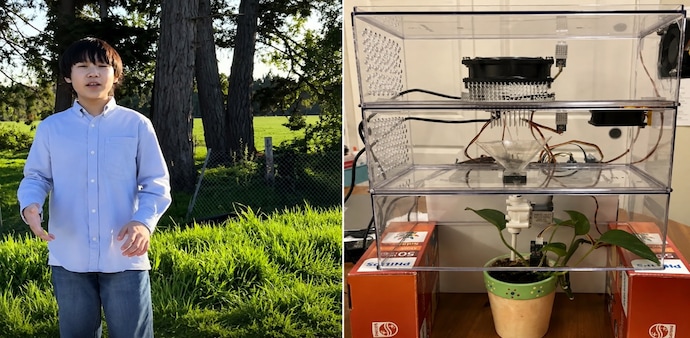
Roy Kim, a student at Whitford Middle School in Beaverton, has created a chamber that captures moisture from the atmosphere and converts it into water for irrigation. His invention has earned him a place among the top 10 national finalists of the 2026 3M Young Scientist Challenge.
Advertisement
How does the device turn air into water?
Roy's invention uses a Peltier module, a device that creates a temperature difference when electricity is applied. One side becomes hot while the other becomes cold, allowing moisture in warm air to condense into water droplets.
(Picture Credit:youngscientistlab.com)
Here's how it works:
- Air enters the chamber and is first warmed.
- A fan pushes the warm air towards the cooled surface.
- Moisture in the air condenses into water droplets.
- The water is collected through a funnel.
- A valve then delivers the water directly to plants.
The system is also equipped with soil moisture, temperature and humidity sensors.
Advertisement
(Picture Credit:youngscientistlab.com)
Don't Miss: Free Netflix every month? Flipkart Plus has a new perk but it comes with conditions
These sensors automatically adjust the airflow and decide when plants actually need watering. This helps avoid unnecessary water use and makes irrigation more efficient.
(Picture Credit:youngscientistlab.com)
What did the prototype achieve?
Advertisement
During testing, Roy's prototype produced 10 millilitres of water in two hours. It also recorded a peak efficiency of 135.8 grams per kilowatt-hour.
While the current prototype produces a small amount of water, Roy hopes the technology can be developed further to support farming in areas facing water shortages.
(Picture Credit:youngscientistlab.com)
Why did Roy build it?
Roy developed the project to tackle one of agriculture's biggest challenges—shrinking freshwater resources.
Many farmers still depend on rainfall, groundwater and rivers for irrigation. However, these water sources are becoming increasingly unreliable due to climate change, making it harder to grow crops in many parts of the world.
A young inventor with big dreams
The 3M Young Scientist Challenge, organised by 3M and Discovery Education, is open to students in Grades 5 to 8 studying at schools across the United States. The competition encourages students to use science and engineering to solve real-world problems.
Roy hopes his invention will encourage wider use of sustainable farming technologies. He also plans to pursue engineering in the future, with a focus on developing environmental solutions to global challenges such as water scarcity and climate change.
As droughts become more common around the world, a 13-year-old student from Oregon has designed a device that could help farmers produce water directly from the air, according to a report by Young Scientist Lab.
Roy Kim, a student at Whitford Middle School in Beaverton, has created a chamber that captures moisture from the atmosphere and converts it into water for irrigation. His invention has earned him a place among the top 10 national finalists of the 2026 3M Young Scientist Challenge.
Advertisement
How does the device turn air into water?
Roy's invention uses a Peltier module, a device that creates a temperature difference when electricity is applied. One side becomes hot while the other becomes cold, allowing moisture in warm air to condense into water droplets.
(Picture Credit:youngscientistlab.com)
Here's how it works:
- Air enters the chamber and is first warmed.
- A fan pushes the warm air towards the cooled surface.
- Moisture in the air condenses into water droplets.
- The water is collected through a funnel.
- A valve then delivers the water directly to plants.
The system is also equipped with soil moisture, temperature and humidity sensors.
Advertisement
(Picture Credit:youngscientistlab.com)
Don't Miss: Free Netflix every month? Flipkart Plus has a new perk but it comes with conditions
These sensors automatically adjust the airflow and decide when plants actually need watering. This helps avoid unnecessary water use and makes irrigation more efficient.
(Picture Credit:youngscientistlab.com)
What did the prototype achieve?
Advertisement
During testing, Roy's prototype produced 10 millilitres of water in two hours. It also recorded a peak efficiency of 135.8 grams per kilowatt-hour.
While the current prototype produces a small amount of water, Roy hopes the technology can be developed further to support farming in areas facing water shortages.
(Picture Credit:youngscientistlab.com)
Why did Roy build it?
Roy developed the project to tackle one of agriculture's biggest challenges—shrinking freshwater resources.
Many farmers still depend on rainfall, groundwater and rivers for irrigation. However, these water sources are becoming increasingly unreliable due to climate change, making it harder to grow crops in many parts of the world.
A young inventor with big dreams
The 3M Young Scientist Challenge, organised by 3M and Discovery Education, is open to students in Grades 5 to 8 studying at schools across the United States. The competition encourages students to use science and engineering to solve real-world problems.
Roy hopes his invention will encourage wider use of sustainable farming technologies. He also plans to pursue engineering in the future, with a focus on developing environmental solutions to global challenges such as water scarcity and climate change.
Read more!