
Sarvam AI launches 30B and 105B open-source models
The company said it is designed for efficiency, producing higher-quality responses while using fewer tokens.
- Feb 18, 2026,
- Updated Feb 19, 2026 5:15 PM IST
Homegrown artificial intelligence startup Sarvam AI on 18 February launched two large language models, Sarvam-30B and Sarvam-105B, at the India AI Impact Summit, as the country steps up efforts to build domestic AI capabilities.
The company said both models will be released as open source, aiming to drive adoption among developers, enterprises and government agencies seeking alternatives to foreign AI systems.
Sarvam AI founder and Chief Executive Officer Pratyush Kumar said the systems were built entirely from the ground up without relying on external datasets. “Everything that Sarvam has built is from scratch, with no data dependency,” he said.
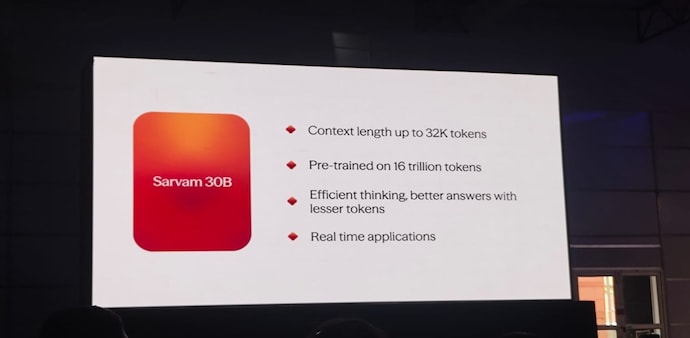
Sarvam-30B, the smaller model, has been pre-trained on 16 trillion tokens and supports a context length of 32,000 tokens. The company said it is designed for efficiency, producing higher-quality responses while using fewer tokens.
The larger Sarvam-105B model supports a context window of 128,000 tokens, allowing it to handle much longer documents and conversations. Sarvam AI said the model performs on par with other frontier systems of comparable size, including both open-source and proprietary models.
The launch comes as India accelerates efforts to develop sovereign AI infrastructure and homegrown foundation models under the government-backed IndiaAI Mission, amid concerns over data security, cost and reliance on foreign technology providers.
Sarvam AI is part of a growing group of domestic startups building large-scale models tailored to India’s languages and enterprise needs.
During the launch, the company presented benchmark results indicating that Sarvam-30B outperformed several well-known AI systems.
It also demonstrated real-world use cases, including an interaction running on a basic feature phone with a physical keypad.
In the demonstration, the company used an example of a chatbot called “Vikram” which was able to converse in multiple Indian languages, including Hindi and Punjabi. The name for this demo honours Vikram Sarabhai, the Indian physicist widely regarded as the father of the country’s space programme.
Homegrown artificial intelligence startup Sarvam AI on 18 February launched two large language models, Sarvam-30B and Sarvam-105B, at the India AI Impact Summit, as the country steps up efforts to build domestic AI capabilities.
The company said both models will be released as open source, aiming to drive adoption among developers, enterprises and government agencies seeking alternatives to foreign AI systems.
Sarvam AI founder and Chief Executive Officer Pratyush Kumar said the systems were built entirely from the ground up without relying on external datasets. “Everything that Sarvam has built is from scratch, with no data dependency,” he said.
Sarvam-30B, the smaller model, has been pre-trained on 16 trillion tokens and supports a context length of 32,000 tokens. The company said it is designed for efficiency, producing higher-quality responses while using fewer tokens.
The larger Sarvam-105B model supports a context window of 128,000 tokens, allowing it to handle much longer documents and conversations. Sarvam AI said the model performs on par with other frontier systems of comparable size, including both open-source and proprietary models.
The launch comes as India accelerates efforts to develop sovereign AI infrastructure and homegrown foundation models under the government-backed IndiaAI Mission, amid concerns over data security, cost and reliance on foreign technology providers.
Sarvam AI is part of a growing group of domestic startups building large-scale models tailored to India’s languages and enterprise needs.
During the launch, the company presented benchmark results indicating that Sarvam-30B outperformed several well-known AI systems.
It also demonstrated real-world use cases, including an interaction running on a basic feature phone with a physical keypad.
In the demonstration, the company used an example of a chatbot called “Vikram” which was able to converse in multiple Indian languages, including Hindi and Punjabi. The name for this demo honours Vikram Sarabhai, the Indian physicist widely regarded as the father of the country’s space programme.