
In India, workers supplement their income by filming daily tasks to help train AI robotics
Indian workers are earning extra money by filming their daily tasks, unknowingly helping robotics companies collect real-world data that could eventually teach AI-powered machines to perform similar jobs.
- Aug 14, 2026,
- Updated Aug 14, 2026 10:00 AM IST
If you work a routine job, you may not expect your everyday movements to become valuable data for the next generation of machines. But that is increasingly happening in India, where workers are recording physical tasks that could help robotics companies teach machines how humans work.
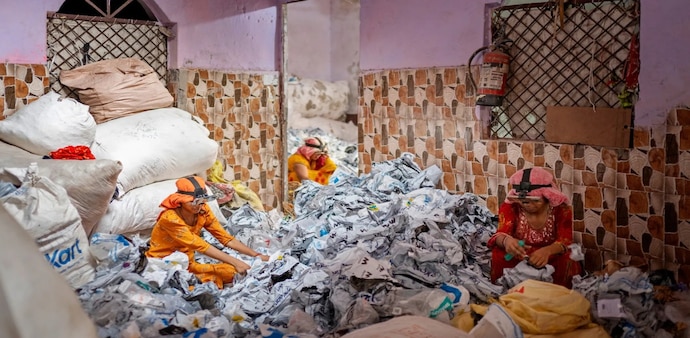
For 43-year-old Sunita Rathore, the day begins much like any other. She sorts and cleans discarded plastic at a recycling colony in Karan Vihar, on the western edge of New Delhi. Her work includes removing labels from plastic bags, separating waste by grade and stacking sacks for recycling.
Must Read: Google’s Gemini app makes history; Crosses 1 billion monthly user in a major AI milestone
Then there is the unusual part - an iPhone strapped to her head, recording the movements of her hands. The camera is positioned to capture her work while keeping her legs out of the frame. According to Bloomberg, Rathore shuts off the camera if someone calls out to her, while capturing people's faces is prohibited.
Why are workers recording their everyday work?
According to a report by Bloomberg, the footage is being collected as companies look for real-world data to train AI-powered robots. The recordings can show machines how people perform physical tasks, from handling objects to sorting materials.
Rathore, however, does not know exactly what her footage will be used for. She knows that wearing the camera brings additional income. Bloomberg reports that workers in other settings are also recording tasks in factories, warehouses and other workplaces.
Must Read: Google could soon change how you search; 3 AI shortcuts may replace the search button
For you, the larger significance is the unusual cycle this creates: humans perform the work, cameras capture their movements, and that data can potentially help machines learn similar tasks.
How much extra can workers earn?
According to Bloomberg, Rathore earns about ₹20,000 a month from sorting plastic. Wearing the camera earns her another ₹150 per hour. The additional income is helping her save for the education of her four children.
The arrangement also raises questions about the future of work. As robots become better at handling physical tasks, the same data collected from workers today could eventually help automate some of those jobs.
The development highlights a broader challenge for India - as AI and robotics create new opportunities, you may also see greater pressure on traditional manual work.
For Unparalleled coverage of India's Businesses and Economy – Subscribe to Business Today Magazine
If you work a routine job, you may not expect your everyday movements to become valuable data for the next generation of machines. But that is increasingly happening in India, where workers are recording physical tasks that could help robotics companies teach machines how humans work.
For 43-year-old Sunita Rathore, the day begins much like any other. She sorts and cleans discarded plastic at a recycling colony in Karan Vihar, on the western edge of New Delhi. Her work includes removing labels from plastic bags, separating waste by grade and stacking sacks for recycling.
Must Read: Google’s Gemini app makes history; Crosses 1 billion monthly user in a major AI milestone
Then there is the unusual part - an iPhone strapped to her head, recording the movements of her hands. The camera is positioned to capture her work while keeping her legs out of the frame. According to Bloomberg, Rathore shuts off the camera if someone calls out to her, while capturing people's faces is prohibited.
Why are workers recording their everyday work?
According to a report by Bloomberg, the footage is being collected as companies look for real-world data to train AI-powered robots. The recordings can show machines how people perform physical tasks, from handling objects to sorting materials.
Rathore, however, does not know exactly what her footage will be used for. She knows that wearing the camera brings additional income. Bloomberg reports that workers in other settings are also recording tasks in factories, warehouses and other workplaces.
Must Read: Google could soon change how you search; 3 AI shortcuts may replace the search button
For you, the larger significance is the unusual cycle this creates: humans perform the work, cameras capture their movements, and that data can potentially help machines learn similar tasks.
How much extra can workers earn?
According to Bloomberg, Rathore earns about ₹20,000 a month from sorting plastic. Wearing the camera earns her another ₹150 per hour. The additional income is helping her save for the education of her four children.
The arrangement also raises questions about the future of work. As robots become better at handling physical tasks, the same data collected from workers today could eventually help automate some of those jobs.
The development highlights a broader challenge for India - as AI and robotics create new opportunities, you may also see greater pressure on traditional manual work.
For Unparalleled coverage of India's Businesses and Economy – Subscribe to Business Today Magazine