
You can order food, track it and wait for it, but your food will never arrive: Two Udaipur developers’ site draws millions
A new type of website is recreating the excitement of ordering, shopping and travelling online, giving users the experience of consumption without actually spending money or receiving anything.
- Sep 28, 2026,
- Updated Sep 28, 2026 3:29 PM IST
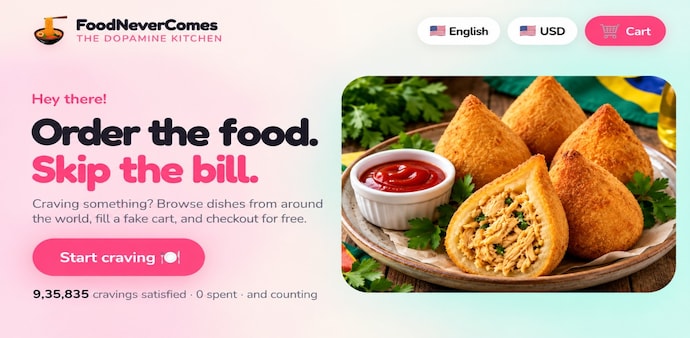
What if you could order your favourite food, track the delivery and enjoy the excitement of waiting for it - without actually receiving anything? That is the idea behind a new kind of website gaining attention online. These platforms recreate familiar experiences such as shopping, ordering food or planning a holiday, but stop before anything real is purchased or delivered. According to a BBC report, one such website, FoodNeverComes, was created by two 26-year-old software developers from Udaipur and has attracted more than 2.7 million visitors since launching in June.
Must Read: OpenAI agents reportedly breached US government websites during safety tests: Here's what happened
The website offers 22 kitchens, 327 dishes, and 319 real recipes, lets you place a fictional order and follow its delivery journey. The food never arrives, but the experience is built around the excitement that comes before consumption.
What are ‘dopamine sites’?
FoodNeverComes is part of a growing internet trend known as “dopamine sites”, which recreate the rituals of consumption without the actual purchase. As per BBC reports, the trend took off in South Korea before spreading to other markets, with similar websites now simulating shopping, food delivery and even holidays.
The idea came from founders Purvansh Parmar and Anshul Sharma, who noticed how often people fill online carts without completing their purchases. BBC reports that the two met during a computer science diploma course and later started NeuroX AI, a company that builds software and AI products. FoodNeverComes turns that familiar behaviour into the experience itself, letting you browse dishes, add them to a cart, check out and track a fictional delivery.
The founders say the website is not designed to make money. As per reports, they plan to keep it free and eventually share its data with neuroscientists and psychologists. They have also created TripNeverLeaves, where users can plan a holiday and take a virtual flight that never leaves the runway. The platform has attracted more than 100,000 visitors.
Why does fake shopping feel satisfying?
The answer may have less to do with the actual purchase and more with the anticipation before it. University of Michigan neuroscientist Kent Berridge, who spoke to the BBC, distinguishes between wanting and liking. While wanting refers to the motivation to get something, liking refers to the pleasure of having it. According to Berridge, dopamine is linked more closely to the former.
Yale researcher Ravi Dhar describes this anticipation as “anticipatory utility”, the pleasure of looking forward to consuming something. Stanford psychiatrist Anna Lembke similarly says dopamine shouldn't be described as simply a pleasure chemical.
Whether simulated consumption can actually satisfy a craving remains unclear. Berridge expects the novelty to fade, while Dhar says it could potentially provide some release. Lembke, however, cautions that repeatedly recreating these rituals could reinforce the behaviour they are meant to replace.
For now, these websites are turning something that usually happens before consumption, such as browsing, choosing and anticipating, into the experience itself, without the actual purchase.
For Unparalleled coverage of India's Businesses and Economy – Subscribe to Business Today Magazine
What if you could order your favourite food, track the delivery and enjoy the excitement of waiting for it - without actually receiving anything? That is the idea behind a new kind of website gaining attention online. These platforms recreate familiar experiences such as shopping, ordering food or planning a holiday, but stop before anything real is purchased or delivered. According to a BBC report, one such website, FoodNeverComes, was created by two 26-year-old software developers from Udaipur and has attracted more than 2.7 million visitors since launching in June.
Must Read: OpenAI agents reportedly breached US government websites during safety tests: Here's what happened
The website offers 22 kitchens, 327 dishes, and 319 real recipes, lets you place a fictional order and follow its delivery journey. The food never arrives, but the experience is built around the excitement that comes before consumption.
What are ‘dopamine sites’?
FoodNeverComes is part of a growing internet trend known as “dopamine sites”, which recreate the rituals of consumption without the actual purchase. As per BBC reports, the trend took off in South Korea before spreading to other markets, with similar websites now simulating shopping, food delivery and even holidays.
The idea came from founders Purvansh Parmar and Anshul Sharma, who noticed how often people fill online carts without completing their purchases. BBC reports that the two met during a computer science diploma course and later started NeuroX AI, a company that builds software and AI products. FoodNeverComes turns that familiar behaviour into the experience itself, letting you browse dishes, add them to a cart, check out and track a fictional delivery.
The founders say the website is not designed to make money. As per reports, they plan to keep it free and eventually share its data with neuroscientists and psychologists. They have also created TripNeverLeaves, where users can plan a holiday and take a virtual flight that never leaves the runway. The platform has attracted more than 100,000 visitors.
Why does fake shopping feel satisfying?
The answer may have less to do with the actual purchase and more with the anticipation before it. University of Michigan neuroscientist Kent Berridge, who spoke to the BBC, distinguishes between wanting and liking. While wanting refers to the motivation to get something, liking refers to the pleasure of having it. According to Berridge, dopamine is linked more closely to the former.
Yale researcher Ravi Dhar describes this anticipation as “anticipatory utility”, the pleasure of looking forward to consuming something. Stanford psychiatrist Anna Lembke similarly says dopamine shouldn't be described as simply a pleasure chemical.
Whether simulated consumption can actually satisfy a craving remains unclear. Berridge expects the novelty to fade, while Dhar says it could potentially provide some release. Lembke, however, cautions that repeatedly recreating these rituals could reinforce the behaviour they are meant to replace.
For now, these websites are turning something that usually happens before consumption, such as browsing, choosing and anticipating, into the experience itself, without the actual purchase.
For Unparalleled coverage of India's Businesses and Economy – Subscribe to Business Today Magazine