
AI Impact Summit 2026: TCS launches 'Tata AI Sakhi', COO says 'AI can assist women, artisans in their daily work'
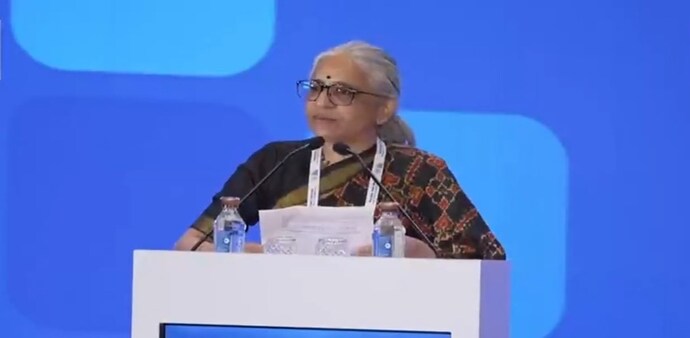
Opening the Tata AI Sakhi Immersion Program, TCS Executive Director, President and COO Aarthi Subramanian framed AI adoption as a community-level transformation rather than just a technological shift
- Feb 17, 2026,
- Updated Feb 17, 2026 12:22 PM IST
At the India AI Impact Summit 2026, the conversation around artificial intelligence stretched from grassroots training sessions to hyperscale computing infrastructure, capturing both the social and industrial sides of India’s AI push.
Opening the Tata AI Sakhi Immersion Program, TCS Executive Director, President and COO Aarthi Subramanian framed AI adoption as a community-level transformation rather than just a technological shift.
“At this summit we are discussing AI and its many opportunities, but at TCS we believe that technological advancement should go hand in hand with the progress of communities. Therefore, the TATA Sakhi program has been designed as a hands-on session that grows from India’s roots, allowing artisans, entrepreneurs and women to experience how AI can help in their daily work and livelihoods.”
She said the program focuses on practical usage rather than theory.
“With the support of mentors, participants will explore new product designs using AI, create marketing material, understand government schemes, translate documents and prepare applications, all on their own phones and in their own languages.”
Subramanian added that the initiative is meant to create ripple effects beyond the venue. “I hope your long journey from different corners of India to Delhi finds a joyful and educational destination here today. And we all hope that every learning you gain here will spread from you to hundreds and thousands more.”
From non-coders to creators
The community-level effort ties into the Bharat YUVAi Hackathon, described as India’s largest hackathon for non-coders. Around 2,000 college students from Arts, Science and Commerce streams will build working applications in three hours using multilingual, voice-first AI tools.
Participants will choose real-world problems across healthcare, education, agriculture and civic services, then research and build digital prototypes guided by AI systems operating in Indian languages. The goal is to remove both coding and language barriers and demonstrate what the next generation of digital creators could look like.
Infrastructure race behind the scenes
While the summit spotlighted inclusion, industry discussions highlighted the scale challenge behind AI adoption, computing capacity.
India currently has roughly 1.5 gigawatts of data-centre capacity, expected to cross 10 gigawatts by 2030, with about $94 billion invested in the sector since 2019 amid rising cloud usage and AI workloads.
To support this surge, TCS introduced HyperVault, an AI-ready infrastructure platform aimed at hyperscalers and AI-driven enterprises. The facilities are designed for intensive computing, using liquid cooling, high rack densities and energy-efficient architecture, alongside high-speed connectivity across cloud regions.
The company plans to work with AI firms and hyperscalers to design and optimise infrastructure, positioning the effort as more than real estate, a services layer for large-scale AI operations.
For Unparalleled coverage of India's Businesses and Economy – Subscribe to Business Today Magazine
At the India AI Impact Summit 2026, the conversation around artificial intelligence stretched from grassroots training sessions to hyperscale computing infrastructure, capturing both the social and industrial sides of India’s AI push.
Opening the Tata AI Sakhi Immersion Program, TCS Executive Director, President and COO Aarthi Subramanian framed AI adoption as a community-level transformation rather than just a technological shift.
“At this summit we are discussing AI and its many opportunities, but at TCS we believe that technological advancement should go hand in hand with the progress of communities. Therefore, the TATA Sakhi program has been designed as a hands-on session that grows from India’s roots, allowing artisans, entrepreneurs and women to experience how AI can help in their daily work and livelihoods.”
She said the program focuses on practical usage rather than theory.
“With the support of mentors, participants will explore new product designs using AI, create marketing material, understand government schemes, translate documents and prepare applications, all on their own phones and in their own languages.”
Subramanian added that the initiative is meant to create ripple effects beyond the venue. “I hope your long journey from different corners of India to Delhi finds a joyful and educational destination here today. And we all hope that every learning you gain here will spread from you to hundreds and thousands more.”
From non-coders to creators
The community-level effort ties into the Bharat YUVAi Hackathon, described as India’s largest hackathon for non-coders. Around 2,000 college students from Arts, Science and Commerce streams will build working applications in three hours using multilingual, voice-first AI tools.
Participants will choose real-world problems across healthcare, education, agriculture and civic services, then research and build digital prototypes guided by AI systems operating in Indian languages. The goal is to remove both coding and language barriers and demonstrate what the next generation of digital creators could look like.
Infrastructure race behind the scenes
While the summit spotlighted inclusion, industry discussions highlighted the scale challenge behind AI adoption, computing capacity.
India currently has roughly 1.5 gigawatts of data-centre capacity, expected to cross 10 gigawatts by 2030, with about $94 billion invested in the sector since 2019 amid rising cloud usage and AI workloads.
To support this surge, TCS introduced HyperVault, an AI-ready infrastructure platform aimed at hyperscalers and AI-driven enterprises. The facilities are designed for intensive computing, using liquid cooling, high rack densities and energy-efficient architecture, alongside high-speed connectivity across cloud regions.
The company plans to work with AI firms and hyperscalers to design and optimise infrastructure, positioning the effort as more than real estate, a services layer for large-scale AI operations.
For Unparalleled coverage of India's Businesses and Economy – Subscribe to Business Today Magazine