
Artemis 2: iPhones hitch a ride on NASA’s Moon mission
Apple iPhones to challenge professional equipment as they embark journey to deep space.
- Apr 2, 2026,
- Updated Apr 2, 2026 4:30 PM IST
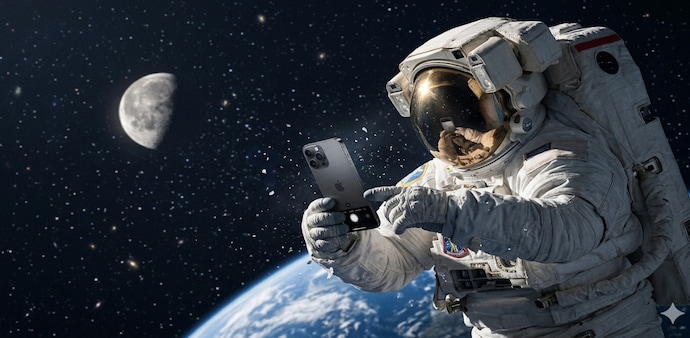
NASA’s Artemis 2 mission takes flight from Florida’s Kennedy Space Centre on April 2, embarking on a historic journey to the Moon after 5 decades. Just ahead of the mission, the space agency approved the use of iPhones in deep space, allowing astronauts to capture historic mission moments.
iPhone goes to space
The Artemis 2 mission involves four astronauts: Reid Wiseman, Victor Glover, Christina Koch, and Jeremy Hansen, who will be flying around the Moon on a crewed lunar flyby.
These astronauts are allowed to keep iPhones in their suits, giving them a tool to capture moments and stay organised during the historic lunar flyby. However, the devices will be kept in Aeroplane Mode at all times, and they will only be used for documentation.
How iPhones will be used in the Artemis 2 mission
NASA introduced a new rule in 2026 under Administrator Jared Isaacman. These rules allow astronauts to carry modern smartphones like iPhones to capture personal moments, high-quality photos or videos.
However, no technical operations will be permitted, and the phone will be kept in Aeroplane mode as mentioned above to restrict signals. As a result, they won’t interfere with the spacecraft’s systems or try to connect to networks on Earth.
With iPhones taking a trip to the Moon, smartphone cameras will now challenge professional equipment, making them suitable even for use in unique environments like deep space. In addition, with a compact design and ease of use, iPhones could come as a convenient way to document missions.
What is NASA’s Artemis 2 mission?
NASA’s Artemis II will be a 10-day mission to test the capabilities, vital systems and operations of the spacecraft for future Moon missions. During these days, the spacecraft will circle the Moon, running safety checks, practising manual piloting and docking simulations. This will help astronauts collect important data that will help plan future lunar missions.
For Unparalleled coverage of India's Businesses and Economy – Subscribe to Business Today Magazine
NASA’s Artemis 2 mission takes flight from Florida’s Kennedy Space Centre on April 2, embarking on a historic journey to the Moon after 5 decades. Just ahead of the mission, the space agency approved the use of iPhones in deep space, allowing astronauts to capture historic mission moments.
iPhone goes to space
The Artemis 2 mission involves four astronauts: Reid Wiseman, Victor Glover, Christina Koch, and Jeremy Hansen, who will be flying around the Moon on a crewed lunar flyby.
These astronauts are allowed to keep iPhones in their suits, giving them a tool to capture moments and stay organised during the historic lunar flyby. However, the devices will be kept in Aeroplane Mode at all times, and they will only be used for documentation.
How iPhones will be used in the Artemis 2 mission
NASA introduced a new rule in 2026 under Administrator Jared Isaacman. These rules allow astronauts to carry modern smartphones like iPhones to capture personal moments, high-quality photos or videos.
However, no technical operations will be permitted, and the phone will be kept in Aeroplane mode as mentioned above to restrict signals. As a result, they won’t interfere with the spacecraft’s systems or try to connect to networks on Earth.
With iPhones taking a trip to the Moon, smartphone cameras will now challenge professional equipment, making them suitable even for use in unique environments like deep space. In addition, with a compact design and ease of use, iPhones could come as a convenient way to document missions.
What is NASA’s Artemis 2 mission?
NASA’s Artemis II will be a 10-day mission to test the capabilities, vital systems and operations of the spacecraft for future Moon missions. During these days, the spacecraft will circle the Moon, running safety checks, practising manual piloting and docking simulations. This will help astronauts collect important data that will help plan future lunar missions.
For Unparalleled coverage of India's Businesses and Economy – Subscribe to Business Today Magazine