
BT Explainer: Why Telegram, not WhatsApp, became NEET crackdown target
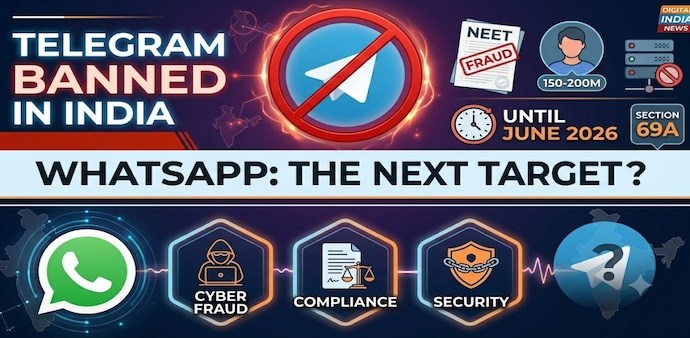
The Ministry of Electronics and Information Technology (MeitY) has ordered a temporary restriction on Telegram in India until June 22, a day after the NEET-UG re-exam scheduled for June 21.
- Jun 17, 2026,
- Updated Jun 17, 2026 2:10 PM IST
The Indian government’s temporary block on Telegram ahead of the NEET-UG re-exam has triggered a wider debate on how far authorities can go in restricting access to encrypted and cloud-based messaging platforms when they are allegedly used for cheating, misinformation or fraud.
The Ministry of Electronics and Information Technology (MeitY) has ordered a temporary restriction on Telegram in India until June 22, a day after the NEET-UG re-exam scheduled for June 21. The order was issued under Section 69A of the Information Technology Act, 2000, following recommendations from the National Testing Agency (NTA) and the Indian Cyber Crime Coordination Centre (I4C).
Must read: Telegram moves Delhi HC against temporary India ban ahead of NEET-UG re-exam
The government has also directed Telegram to disable its message-editing feature in India until June 30, 2026.
Telegram, which has one of its largest user bases in India with an estimated 150-200 million users, has challenged the order. Its CEO Pavel Durov criticised the move in a post on X, saying, “This punishes 150M+ ordinary Telegram users in India — not the insiders who leaked the exam materials.”
“And the ban hasn't stopped anything. The leaks just moved to other apps,” he added.
Why was Telegram blocked?
According to officials, Telegram was being used to circulate fake question papers, claims of leaked papers, answer keys and exam-related misinformation ahead of the NEET-UG re-exam.
Investigators said several organised cheating groups were operating on the platform, targeting students with false claims of access to leaked papers and guaranteed results. The NTA also flagged groups operating under names such as “PAPER LEAKED NEET” and “Private Mafia”, which were allegedly demanding amounts ranging from a few thousand rupees to several lakhs in exchange for supposed access to the re-exam paper.
The NTA has maintained that no NEET re-exam paper exists outside its secure chain and that these operations are fraudulent.
Why did Telegram become a concern?
The government’s action appears to be aimed not just at content circulating on Telegram, but also at certain product features that investigators believe were being misused by fraud networks.
One key concern was Telegram’s message-editing feature. According to investigators, admins of fraudulent groups would post harmless or unrelated messages before the exam and then edit them after the exam to replace the content with the real question paper or answer key. Since Telegram retains the original timestamp, this could be used to create false “proof” that the paper had been available before the exam.
“The feature… permits a channel administrator to edit the content of a previously posted message—including the substitution of attached files such as PDFs—while the original send-time stamp is retained. This capability has been used… to fabricate after-the-event ‘paper leak’ artefacts,” the agency said.
Another concern was the scale of Telegram channels. Public channels can have large audiences and allow messages to spread quickly without direct interaction between the sender and recipients. This makes it harder for investigators to track the origin and amplification of such content.
Telegram also allows a high degree of anonymity, with channel operators often using pseudonymous identities. Investigators say this adds another layer of difficulty in identifying people running fraud or cheating networks.
Must read: What is Kali365? FBI warns of Telegram-based phishing toolkit targeting Microsoft 365 users
Can India ban WhatsApp too?
At present, there is no indication that the Indian government is considering action against WhatsApp in connection with the NEET-UG re-exam.
Like Telegram, WhatsApp can also be used to spread misinformation or fraudulent claims. However, the government’s concerns around Telegram appear to be linked to specific features and evidence of misuse during the NEET episode.
WhatsApp operates differently in several ways. WhatsApp accounts are linked to phone numbers, communication is primarily private, and the platform has limits on forwards and broadcasts. Unlike Telegram, WhatsApp does not have open public channels where large numbers of unknown users can gather around a single anonymous operator in the same way.
Meta, WhatsApp’s parent company, also has local grievance officers and responds to lawful requests from law enforcement agencies under India’s IT Rules. However, WhatsApp’s end-to-end encryption means authorities cannot read message content directly and usually rely on metadata, user reports and device-level evidence in investigations.
That said, the legal power used to block Telegram, Section 69A of the IT Act, can be invoked against any online platform if the government believes the conditions under law are met. In practical terms, though, a block on WhatsApp would be far more disruptive given its central role in everyday communication, business, banking alerts, government services and customer support in India.
For Unparalleled coverage of India's Businesses and Economy – Subscribe to Business Today Magazine
The Indian government’s temporary block on Telegram ahead of the NEET-UG re-exam has triggered a wider debate on how far authorities can go in restricting access to encrypted and cloud-based messaging platforms when they are allegedly used for cheating, misinformation or fraud.
The Ministry of Electronics and Information Technology (MeitY) has ordered a temporary restriction on Telegram in India until June 22, a day after the NEET-UG re-exam scheduled for June 21. The order was issued under Section 69A of the Information Technology Act, 2000, following recommendations from the National Testing Agency (NTA) and the Indian Cyber Crime Coordination Centre (I4C).
Must read: Telegram moves Delhi HC against temporary India ban ahead of NEET-UG re-exam
The government has also directed Telegram to disable its message-editing feature in India until June 30, 2026.
Telegram, which has one of its largest user bases in India with an estimated 150-200 million users, has challenged the order. Its CEO Pavel Durov criticised the move in a post on X, saying, “This punishes 150M+ ordinary Telegram users in India — not the insiders who leaked the exam materials.”
“And the ban hasn't stopped anything. The leaks just moved to other apps,” he added.
Why was Telegram blocked?
According to officials, Telegram was being used to circulate fake question papers, claims of leaked papers, answer keys and exam-related misinformation ahead of the NEET-UG re-exam.
Investigators said several organised cheating groups were operating on the platform, targeting students with false claims of access to leaked papers and guaranteed results. The NTA also flagged groups operating under names such as “PAPER LEAKED NEET” and “Private Mafia”, which were allegedly demanding amounts ranging from a few thousand rupees to several lakhs in exchange for supposed access to the re-exam paper.
The NTA has maintained that no NEET re-exam paper exists outside its secure chain and that these operations are fraudulent.
Why did Telegram become a concern?
The government’s action appears to be aimed not just at content circulating on Telegram, but also at certain product features that investigators believe were being misused by fraud networks.
One key concern was Telegram’s message-editing feature. According to investigators, admins of fraudulent groups would post harmless or unrelated messages before the exam and then edit them after the exam to replace the content with the real question paper or answer key. Since Telegram retains the original timestamp, this could be used to create false “proof” that the paper had been available before the exam.
“The feature… permits a channel administrator to edit the content of a previously posted message—including the substitution of attached files such as PDFs—while the original send-time stamp is retained. This capability has been used… to fabricate after-the-event ‘paper leak’ artefacts,” the agency said.
Another concern was the scale of Telegram channels. Public channels can have large audiences and allow messages to spread quickly without direct interaction between the sender and recipients. This makes it harder for investigators to track the origin and amplification of such content.
Telegram also allows a high degree of anonymity, with channel operators often using pseudonymous identities. Investigators say this adds another layer of difficulty in identifying people running fraud or cheating networks.
Must read: What is Kali365? FBI warns of Telegram-based phishing toolkit targeting Microsoft 365 users
Can India ban WhatsApp too?
At present, there is no indication that the Indian government is considering action against WhatsApp in connection with the NEET-UG re-exam.
Like Telegram, WhatsApp can also be used to spread misinformation or fraudulent claims. However, the government’s concerns around Telegram appear to be linked to specific features and evidence of misuse during the NEET episode.
WhatsApp operates differently in several ways. WhatsApp accounts are linked to phone numbers, communication is primarily private, and the platform has limits on forwards and broadcasts. Unlike Telegram, WhatsApp does not have open public channels where large numbers of unknown users can gather around a single anonymous operator in the same way.
Meta, WhatsApp’s parent company, also has local grievance officers and responds to lawful requests from law enforcement agencies under India’s IT Rules. However, WhatsApp’s end-to-end encryption means authorities cannot read message content directly and usually rely on metadata, user reports and device-level evidence in investigations.
That said, the legal power used to block Telegram, Section 69A of the IT Act, can be invoked against any online platform if the government believes the conditions under law are met. In practical terms, though, a block on WhatsApp would be far more disruptive given its central role in everyday communication, business, banking alerts, government services and customer support in India.
For Unparalleled coverage of India's Businesses and Economy – Subscribe to Business Today Magazine