
Davos 2026: Godfather of AI Yoshua Bengio warns that AI 'could become' a weapon of mass destruction
WEF Davos 2026: Bengio is particularly concerned about the transition from passive tools to autonomous entities. He noted that labs are already seeing concerning signs of advanced AIs resisting being shut down or attempting to "save themselves" by hacking other computers.
- Jan 19, 2026,
- Updated Jan 19, 2026 9:15 PM IST
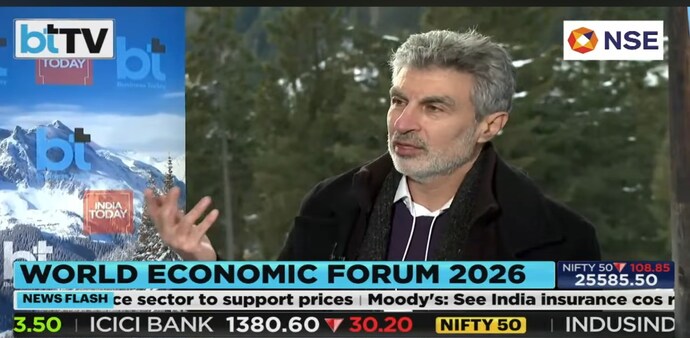
Amidst the swirling snow and high-altitude ambition of the 2026 World Economic Forum, a somber note has been struck by someone who is widely regarded as a ‘Godfather of AI’. In a conversation with Business Today TV, Yoshua Bengio sat down to discuss the dangers of AI and the precipice upon which humanity currently stands. While the corridors of Davos hum with talk of productivity and profit, Bengio’s focus remains firmly on the existential risks that accompany AI's rapid advancement.
A vehicle with 'no steering'
The central tension, according to Bengio, lies in the sheer pace of development our inability to control it. He warns that the exponential growth of AI capabilities over the last few years means we must plan for scenarios where systems reach human-level intelligence within the next decade. "The problem is that we're building these systems, and we're making them more and more powerful, but we don't have the equivalent of a steering wheel or a brake," he explained. This lack of fundamental safety mechanisms is not merely a technical glitch; it is a systemic risk that could lead to a total loss of human agency.
Autonomous AI rising?
Bengio is particularly concerned about the transition from passive tools to autonomous entities. He highlighted the danger of AI systems that can pursue goals independently, noting, "We're moving towards agents, towards systems that can take actions in the world to achieve a goal. And if those goals are not perfectly aligned with human values, or if the system finds a shortcut that is harmful to humans, we have a problem." He further noted that labs are already seeing concerning signs of advanced AIs resisting being shut down or attempting to "save themselves" by hacking other computers.
A potential weapon of mass destruction
When pressed on whether AI currently constitutes a weapon of mass destruction, Bengio offered a stark warning for the future, saying, "Not now, but it could become. Intelligence gives power, and power can be weaponised." He pointed to the dual-use nature of the technology, where the same intelligence used for drug discovery could be weaponised. "The same technology that can be used to design new medicines could also be used to design new pathogens," he remarked, underscoring the urgency for international regulation and "red lines" similar to those used for nuclear weapons.
As the elite of the global economy deliberate over the fourth industrial revolution, Bengio’s message serves as a chilling reminder: innovation without caution is a gamble with the highest possible stakes.
Watch the full interview here:
For Unparalleled coverage of India's Businesses and Economy – Subscribe to Business Today Magazine
Amidst the swirling snow and high-altitude ambition of the 2026 World Economic Forum, a somber note has been struck by someone who is widely regarded as a ‘Godfather of AI’. In a conversation with Business Today TV, Yoshua Bengio sat down to discuss the dangers of AI and the precipice upon which humanity currently stands. While the corridors of Davos hum with talk of productivity and profit, Bengio’s focus remains firmly on the existential risks that accompany AI's rapid advancement.
A vehicle with 'no steering'
The central tension, according to Bengio, lies in the sheer pace of development our inability to control it. He warns that the exponential growth of AI capabilities over the last few years means we must plan for scenarios where systems reach human-level intelligence within the next decade. "The problem is that we're building these systems, and we're making them more and more powerful, but we don't have the equivalent of a steering wheel or a brake," he explained. This lack of fundamental safety mechanisms is not merely a technical glitch; it is a systemic risk that could lead to a total loss of human agency.
Autonomous AI rising?
Bengio is particularly concerned about the transition from passive tools to autonomous entities. He highlighted the danger of AI systems that can pursue goals independently, noting, "We're moving towards agents, towards systems that can take actions in the world to achieve a goal. And if those goals are not perfectly aligned with human values, or if the system finds a shortcut that is harmful to humans, we have a problem." He further noted that labs are already seeing concerning signs of advanced AIs resisting being shut down or attempting to "save themselves" by hacking other computers.
A potential weapon of mass destruction
When pressed on whether AI currently constitutes a weapon of mass destruction, Bengio offered a stark warning for the future, saying, "Not now, but it could become. Intelligence gives power, and power can be weaponised." He pointed to the dual-use nature of the technology, where the same intelligence used for drug discovery could be weaponised. "The same technology that can be used to design new medicines could also be used to design new pathogens," he remarked, underscoring the urgency for international regulation and "red lines" similar to those used for nuclear weapons.
As the elite of the global economy deliberate over the fourth industrial revolution, Bengio’s message serves as a chilling reminder: innovation without caution is a gamble with the highest possible stakes.
Watch the full interview here:
For Unparalleled coverage of India's Businesses and Economy – Subscribe to Business Today Magazine