
'From no bank account to same vendor accepting online payments': Macron praises India's AI shift as 'civilisational'
The French president pointed to India’s digital public infrastructure, a digital identity system covering 1.4 billion people, a payments network processing 20 billion transactions every month
- Feb 19, 2026,
- Updated Feb 19, 2026 11:16 AM IST
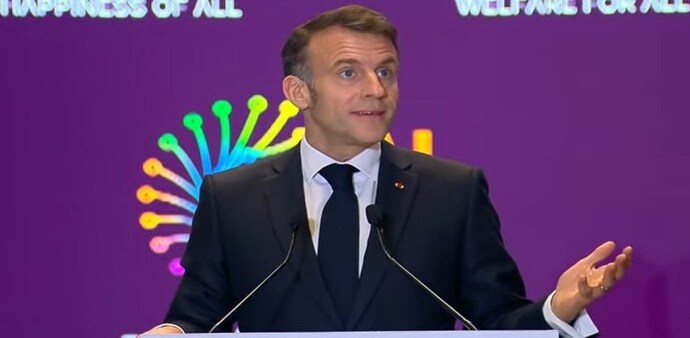
Addressing leaders, CEOs and policymakers at the India AI Impact Summit at Bharat Mandapam in New Delhi, Emmanuel Macron anchored his message in a Mumbai street story to illustrate India’s digital leap, and to make a broader case for sovereign, inclusive artificial intelligence.
Opening with a greeting, “Mr. Prime Minister Narendra Modi, heads of state and government, ministers, ambassadors, CEOs, ladies and gentlemen, Namaste,” Macron said it was a privilege to return to India after his 2024 State Visit and to join Prime Minister Narendra Modi again, this time for a summit focused on AI’s next phase.
He recalled how, a decade ago, a street vendor in Mumbai could not open a bank account due to the absence of an address, papers or access. Today, he said, that same vendor accepts digital payments instantly and free of cost from anywhere in the country.
“That is not just a tech transformation. It is a civilizational shift,” Macron said.
He pointed to India’s digital public infrastructure, a digital identity system covering 1.4 billion people, a payments network processing 20 billion transactions every month, and 500 million digital health IDs, describing the India Stack as open, interoperable and sovereign.
Talent, quantum and the ‘right purpose’
Highlighting talent pipelines, Macron noted that India trains hundreds of thousands of AI engineers every year and now has the world’s second-largest developer community, with over 500,000 engineers. France, he said, is doubling the number of AI scientists it trains and currently hosts more than 1,100 AI startups.
Turning to quantum computing, he said France is placing bets across four technologies with four companies, aiming to make Europe a quantum power.
“The smartest AI is not the most expensive. It is the one built by the best people, for the right purpose,” he said, underscoring that capability must align with societal needs.
Inclusion as a competitive edge
Macron repeatedly stressed that inclusion is a strength, not a constraint. India’s AI ecosystem, he said, delivers tools for 200 million farmers in their own dialects, travel guidance for 400 million pilgrims, and AI diagnostics for rural clinics, all operating on open digital public infrastructure with near-zero-cost adoption.
In Europe, he added, AI is optimising energy grids, transforming logistics and reinventing healthcare administration, while safeguarding citizens’ data. Pushing back against criticism that Europe is overly regulatory, he argued that innovation and safety are not contradictory. “Safe spaces win in the long run,” he said.
Child safety and digital responsibility
A key shared priority, Macron said, is protecting children from digital abuse.
“There is no reason children should be exposed online to what is forbidden in the real world,” he stated, adding that protecting children is not simply regulation but a matter of civilisation.
France is moving to ban social networks for children under 15, and Macron welcomed India’s willingness to align on child protection measures.
For Unparalleled coverage of India's Businesses and Economy – Subscribe to Business Today Magazine
Addressing leaders, CEOs and policymakers at the India AI Impact Summit at Bharat Mandapam in New Delhi, Emmanuel Macron anchored his message in a Mumbai street story to illustrate India’s digital leap, and to make a broader case for sovereign, inclusive artificial intelligence.
Opening with a greeting, “Mr. Prime Minister Narendra Modi, heads of state and government, ministers, ambassadors, CEOs, ladies and gentlemen, Namaste,” Macron said it was a privilege to return to India after his 2024 State Visit and to join Prime Minister Narendra Modi again, this time for a summit focused on AI’s next phase.
He recalled how, a decade ago, a street vendor in Mumbai could not open a bank account due to the absence of an address, papers or access. Today, he said, that same vendor accepts digital payments instantly and free of cost from anywhere in the country.
“That is not just a tech transformation. It is a civilizational shift,” Macron said.
He pointed to India’s digital public infrastructure, a digital identity system covering 1.4 billion people, a payments network processing 20 billion transactions every month, and 500 million digital health IDs, describing the India Stack as open, interoperable and sovereign.
Talent, quantum and the ‘right purpose’
Highlighting talent pipelines, Macron noted that India trains hundreds of thousands of AI engineers every year and now has the world’s second-largest developer community, with over 500,000 engineers. France, he said, is doubling the number of AI scientists it trains and currently hosts more than 1,100 AI startups.
Turning to quantum computing, he said France is placing bets across four technologies with four companies, aiming to make Europe a quantum power.
“The smartest AI is not the most expensive. It is the one built by the best people, for the right purpose,” he said, underscoring that capability must align with societal needs.
Inclusion as a competitive edge
Macron repeatedly stressed that inclusion is a strength, not a constraint. India’s AI ecosystem, he said, delivers tools for 200 million farmers in their own dialects, travel guidance for 400 million pilgrims, and AI diagnostics for rural clinics, all operating on open digital public infrastructure with near-zero-cost adoption.
In Europe, he added, AI is optimising energy grids, transforming logistics and reinventing healthcare administration, while safeguarding citizens’ data. Pushing back against criticism that Europe is overly regulatory, he argued that innovation and safety are not contradictory. “Safe spaces win in the long run,” he said.
Child safety and digital responsibility
A key shared priority, Macron said, is protecting children from digital abuse.
“There is no reason children should be exposed online to what is forbidden in the real world,” he stated, adding that protecting children is not simply regulation but a matter of civilisation.
France is moving to ban social networks for children under 15, and Macron welcomed India’s willingness to align on child protection measures.
For Unparalleled coverage of India's Businesses and Economy – Subscribe to Business Today Magazine