
Garmin Forerunner 970 review: A supercomputer for runners, but not for everyone
The Garmin Forerunner 970 is packed with advanced training metrics, dual-frequency GPS, long battery life and a lightweight build. But its high price and overwhelming depth of features may make it best suited for serious runners and triathletes rather than casual users.
- Oct 3, 2025,
- Updated Oct 3, 2025 10:48 AM IST
I’m going to admit something upfront: I’m not a runner. I don’t train for marathons, I don’t wake up at 5 am to clock 10K before breakfast. At best, I’m an occasional runner who squeezes in a 5K every now and then when I feel like getting the heart rate up. Which is exactly why testing the Garmin Forerunner 970 over the last two weeks has been so fascinating.
This isn’t just a smartwatch. It’s a data-driven coach strapped to your wrist, one that’s designed for athletes who live and breathe running. But even as a casual jogger, I found myself sucked into its world of numbers, insights, and impressive hardware.
First run, first impressions
My first 5K with the Forerunner 970 was almost overwhelming. The watch didn’t just record pace, time, and distance like most wearables, it tracked running power, cadence, stride length, ground contact time, vertical oscillation, and something called step speed loss. If you pair it with Garmin’s HRM strap, it unlocks even more advanced metrics like running economy and tolerance.
At first, all those numbers felt like jargon. But then I noticed how easy it was to see patterns. My stride was efficient, but my cadence dipped halfway through. My ground contact time was a little high, meaning I was spending more time on the ground than I should. Suddenly, running wasn’t just a sweaty blur, it became measurable, improvable.
That’s the beauty of this watch: it doesn’t just log your workout, it teaches you about yourself.
Wearing it 24/7
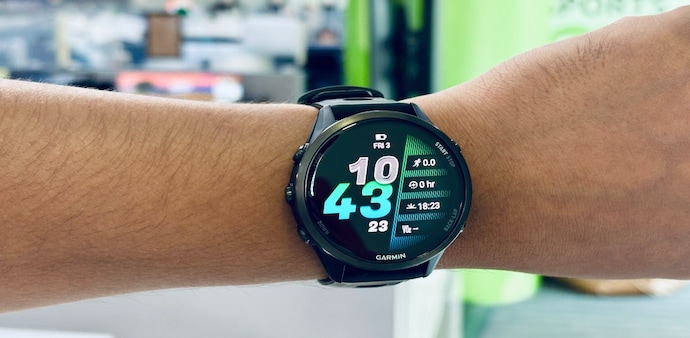
For all its power, the Forerunner 970 is surprisingly light. Despite the sapphire glass, titanium bezel, and big AMOLED screen, it’s easy to forget you’re wearing it. I wore it through the day, to bed, and even during naps. The only time I took it off was in the shower, though you don’t have to, since it’s water-resistant enough to handle it.
The strap was a mixed bag at first. It felt slightly itchy in the beginning, and I wondered if this would bother me long-term. But a few days in, my wrist simply got used to it. By the second week, it felt natural.
Sleep tracking that beats the Apple Watch
One area that genuinely surprised me was sleep tracking. I’ve been using an Apple Watch alongside this for comparison, and Garmin’s data simply felt more accurate and consistent.
Every night, it broke my sleep into light, deep, REM, and awake stages. It even picked up on interruptions I didn’t notice myself. The insights went beyond numbers, giving me an idea of how restorative my sleep was. Unlike the Apple Watch, which sometimes feels like it’s just guessing, the Forerunner 970 gave me results I actually trusted.
Battery life: the silent hero
Here’s where Garmin absolutely destroys most smartwatches: battery life. I charged it to 100% after unboxing, turned off the always-on display, and… I haven’t had to charge it since. Two weeks later, it’s still going strong.
Even with GPS workouts, sleep tracking, and constant health monitoring, the battery hardly budged. For context, my Apple Watch usually cries for a charger every night. The freedom of not worrying about charging is a luxury that spoils you very quickly.
Display and health metrics
The AMOLED display is stunning. Bright, crisp, and easy to read even under harsh sunlight. It makes scanning through health metrics a pleasure rather than a chore.
Speaking of metrics, Garmin throws the kitchen sink at you. Heart rate, SpO₂, stress levels, body battery (essentially your energy reserve), VO₂ max, respiration rate, it’s all there. And it all feels reliable. The large display ensures you don’t miss a beat, literally.
The “runner’s watch” experience
Strip everything else away, and the Forerunner 970 is first and foremost a runner’s watch. That’s where it shines brightest.
The multi-band GPS is frighteningly accurate. I tested it on runs where the Apple Watch has been thrown off by tall buildings, and the Garmin didn’t flinch. It also comes with full-colour maps and even turn-by-turn navigation, features I didn’t expect to use much, but ended up appreciating.
Oh, and there’s even a built-in LED torch. It sounds gimmicky, but it turned out to be surprisingly handy for late-night walks or fumbling around in the dark.
Beyond running
The Forerunner 970 isn’t just for runners. It has profiles for cycling, swimming, hiking, gym workouts, yoga, HIIT, and even triathlon modes that let you switch sports mid-session. I logged a couple of strength sessions, and the watch tracked reps and sets with surprising accuracy.
For swimmers, the water resistance and stroke tracking would make it just as useful in the pool. Cyclists get detailed power and cadence support when paired with external sensors. It’s very much an all-rounder for training, not just a running companion.
Smartwatch features
Garmin’s focus is fitness, but it doesn’t ignore the basics of smartwatch life:
- Notifications come through clearly, and the AMOLED display makes them easy to read.
- There’s music storage and Spotify support, so you can leave your phone at home for runs if you use Bluetooth earbuds.
- The built-in microphone and speaker let you take calls directly on the watch, though the experience feels functional rather than luxurious.
It’s not competing with Apple or Samsung in terms of app ecosystems or smart features. But as a training-focused watch with just enough “smart” functionality, it holds its own.
Where it falls short
But no gadget is perfect. The Forerunner 970 has a few quirks worth mentioning.
First, while the AMOLED screen is beautiful, keeping it always on kills battery life faster. With it enabled, you’re looking at 4–5 days, which is still solid, but not the two-week marathon I experienced with it off.
Second, Garmin’s software can feel clunky at times. The menus are dense, the interface isn’t always intuitive, and I ran into occasional ghost touches. It’s not a dealbreaker, but it reminds you that this is still a watch made for athletes, not a polished everyday smartwatch.
And then there’s the price. At ₹90,990 in India, this isn’t just expensive, it’s luxury-tier.
Who should buy this?
The Garmin Forerunner 970 is a phenomenal piece of tech. It’s light, it’s bright, it’s crammed with features, and it gives you more insight into your body and training than almost any other watch out there. It’s a serious athlete’s dream.
But it’s also unapologetically niche. If you’re a marathon runner, triathlete, or someone committed to structured training, this is the best wrist-based tool you can buy today. It will help you optimise, recover smarter, and perform better.
If you’re like me, an occasional runner who just wants to keep moving, it’s probably overkill. You don’t need a ₹90,990 supercomputer on your wrist to log a casual 5K. In fact, you’d be better off with a more affordable Garmin or even a fitness-focused smartwatch.
For two weeks, I lived with the Forerunner 970, and it gave me a glimpse into a world where running is science, not just sweat. And while I’m not ready to join that world full-time, I now understand why serious athletes swear by Garmin.
For Unparalleled coverage of India's Businesses and Economy – Subscribe to Business Today Magazine
I’m going to admit something upfront: I’m not a runner. I don’t train for marathons, I don’t wake up at 5 am to clock 10K before breakfast. At best, I’m an occasional runner who squeezes in a 5K every now and then when I feel like getting the heart rate up. Which is exactly why testing the Garmin Forerunner 970 over the last two weeks has been so fascinating.
This isn’t just a smartwatch. It’s a data-driven coach strapped to your wrist, one that’s designed for athletes who live and breathe running. But even as a casual jogger, I found myself sucked into its world of numbers, insights, and impressive hardware.
First run, first impressions
My first 5K with the Forerunner 970 was almost overwhelming. The watch didn’t just record pace, time, and distance like most wearables, it tracked running power, cadence, stride length, ground contact time, vertical oscillation, and something called step speed loss. If you pair it with Garmin’s HRM strap, it unlocks even more advanced metrics like running economy and tolerance.
At first, all those numbers felt like jargon. But then I noticed how easy it was to see patterns. My stride was efficient, but my cadence dipped halfway through. My ground contact time was a little high, meaning I was spending more time on the ground than I should. Suddenly, running wasn’t just a sweaty blur, it became measurable, improvable.
That’s the beauty of this watch: it doesn’t just log your workout, it teaches you about yourself.
Wearing it 24/7
For all its power, the Forerunner 970 is surprisingly light. Despite the sapphire glass, titanium bezel, and big AMOLED screen, it’s easy to forget you’re wearing it. I wore it through the day, to bed, and even during naps. The only time I took it off was in the shower, though you don’t have to, since it’s water-resistant enough to handle it.
The strap was a mixed bag at first. It felt slightly itchy in the beginning, and I wondered if this would bother me long-term. But a few days in, my wrist simply got used to it. By the second week, it felt natural.
Sleep tracking that beats the Apple Watch
One area that genuinely surprised me was sleep tracking. I’ve been using an Apple Watch alongside this for comparison, and Garmin’s data simply felt more accurate and consistent.
Every night, it broke my sleep into light, deep, REM, and awake stages. It even picked up on interruptions I didn’t notice myself. The insights went beyond numbers, giving me an idea of how restorative my sleep was. Unlike the Apple Watch, which sometimes feels like it’s just guessing, the Forerunner 970 gave me results I actually trusted.
Battery life: the silent hero
Here’s where Garmin absolutely destroys most smartwatches: battery life. I charged it to 100% after unboxing, turned off the always-on display, and… I haven’t had to charge it since. Two weeks later, it’s still going strong.
Even with GPS workouts, sleep tracking, and constant health monitoring, the battery hardly budged. For context, my Apple Watch usually cries for a charger every night. The freedom of not worrying about charging is a luxury that spoils you very quickly.
Display and health metrics
The AMOLED display is stunning. Bright, crisp, and easy to read even under harsh sunlight. It makes scanning through health metrics a pleasure rather than a chore.
Speaking of metrics, Garmin throws the kitchen sink at you. Heart rate, SpO₂, stress levels, body battery (essentially your energy reserve), VO₂ max, respiration rate, it’s all there. And it all feels reliable. The large display ensures you don’t miss a beat, literally.
The “runner’s watch” experience
Strip everything else away, and the Forerunner 970 is first and foremost a runner’s watch. That’s where it shines brightest.
The multi-band GPS is frighteningly accurate. I tested it on runs where the Apple Watch has been thrown off by tall buildings, and the Garmin didn’t flinch. It also comes with full-colour maps and even turn-by-turn navigation, features I didn’t expect to use much, but ended up appreciating.
Oh, and there’s even a built-in LED torch. It sounds gimmicky, but it turned out to be surprisingly handy for late-night walks or fumbling around in the dark.
Beyond running
The Forerunner 970 isn’t just for runners. It has profiles for cycling, swimming, hiking, gym workouts, yoga, HIIT, and even triathlon modes that let you switch sports mid-session. I logged a couple of strength sessions, and the watch tracked reps and sets with surprising accuracy.
For swimmers, the water resistance and stroke tracking would make it just as useful in the pool. Cyclists get detailed power and cadence support when paired with external sensors. It’s very much an all-rounder for training, not just a running companion.
Smartwatch features
Garmin’s focus is fitness, but it doesn’t ignore the basics of smartwatch life:
- Notifications come through clearly, and the AMOLED display makes them easy to read.
- There’s music storage and Spotify support, so you can leave your phone at home for runs if you use Bluetooth earbuds.
- The built-in microphone and speaker let you take calls directly on the watch, though the experience feels functional rather than luxurious.
It’s not competing with Apple or Samsung in terms of app ecosystems or smart features. But as a training-focused watch with just enough “smart” functionality, it holds its own.
Where it falls short
But no gadget is perfect. The Forerunner 970 has a few quirks worth mentioning.
First, while the AMOLED screen is beautiful, keeping it always on kills battery life faster. With it enabled, you’re looking at 4–5 days, which is still solid, but not the two-week marathon I experienced with it off.
Second, Garmin’s software can feel clunky at times. The menus are dense, the interface isn’t always intuitive, and I ran into occasional ghost touches. It’s not a dealbreaker, but it reminds you that this is still a watch made for athletes, not a polished everyday smartwatch.
And then there’s the price. At ₹90,990 in India, this isn’t just expensive, it’s luxury-tier.
Who should buy this?
The Garmin Forerunner 970 is a phenomenal piece of tech. It’s light, it’s bright, it’s crammed with features, and it gives you more insight into your body and training than almost any other watch out there. It’s a serious athlete’s dream.
But it’s also unapologetically niche. If you’re a marathon runner, triathlete, or someone committed to structured training, this is the best wrist-based tool you can buy today. It will help you optimise, recover smarter, and perform better.
If you’re like me, an occasional runner who just wants to keep moving, it’s probably overkill. You don’t need a ₹90,990 supercomputer on your wrist to log a casual 5K. In fact, you’d be better off with a more affordable Garmin or even a fitness-focused smartwatch.
For two weeks, I lived with the Forerunner 970, and it gave me a glimpse into a world where running is science, not just sweat. And while I’m not ready to join that world full-time, I now understand why serious athletes swear by Garmin.
For Unparalleled coverage of India's Businesses and Economy – Subscribe to Business Today Magazine