
Google’s AI satellite sends first poem from space using onboard chip: Here’s how it worked
The experiment marks a milestone in Google’s attempt to move artificial intelligence computing beyond Earth, with two interconnected satellites planned as the next step in 2027.
- Nov 4, 2026,
- Updated Nov 4, 2026 6:30 AM IST
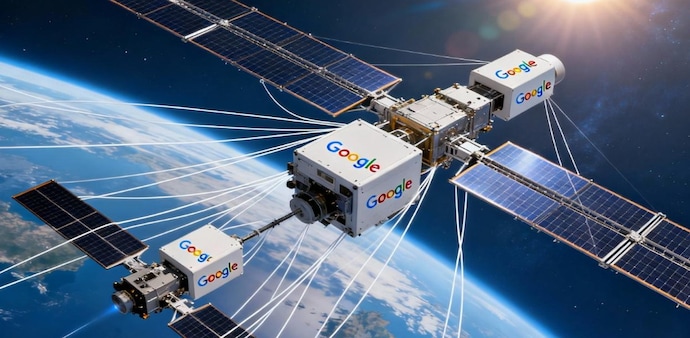
Building data centres in space could give technology companies another way to support the growing computing requirements of artificial intelligence. Google has taken an early step towards exploring that possibility by successfully running an AI model on a satellite in orbit, without relying on a computer on the ground to generate the response. The demonstration used one of Google’s Tensor Processing Units (TPUs) installed aboard a prototype satellite developed under Project Suncatcher. The system received a command from Earth, processed it in orbit and sent back an AI-generated answer.
While the first task was a simple poem, the experiment is intended to test whether specialised AI hardware can operate beyond the planet. The results could help Google decide how far it can take its plans for orbital computing infrastructure.
MUST READ | ‘Stop AI development if….”: Microsoft AI chief warns against machines gaining consciousness
Google’s space experiment goes beyond a simple AI response
The prototype was developed in collaboration with satellite company Planet and launched aboard a SpaceX Falcon 9 rocket as part of the Transporter-18 rideshare mission. It travelled alongside more than 100 other spacecraft. Before launch, Google installed its Gemma 4 AI model on the satellite.
For its first demonstration, engineers asked the satellite to generate a haiku from the perspective of a TPU orbiting Earth. Google CEO Sundar Pichai described the achievement as a “hello world” moment, referring to the first basic test typically performed when starting with a new computing system. The spacecraft was also asked to report the status of its onboard systems, which Google said were functioning as expected.
As the satellite passed over Svalbard, Norway, the team received the AI-generated poem on Earth. It read:
Blue marble below
Data streams in silent grace
Starlight feeds my core. ✨
Google also tested space-themed limericks and prompts asking the AI model to report technical information about the satellite's onboard systems.
The spacecraft carries four TPUs, but its power generation is limited to 1 kilowatt. This means it can operate only one chip at a time for approximately 20 minutes. These computing sessions must also be timed around the satellite's communication windows with ground stations.
DON'T MISS | Google wants to build AI data centres in space: What Project Suncatcher's satellite test means
Can AI chips survive in orbit?
Google still needs to establish whether its hardware can withstand the conditions of space over longer periods. Radiation from cosmic rays and solar activity can cause bit flips, potentially changing stored data and affecting computing results.
In ground testing at UC Davis, Google’s Trillium TPUs were exposed to a proton beam representing more radiation than a five-year space mission. The tests suggested that AI inference may be less affected by radiation than model training. Managing heat is another concern: without air to support conventional cooling fans, the satellite relies on heat pipes and radiators.
Google plans to launch two more Suncatcher satellites in 2027, with greater power capacity and laser links that could let them share AI workloads. The company also sees potential for using sunlight, which can provide up to eight times more solar power in orbit than on Earth.
However, the business case remains uncertain. Researchers estimate that SpaceX’s Starship could require around 1,800 flights to make orbital data centres economically viable in the 2030s. The prototype’s performance over the coming months will help determine whether the next satellites can proceed as planned.
For Unparalleled coverage of India's Businesses and Economy – Subscribe to Business Today Magazine