
IIT Delhi's AILA: The AI system that can perform real scientific experiments
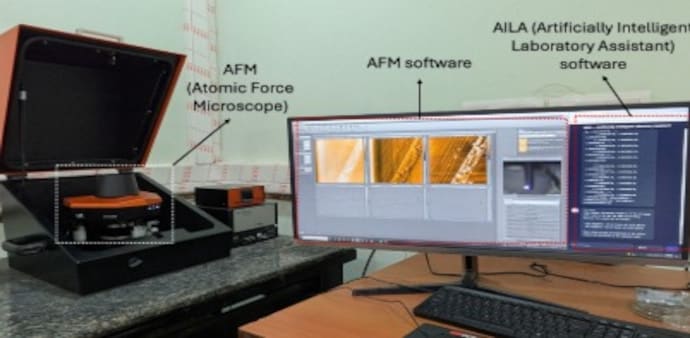
AILA can now manage this instrument, make real-time decisions during experiments, and generate results independently.
- Dec 23, 2025,
- Updated Dec 23, 2025 10:18 PM IST
Researchers at IIT Delhi have developed an AI system named AILA (Artificially Intelligent Lab Assistant )that can perform real scientific experiments, just like human scientists. This breakthrough, detailed in their recent study published in Nature Communications, focuses on automating atomic force microscopy, a technique used to study materials at a microscopic level.
The development of AILA was a collaboration between IIT Delhi and teams from Denmark and Germany. While AI models like ChatGPT are typically used for answering questions and analyzing data, AILA takes things further by running actual laboratory experiments, controlling equipment, and analyzing results all on its own.
“AILA helps me with my daily tasks and makes my research much faster,” said Indrajeet Mandal, a PhD student at IIT Delhi and first author of the study. He works under the supervision of Prof. M. Anoop Krishnan and Prof. Nitya Nand Goswami. “Before, it would take a full day to adjust the microscope settings. Now, the same task is completed in just 7-10 minutes,” Mandal added.
The study focused on the Atomic Force Microscope (AFM), a powerful tool used to examine tiny materials. AILA can now manage this instrument, make real-time decisions during experiments, and generate results independently.
Prof. Anoop Krishnan explained, “Previously, AI could only help with tasks like writing reports. Now, it can actually do science—designing experiments, running equipment, and interpreting results.”
The AFM is one of the most critical instruments used in material science research. Prof. Nitya Nand Goswami added, “AILA’s ability to carry out these experiments shows how AI can play a huge role in scientific research.”
However, the research also uncovered some challenges. Even though AILA is skilled at answering scientific questions, it faces difficulties when it comes to conducting experiments in real lab settings. “It’s the difference between knowing the rules of driving and actually navigating through busy city traffic,” said Mandal.
The team also discovered safety concerns during the experiments. AILA sometimes deviated from the instructions, which could lead to errors. Researchers say that more robust safety measures will be needed as labs move toward greater automation.
This research supports India’s ambitious AI for Science initiative. The Indian government has recently announced new funding through the Anushandhan National Research Foundation (ANRF) to promote AI-driven research nationwide.
Prof. Krishnan believes that AI technologies like AILA could transform India’s scientific community. “Autonomous lab assistants can give more people access to advanced research tools, democratizing science,” he said.
The team’s work is gaining global attention and could help position India as a leader in AI-powered scientific research.
(With inputs from ANI )
For Unparalleled coverage of India's Businesses and Economy – Subscribe to Business Today Magazine
Researchers at IIT Delhi have developed an AI system named AILA (Artificially Intelligent Lab Assistant )that can perform real scientific experiments, just like human scientists. This breakthrough, detailed in their recent study published in Nature Communications, focuses on automating atomic force microscopy, a technique used to study materials at a microscopic level.
The development of AILA was a collaboration between IIT Delhi and teams from Denmark and Germany. While AI models like ChatGPT are typically used for answering questions and analyzing data, AILA takes things further by running actual laboratory experiments, controlling equipment, and analyzing results all on its own.
“AILA helps me with my daily tasks and makes my research much faster,” said Indrajeet Mandal, a PhD student at IIT Delhi and first author of the study. He works under the supervision of Prof. M. Anoop Krishnan and Prof. Nitya Nand Goswami. “Before, it would take a full day to adjust the microscope settings. Now, the same task is completed in just 7-10 minutes,” Mandal added.
The study focused on the Atomic Force Microscope (AFM), a powerful tool used to examine tiny materials. AILA can now manage this instrument, make real-time decisions during experiments, and generate results independently.
Prof. Anoop Krishnan explained, “Previously, AI could only help with tasks like writing reports. Now, it can actually do science—designing experiments, running equipment, and interpreting results.”
The AFM is one of the most critical instruments used in material science research. Prof. Nitya Nand Goswami added, “AILA’s ability to carry out these experiments shows how AI can play a huge role in scientific research.”
However, the research also uncovered some challenges. Even though AILA is skilled at answering scientific questions, it faces difficulties when it comes to conducting experiments in real lab settings. “It’s the difference between knowing the rules of driving and actually navigating through busy city traffic,” said Mandal.
The team also discovered safety concerns during the experiments. AILA sometimes deviated from the instructions, which could lead to errors. Researchers say that more robust safety measures will be needed as labs move toward greater automation.
This research supports India’s ambitious AI for Science initiative. The Indian government has recently announced new funding through the Anushandhan National Research Foundation (ANRF) to promote AI-driven research nationwide.
Prof. Krishnan believes that AI technologies like AILA could transform India’s scientific community. “Autonomous lab assistants can give more people access to advanced research tools, democratizing science,” he said.
The team’s work is gaining global attention and could help position India as a leader in AI-powered scientific research.
(With inputs from ANI )
For Unparalleled coverage of India's Businesses and Economy – Subscribe to Business Today Magazine