
India AI Impact Summit 2026: Google DeepMind CEO Demis Hassabis predicts artificial general intelligence within 8 yrs
India AI Impact Summit 2026: Demis Hassabis revealed that the path to AGI will require a hybrid approach that combines massive knowledge of foundation models along with planning and reasoning capabilities of reinforcement learning.
- Feb 18, 2026,
- Updated Feb 18, 2026 10:55 AM IST
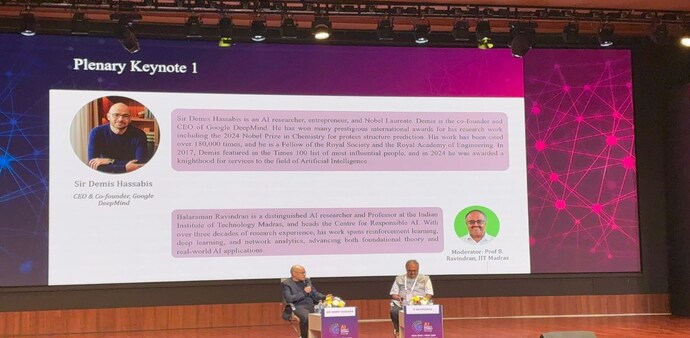
India AI Impact Summit 2026: The world is standing at a "threshold moment", which is transitioning from "jagged" tools to truly autonomous, creative, and general intelligence, said Google DeepMind CEO Demis Hassabis at the India AI Impact Summit on Tuesday. He took to the stage to address the packed auditorium about the future of Artificial Intelligence (AI) and Artificial General Intelligence (AGI).
Road to AGI
At the summit, Hassabis suggesting AGI could be a reality by the end of the decade. As the technology advances very quickly, he pointed out that while today’s AI tools could solve complex math, it still lacks the core stability of human thought.
"At this point, I think we're at a threshold moment where AGI, artificial general intelligence, is on the horizon, maybe in the next five to eight years. So this summer comes at a critical moment as we start seeing more autonomous, agentic AI systems, much more capable, I think we're seeing the beginnings of what those kinds of systems can do,” said Hassabis.
Highlighting the “jaggedness” of the current AI models, he said, “They're very good at certain things. But they're very, you know, very poor at other things, including sometimes the same thing.”
Hassabis revealed that the path to AGI will require a hybrid approach that combines massive knowledge of foundation models along with planning and reasoning capabilities of reinforcement learning (RL). “I think the foundation models like Gemini are going to be a critical part of the ultimate AGI solution. And then I think we'll have a lot of interesting reinforcement learning on top... I think it makes sense to use the foundation models and, you know, all the information that's already out there and learn that as almost like a model of how the world works and then do your reinforcer learning and planning on top of that,” he said.
Human misuse and dual risk of AI
While Hassabis showcased huge enthusiasm for the future of AI, he also warned about the risks that it brings. He highlighted the "dual-purpose" nature of the technology, characterising the threat of human misuse and the long-term technical challenge of autonomy.
He said, “There's, you know, at least 2 risks that we've always worried about. One is bad actors, human actors, but individuals, but it could also be nation states, using these systems and repurposing them for harmful lens, because their dual purpose. But then also as we get closer to AGI... we have to make sure as well that the guard whales are in place that these systems do what we expect them to do.” He also called for international cooperation on bio and cyber-risks, emphasizing that "we need to make sure cyber defenders are more powerful than the attack vectors".
Golden era for scientific discovery
Hassabis also noted that AI isn’t mainly about chatbots, productivity tools, or business automation. He sees AI as something much bigger with the “ultimate tool” for science. With the context, he talked about Alpha Fold as the beginning of “Renaissance" in human knowledge.
"I think we're going to enter in the next, probably 10 years, this golden era for scientific discovery, almost a new Renaissance, using these incredible tools like Alpha Fold, but I hope that will be the first of many to massively speed up our research and accelerate scientific discovery across almost any subject area,” he said.
Hassabis also expressed excitement for robotics, predicting that the next two to three years will bring "breakout moments" as foundation models like Gemini are integrated into physical bodies.
For Unparalleled coverage of India's Businesses and Economy – Subscribe to Business Today Magazine
India AI Impact Summit 2026: The world is standing at a "threshold moment", which is transitioning from "jagged" tools to truly autonomous, creative, and general intelligence, said Google DeepMind CEO Demis Hassabis at the India AI Impact Summit on Tuesday. He took to the stage to address the packed auditorium about the future of Artificial Intelligence (AI) and Artificial General Intelligence (AGI).
Road to AGI
At the summit, Hassabis suggesting AGI could be a reality by the end of the decade. As the technology advances very quickly, he pointed out that while today’s AI tools could solve complex math, it still lacks the core stability of human thought.
"At this point, I think we're at a threshold moment where AGI, artificial general intelligence, is on the horizon, maybe in the next five to eight years. So this summer comes at a critical moment as we start seeing more autonomous, agentic AI systems, much more capable, I think we're seeing the beginnings of what those kinds of systems can do,” said Hassabis.
Highlighting the “jaggedness” of the current AI models, he said, “They're very good at certain things. But they're very, you know, very poor at other things, including sometimes the same thing.”
Hassabis revealed that the path to AGI will require a hybrid approach that combines massive knowledge of foundation models along with planning and reasoning capabilities of reinforcement learning (RL). “I think the foundation models like Gemini are going to be a critical part of the ultimate AGI solution. And then I think we'll have a lot of interesting reinforcement learning on top... I think it makes sense to use the foundation models and, you know, all the information that's already out there and learn that as almost like a model of how the world works and then do your reinforcer learning and planning on top of that,” he said.
Human misuse and dual risk of AI
While Hassabis showcased huge enthusiasm for the future of AI, he also warned about the risks that it brings. He highlighted the "dual-purpose" nature of the technology, characterising the threat of human misuse and the long-term technical challenge of autonomy.
He said, “There's, you know, at least 2 risks that we've always worried about. One is bad actors, human actors, but individuals, but it could also be nation states, using these systems and repurposing them for harmful lens, because their dual purpose. But then also as we get closer to AGI... we have to make sure as well that the guard whales are in place that these systems do what we expect them to do.” He also called for international cooperation on bio and cyber-risks, emphasizing that "we need to make sure cyber defenders are more powerful than the attack vectors".
Golden era for scientific discovery
Hassabis also noted that AI isn’t mainly about chatbots, productivity tools, or business automation. He sees AI as something much bigger with the “ultimate tool” for science. With the context, he talked about Alpha Fold as the beginning of “Renaissance" in human knowledge.
"I think we're going to enter in the next, probably 10 years, this golden era for scientific discovery, almost a new Renaissance, using these incredible tools like Alpha Fold, but I hope that will be the first of many to massively speed up our research and accelerate scientific discovery across almost any subject area,” he said.
Hassabis also expressed excitement for robotics, predicting that the next two to three years will bring "breakout moments" as foundation models like Gemini are integrated into physical bodies.
For Unparalleled coverage of India's Businesses and Economy – Subscribe to Business Today Magazine