
India’s AI future can’t be built on copy-paste regulation, says Google’s Sachin Kakkar
He pointed out that global regulation often ignores the real-world challenges for countries as unique as India, which consists of extreme linguistic diversity.
- Feb 20, 2026,
- Updated Feb 20, 2026 12:06 PM IST
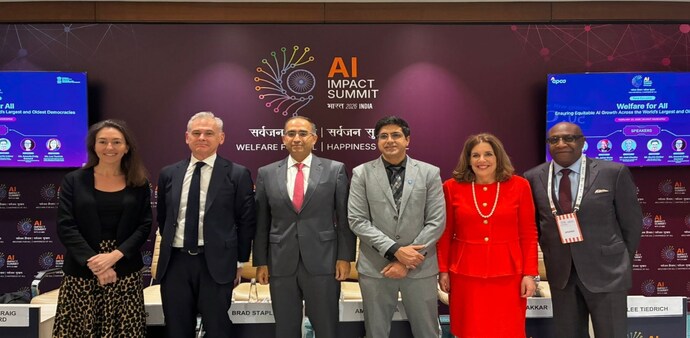
On February 20, Google’s Engineering Site Director, Sachin Kakkar, became a part of a panel discussion at the India AI Impact Summit 2026. During the discussion, Kakkar argued about how India is in need of standardised AI regulation.
He said copy-pasting AI laws or policy structures from regions like the EU or the US, and applying them in India without adapting for India’s economic structure, could restrict its ability to build its own AI ecosystem.
“One of the challenges we see is copy-pasting, the regulations or standards from, you know, international markets to local markets may not always work. So localising them, understanding the needs and constraints of the local area,” said Kakkar.
He pointed out that global regulation often ignores the real-world challenges for countries as unique as India, which consists of extreme linguistic diversity. By enforcing rigid, international rules, India risks creating barriers for its own homegrown startups.
To avoid such challenges, Kakkar proposed a “co-creation” model, where the government and communities can build standards together as an "equalizer" rather than a "compliance hurdle."
He said, “I think, at the highest level, the way we think, to reach the gap between the AI divide, is to move away from the traditional transfer approach to more co-creation. We're developers and government coming together, and the underlying goal is that standards and regulations are seen as enablers and equalisers, not as barriers or compliance hurdles."
Kakkar also noted India’s Digital Public Infrastructure (DPI), which includes Aadhaar and UPI, providing a unique ecosystem for secure AI deployment that other nations lack.
For Unparalleled coverage of India's Businesses and Economy – Subscribe to Business Today Magazine
On February 20, Google’s Engineering Site Director, Sachin Kakkar, became a part of a panel discussion at the India AI Impact Summit 2026. During the discussion, Kakkar argued about how India is in need of standardised AI regulation.
He said copy-pasting AI laws or policy structures from regions like the EU or the US, and applying them in India without adapting for India’s economic structure, could restrict its ability to build its own AI ecosystem.
“One of the challenges we see is copy-pasting, the regulations or standards from, you know, international markets to local markets may not always work. So localising them, understanding the needs and constraints of the local area,” said Kakkar.
He pointed out that global regulation often ignores the real-world challenges for countries as unique as India, which consists of extreme linguistic diversity. By enforcing rigid, international rules, India risks creating barriers for its own homegrown startups.
To avoid such challenges, Kakkar proposed a “co-creation” model, where the government and communities can build standards together as an "equalizer" rather than a "compliance hurdle."
He said, “I think, at the highest level, the way we think, to reach the gap between the AI divide, is to move away from the traditional transfer approach to more co-creation. We're developers and government coming together, and the underlying goal is that standards and regulations are seen as enablers and equalisers, not as barriers or compliance hurdles."
Kakkar also noted India’s Digital Public Infrastructure (DPI), which includes Aadhaar and UPI, providing a unique ecosystem for secure AI deployment that other nations lack.
For Unparalleled coverage of India's Businesses and Economy – Subscribe to Business Today Magazine