
Is India’s SpaceX moment here? Skyroot’s Vikram-I takes centre stage as PM Modi opens new campus
The inauguration comes amid unprecedented liberalisation of India’s space sector. Since 2023, regulatory reforms have opened the doors for startups in launch systems, satellite services, and space analytics.
- Nov 27, 2025,
- Updated Nov 27, 2025 4:55 PM IST
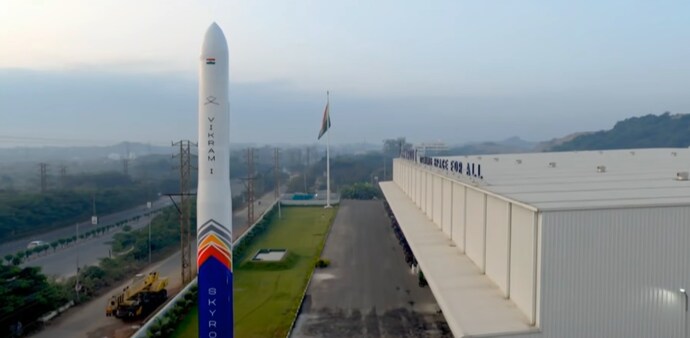
Prime Minister Narendra Modi on November 27 inaugurated Skyroot Aerospace’s new Infinity Campus and unveiled the company’s first orbital launch vehicle, Vikram-I, marking a significant milestone for India’s rapidly expanding private space industry. The event, held through video conferencing, showcased how policy reforms introduced since 2023 have catalysed the rise of deep-tech space startups.
The newly-constructed Infinity Campus, spread across 200,000 sq ft, is designed to support the full lifecycle of launch-vehicle development—designing, integrating, assembling, and testing.
A key feature: The facility can produce one orbital rocket every month, scaling India’s indigenous launch capacity at a pace previously seen only in global private players.
Skyroot Aerospace — founded by IIT alumni and former ISRO engineers Pawan Chandana and Bharath Daka — has quickly emerged as the flagship private rocket manufacturer in India. The company made history in November 2022 with Vikram-S, the country’s first privately-built sub-orbital rocket.
What is Vikram-I?
Named after Dr. Vikram Sarabhai, the father of India’s space programme, Vikram-I is Skyroot’s maiden orbital launch vehicle aimed at capturing the booming small-satellite market.
Key features of Vikram-I:
- Payload capacity: 300 kg to Low Earth Orbit (LEO)
- Multi-stage, all carbon-fibre rocket
- 3D-printed liquid engines
- Capable of placing multiple satellites in orbit simultaneously
- Ultra-fast readiness—can be assembled and launched within 24 hours from any site
This multi-satellite insertion capability is a first for India’s private space sector, positioning the country among global leaders in flexible satellite deployment.
The broader Vikram rocket series is being developed for multi-orbit insertion and potential interplanetary missions, targeting India’s share in the multi-million-dollar global small-satellite launch market.
Why this matters
The inauguration comes amid unprecedented liberalisation of India’s space sector. Since 2023, regulatory reforms have opened the doors for startups in launch systems, satellite services, and space analytics.
With global projections indicating a $77 billion opportunity by 2030, Vikram-I strengthens India’s push to build onshore launch capabilities and reduce dependence on foreign vehicles.
Skyroot has raised more than $95 million from investors and has partnered with international entities such as Axiom Space to expand commercial access to Low-Earth Orbit.
With the Infinity Campus operational and Vikram-I unveiled, Skyroot Aerospace is positioning itself as India’s SpaceX-style private launch provider. The company’s rapid production model, advanced carbon-fibre rockets, and 3D-printed engines reflect a shift toward high-frequency, lower-cost launch services.
For Unparalleled coverage of India's Businesses and Economy – Subscribe to Business Today Magazine
Prime Minister Narendra Modi on November 27 inaugurated Skyroot Aerospace’s new Infinity Campus and unveiled the company’s first orbital launch vehicle, Vikram-I, marking a significant milestone for India’s rapidly expanding private space industry. The event, held through video conferencing, showcased how policy reforms introduced since 2023 have catalysed the rise of deep-tech space startups.
The newly-constructed Infinity Campus, spread across 200,000 sq ft, is designed to support the full lifecycle of launch-vehicle development—designing, integrating, assembling, and testing.
A key feature: The facility can produce one orbital rocket every month, scaling India’s indigenous launch capacity at a pace previously seen only in global private players.
Skyroot Aerospace — founded by IIT alumni and former ISRO engineers Pawan Chandana and Bharath Daka — has quickly emerged as the flagship private rocket manufacturer in India. The company made history in November 2022 with Vikram-S, the country’s first privately-built sub-orbital rocket.
What is Vikram-I?
Named after Dr. Vikram Sarabhai, the father of India’s space programme, Vikram-I is Skyroot’s maiden orbital launch vehicle aimed at capturing the booming small-satellite market.
Key features of Vikram-I:
- Payload capacity: 300 kg to Low Earth Orbit (LEO)
- Multi-stage, all carbon-fibre rocket
- 3D-printed liquid engines
- Capable of placing multiple satellites in orbit simultaneously
- Ultra-fast readiness—can be assembled and launched within 24 hours from any site
This multi-satellite insertion capability is a first for India’s private space sector, positioning the country among global leaders in flexible satellite deployment.
The broader Vikram rocket series is being developed for multi-orbit insertion and potential interplanetary missions, targeting India’s share in the multi-million-dollar global small-satellite launch market.
Why this matters
The inauguration comes amid unprecedented liberalisation of India’s space sector. Since 2023, regulatory reforms have opened the doors for startups in launch systems, satellite services, and space analytics.
With global projections indicating a $77 billion opportunity by 2030, Vikram-I strengthens India’s push to build onshore launch capabilities and reduce dependence on foreign vehicles.
Skyroot has raised more than $95 million from investors and has partnered with international entities such as Axiom Space to expand commercial access to Low-Earth Orbit.
With the Infinity Campus operational and Vikram-I unveiled, Skyroot Aerospace is positioning itself as India’s SpaceX-style private launch provider. The company’s rapid production model, advanced carbon-fibre rockets, and 3D-printed engines reflect a shift toward high-frequency, lower-cost launch services.
For Unparalleled coverage of India's Businesses and Economy – Subscribe to Business Today Magazine