
ISRO's Aditya L1 mission observes solar winds, signals success
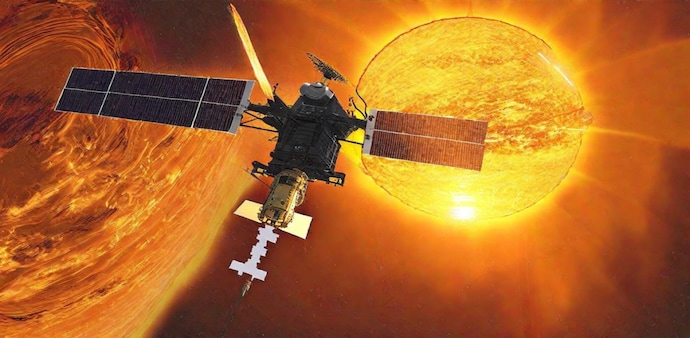
The Indian Space Research Organisation (ISRO) on Saturday said Aditya Solar Wind Particle Experiment (ASPEX) payload onboard India's first solar satellite Aditya-L1, has commenced its operations and started working normally.
- Dec 2, 2023,
- Updated Dec 2, 2023 2:06 PM IST
Aditya L1, India's ambitious endeavour to explore the sun, has taken a significant step forward by initiating observations of solar winds. The Indian Space Research Organisation (ISRO) announced this development, stating that the Aditya Solar Wind Particle Experiment (ASPEX) aboard the satellite is now operational and functioning as expected.
ASPEX consists of two instruments: the Solar Wind Ion Spectrometer (SWIS) and STEPS (SupraThermal and Energetic Particle Spectrometer). While STEPS began operations on September 10, the SWIS instrument was activated recently and has shown excellent performance, as per ISRO.
Additionally, the space agency shared an image on X (formerly Twitter), depicting the fluctuations in energy levels observed in proton and alpha particle counts recorded by the new payload.
The mission commenced from Sriharikota in Andhra Pradesh on September 2. Its primary objectives include studying the physics of the solar corona and its heating mechanisms, solar wind acceleration, dynamics and coupling of the solar atmosphere, distribution and temperature anisotropy of solar wind, as well as the origins of Coronal Mass Ejections (CME) and flares, and near-Earth space weather.
Among India's ongoing projects is a human spaceflight program aiming to launch astronauts into orbit, potentially achieving this milestone by 2025.
Studying solar winds is crucial for several reasons:
1. Space Weather Prediction: Solar winds can cause geomagnetic storms when they interact with Earth's magnetic field. Understanding their behaviour helps in predicting and preparing for potential impacts on satellites, communication systems, and power grids.
2. Impact on Technology: High-energy particles from solar winds can damage satellites, disrupt communication, and affect power grids. Understanding solar winds allows us to design better technology to withstand or mitigate these effects.
3. Auroras: Solar winds interacting with Earth's magnetic field create auroras (northern and southern lights), offering beautiful celestial displays. Studying solar winds helps us understand these phenomena better.
4. Space Exploration: Solar winds affect spacecraft and astronauts travelling beyond Earth's protective magnetic field. Understanding them is essential for planning and executing safe missions to other planets or deep space.
5. Fundamental Science: Solar winds offer insights into fundamental astrophysical processes. Studying them can deepen our understanding of the Sun's behaviour and its impact on the solar system.
Also Read Chandrayaan-3 back on Earth! ISRO confirms controlled disposal after successful mission
For Unparalleled coverage of India's Businesses and Economy – Subscribe to Business Today Magazine
Aditya L1, India's ambitious endeavour to explore the sun, has taken a significant step forward by initiating observations of solar winds. The Indian Space Research Organisation (ISRO) announced this development, stating that the Aditya Solar Wind Particle Experiment (ASPEX) aboard the satellite is now operational and functioning as expected.
ASPEX consists of two instruments: the Solar Wind Ion Spectrometer (SWIS) and STEPS (SupraThermal and Energetic Particle Spectrometer). While STEPS began operations on September 10, the SWIS instrument was activated recently and has shown excellent performance, as per ISRO.
Additionally, the space agency shared an image on X (formerly Twitter), depicting the fluctuations in energy levels observed in proton and alpha particle counts recorded by the new payload.
The mission commenced from Sriharikota in Andhra Pradesh on September 2. Its primary objectives include studying the physics of the solar corona and its heating mechanisms, solar wind acceleration, dynamics and coupling of the solar atmosphere, distribution and temperature anisotropy of solar wind, as well as the origins of Coronal Mass Ejections (CME) and flares, and near-Earth space weather.
Among India's ongoing projects is a human spaceflight program aiming to launch astronauts into orbit, potentially achieving this milestone by 2025.
Studying solar winds is crucial for several reasons:
1. Space Weather Prediction: Solar winds can cause geomagnetic storms when they interact with Earth's magnetic field. Understanding their behaviour helps in predicting and preparing for potential impacts on satellites, communication systems, and power grids.
2. Impact on Technology: High-energy particles from solar winds can damage satellites, disrupt communication, and affect power grids. Understanding solar winds allows us to design better technology to withstand or mitigate these effects.
3. Auroras: Solar winds interacting with Earth's magnetic field create auroras (northern and southern lights), offering beautiful celestial displays. Studying solar winds helps us understand these phenomena better.
4. Space Exploration: Solar winds affect spacecraft and astronauts travelling beyond Earth's protective magnetic field. Understanding them is essential for planning and executing safe missions to other planets or deep space.
5. Fundamental Science: Solar winds offer insights into fundamental astrophysical processes. Studying them can deepen our understanding of the Sun's behaviour and its impact on the solar system.
Also Read Chandrayaan-3 back on Earth! ISRO confirms controlled disposal after successful mission
For Unparalleled coverage of India's Businesses and Economy – Subscribe to Business Today Magazine