
Meta AI can clone your voice in another language: Here's how it works
Meta has launched a new AI voice translation tool for Instagram and Facebook, allowing creators to dub their Reels in other languages with lip sync and voice cloning. Here’s everything you need to know.
- Aug 20, 2025,
- Updated Aug 20, 2025 3:31 PM IST
Meta has introduced a new artificial intelligence-powered voice translation tool for creators on Instagram and Facebook, designed to help content reach audiences beyond language barriers. The feature uses AI to automatically dub videos in different languages while preserving the creator’s tone and delivery, and even synchronising lip movements.
At launch, the tool supports two-way translations between English and Spanish, with the company confirming that additional languages will be added in the future. The rollout applies to all public Instagram accounts and Facebook creators with more than 1,000 followers, though it will not be available in certain regions, including the European Union, the United Kingdom, South Korea, Brazil, Australia, Nigeria, Turkey, South Africa, and some US states such as Texas and Illinois.
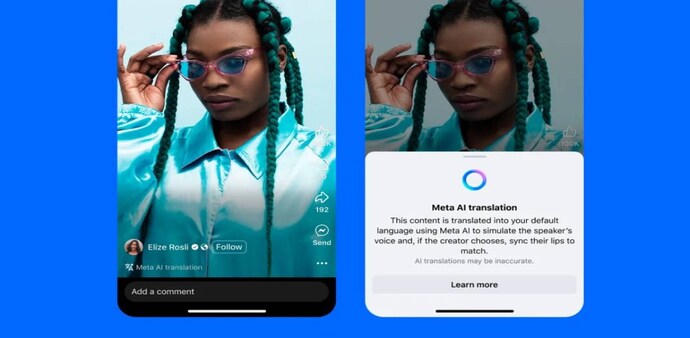
Creators can activate the feature when publishing a Reel by selecting the option “Translate your voice with Meta AI.” They can choose whether to enable lip syncing so that the dubbed version matches their mouth movements. Once the process is complete, creators receive a notification to review the translation, approve it, or disable features such as lip sync before publishing. A subtle indicator appears on the final video to show viewers that Meta AI handled the translation.
Meta says its system is designed to make dubbed content feel authentic by cloning the creator’s voice rather than replacing it with a generic narrator. Viewers can also adjust their preferences if they would rather not see dubbed videos in certain languages.
The company has added new analytics tools to give creators deeper insights into how their content performs across different languages, showing breakdowns of views by translation. Meta has also shared best practices, encouraging creators to face the camera, speak clearly, and minimise background noise for more accurate translations. The tool currently supports up to two speakers per video, provided they do not talk over one another.
In addition to AI dubbing, Facebook creators can upload as many as 20 of their own dubbed audio tracks for a single Reel via the Meta Business Suite platform. This manual option allows creators to add translations even after a video has been published.
Meta first teased the AI voice translation tool at its Connect developer conference last year before running pilot tests on Reels. Instagram head Adam Mosseri said the feature is aimed at helping creators grow their audiences by connecting with viewers across language boundaries.
The launch comes as Meta continues to restructure its AI division, with a renewed focus on research, infrastructure, products, and its longer-term ambitions around advanced AI systems. For creators, however, the immediate impact is clear: their Reels can now speak to a wider global audience.
For Unparalleled coverage of India's Businesses and Economy – Subscribe to Business Today Magazine
Meta has introduced a new artificial intelligence-powered voice translation tool for creators on Instagram and Facebook, designed to help content reach audiences beyond language barriers. The feature uses AI to automatically dub videos in different languages while preserving the creator’s tone and delivery, and even synchronising lip movements.
At launch, the tool supports two-way translations between English and Spanish, with the company confirming that additional languages will be added in the future. The rollout applies to all public Instagram accounts and Facebook creators with more than 1,000 followers, though it will not be available in certain regions, including the European Union, the United Kingdom, South Korea, Brazil, Australia, Nigeria, Turkey, South Africa, and some US states such as Texas and Illinois.
Creators can activate the feature when publishing a Reel by selecting the option “Translate your voice with Meta AI.” They can choose whether to enable lip syncing so that the dubbed version matches their mouth movements. Once the process is complete, creators receive a notification to review the translation, approve it, or disable features such as lip sync before publishing. A subtle indicator appears on the final video to show viewers that Meta AI handled the translation.
Meta says its system is designed to make dubbed content feel authentic by cloning the creator’s voice rather than replacing it with a generic narrator. Viewers can also adjust their preferences if they would rather not see dubbed videos in certain languages.
The company has added new analytics tools to give creators deeper insights into how their content performs across different languages, showing breakdowns of views by translation. Meta has also shared best practices, encouraging creators to face the camera, speak clearly, and minimise background noise for more accurate translations. The tool currently supports up to two speakers per video, provided they do not talk over one another.
In addition to AI dubbing, Facebook creators can upload as many as 20 of their own dubbed audio tracks for a single Reel via the Meta Business Suite platform. This manual option allows creators to add translations even after a video has been published.
Meta first teased the AI voice translation tool at its Connect developer conference last year before running pilot tests on Reels. Instagram head Adam Mosseri said the feature is aimed at helping creators grow their audiences by connecting with viewers across language boundaries.
The launch comes as Meta continues to restructure its AI division, with a renewed focus on research, infrastructure, products, and its longer-term ambitions around advanced AI systems. For creators, however, the immediate impact is clear: their Reels can now speak to a wider global audience.
For Unparalleled coverage of India's Businesses and Economy – Subscribe to Business Today Magazine