
Pax Silica membership positions India at the heart of a new US-led tech order
India’s inclusion marks a notable shift in its global positioning. Long viewed primarily as a technology market, the country is now being courted as a contributor to supply-chain resilience.
- Feb 20, 2026,
- Updated Feb 20, 2026 10:05 PM IST
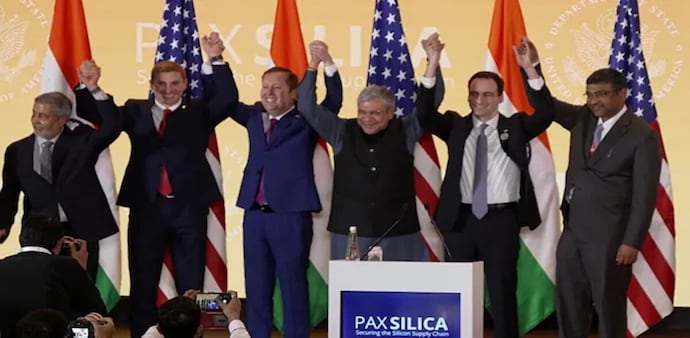
India has formally joined Pax Silica, a United States-led strategic initiative aimed at securing global supply chains for semiconductors, artificial intelligence infrastructure and critical minerals, a move that signals New Delhi’s growing role in the geopolitics of advanced technology.
The Pax Silica Declaration was signed on the sidelines of the India AI Impact Summit, placing India alongside a coalition of countries seeking to reduce dependence on a single geography for chips that power everything from smartphones and automobiles to defence systems and AI platforms.
“Today, we signed the Pax Silica Declaration, a document that’s not merely an agreement on paper, but a road map for a shared future… as we sign the Pax Silica, we say no to weaponised dependency, and we say no to blackmail, and together, we say that economic security is national security,” said Jacob Helberg, Under Secretary of State for Economic Affairs at the time of signing.
A new supply-chain bloc for the AI age
Semiconductors sit at the heart of modern economies, yet production remains heavily concentrated in a few regions. Disruptions triggered by the Covid-19 pandemic and rising geopolitical tensions have exposed vulnerabilities in this model, prompting countries to prioritise resilience and self-reliance over the earlier “global village” approach.
Pax Silica is Washington’s attempt to build a trusted network spanning the semiconductor and AI value chain, not by duplicating entire supply chains domestically, but by distributing capabilities across allied nations.
“Pax Silica represents a new US led geopolitical and economic order for the AI age. By organising an exclusive coalition of nations that control critical bottlenecks from Dutch lithography to Japanese chemicals and Middle Eastern energy, Washington is attempting to build a trusted ecosystem that explicitly reduces coercive dependencies on non-market actors (primarily China). It is a strategic bloc designed to ensure that the US and its partners maintain dominance over the technological frontier,” said Pareekh Jain, CEO at EIIRTrend & Pareekh Consulting.
Analysts say the framework echoes the logic of OPEC, which shaped oil geopolitics in the 20th century, except this time the strategic commodities are chips, data-centre infrastructure and AI compute.
From consumer to strategic partner
India’s inclusion marks a notable shift in its global positioning. Long viewed primarily as a technology market, the country is now being courted as a contributor to supply-chain resilience.
Early signatories to Pax Silica in December 2025 included Japan, Israel, Australia, Singapore and South Korea. Greece, Qatar, the United Arab Emirates and the United Kingdom later joined, while Canada, the European Union, the Netherlands, the OECD and Taiwan are participating as non-signatory members.
“Technological leaders such as Japan, South Korea and the Netherlands aim to protect their domestic champions, align on export controls to avoid secondary US sanctions, and secure continued access to US-controlled IP and critical minerals. Capital and energy rich hubs like the UAE and Qatar use their financial strength and low-cost energy to attract AI infrastructure and data centers, effectively trading investment for access to advanced compute,” Jain added.
India was formally invited in January 2026 despite not yet being a major semiconductor manufacturing hub, a decision experts attribute to policy momentum and long-term strategic potential.
“The last four years of dedication and relentless pursuit of Indian government to bring home semiconductor manufacturing, assembly and test value chain in India via unparalleled subsidy and ease of doing business metrics has culminated to upgrade India’s candidacy as a Pax Silica nation,” said Danish Faruqui, CEO at Fab Economics.
India’s strengths lie in talent, market scale and future manufacturing capacity, analysts say.
“India represents a vital, long-term ground for US for scaling up semiconductor manufacturing in areas where it has over 70% reliance on China including in the most critical Aerospace and Defence segment, securing critical mineral supply chains, and providing a massive, high-skilled engineering talent pool,” Faruqui added.
Jain noted that India hosts a large share of the world’s semiconductor design engineers and AI software developers, while its rapidly digitising economy offers an enormous domestic market, reducing the risk of rival technology ecosystems gaining dominance across the Global South.
Large technology firms have already announced plans to build AI hubs in India with massive computing infrastructure, further strengthening the country’s strategic importance.
Investment gains and geopolitical trade-offs
Membership in Pax Silica is expected to unlock investment, integration into secure supply chains and institutional backing for India’s semiconductor ambitions.
“The framework is likely to catalyse greater US and allied investment in domestic data centers and AI compute capacity. It also provides institutional backing that reduces geopolitical risk for foreign firms establishing ATMP and legacy fabrication facilities under India’s Semiconductor Mission. Additionally, it aligns India more closely with secure supply chains for critical minerals such as lithium, cobalt, and rare earths, essential for technology hardware and the EV transition, complementing its role in broader mineral security initiatives,” Jain said.
In the near to medium term, cooperation is expected to focus on chip design, mature manufacturing nodes (28 nanometres and above), supply-chain security and advanced packaging rather than cutting-edge fabrication.
However, the alignment may also come with strategic constraints.
“As a Pax Silica member, India would need to align with Western-led export controls including restraints on supplying India made products to specific countries and implement technology investment screenings from US adversarial nations, potentially jeopardizing ties with China and Russia,” Faruqui said.
“Aligning with a US-centric bloc could also force India to choose sides in tech-geopolitics going forward, reducing its flexibility in maintaining a East-West balanced foreign policy.”
Experts warn India may also face pressure to adopt US-aligned standards in AI and electronics, potentially limiting the scope for independent regulatory frameworks tailored to domestic needs.
For Unparalleled coverage of India's Businesses and Economy – Subscribe to Business Today Magazine
India has formally joined Pax Silica, a United States-led strategic initiative aimed at securing global supply chains for semiconductors, artificial intelligence infrastructure and critical minerals, a move that signals New Delhi’s growing role in the geopolitics of advanced technology.
The Pax Silica Declaration was signed on the sidelines of the India AI Impact Summit, placing India alongside a coalition of countries seeking to reduce dependence on a single geography for chips that power everything from smartphones and automobiles to defence systems and AI platforms.
“Today, we signed the Pax Silica Declaration, a document that’s not merely an agreement on paper, but a road map for a shared future… as we sign the Pax Silica, we say no to weaponised dependency, and we say no to blackmail, and together, we say that economic security is national security,” said Jacob Helberg, Under Secretary of State for Economic Affairs at the time of signing.
A new supply-chain bloc for the AI age
Semiconductors sit at the heart of modern economies, yet production remains heavily concentrated in a few regions. Disruptions triggered by the Covid-19 pandemic and rising geopolitical tensions have exposed vulnerabilities in this model, prompting countries to prioritise resilience and self-reliance over the earlier “global village” approach.
Pax Silica is Washington’s attempt to build a trusted network spanning the semiconductor and AI value chain, not by duplicating entire supply chains domestically, but by distributing capabilities across allied nations.
“Pax Silica represents a new US led geopolitical and economic order for the AI age. By organising an exclusive coalition of nations that control critical bottlenecks from Dutch lithography to Japanese chemicals and Middle Eastern energy, Washington is attempting to build a trusted ecosystem that explicitly reduces coercive dependencies on non-market actors (primarily China). It is a strategic bloc designed to ensure that the US and its partners maintain dominance over the technological frontier,” said Pareekh Jain, CEO at EIIRTrend & Pareekh Consulting.
Analysts say the framework echoes the logic of OPEC, which shaped oil geopolitics in the 20th century, except this time the strategic commodities are chips, data-centre infrastructure and AI compute.
From consumer to strategic partner
India’s inclusion marks a notable shift in its global positioning. Long viewed primarily as a technology market, the country is now being courted as a contributor to supply-chain resilience.
Early signatories to Pax Silica in December 2025 included Japan, Israel, Australia, Singapore and South Korea. Greece, Qatar, the United Arab Emirates and the United Kingdom later joined, while Canada, the European Union, the Netherlands, the OECD and Taiwan are participating as non-signatory members.
“Technological leaders such as Japan, South Korea and the Netherlands aim to protect their domestic champions, align on export controls to avoid secondary US sanctions, and secure continued access to US-controlled IP and critical minerals. Capital and energy rich hubs like the UAE and Qatar use their financial strength and low-cost energy to attract AI infrastructure and data centers, effectively trading investment for access to advanced compute,” Jain added.
India was formally invited in January 2026 despite not yet being a major semiconductor manufacturing hub, a decision experts attribute to policy momentum and long-term strategic potential.
“The last four years of dedication and relentless pursuit of Indian government to bring home semiconductor manufacturing, assembly and test value chain in India via unparalleled subsidy and ease of doing business metrics has culminated to upgrade India’s candidacy as a Pax Silica nation,” said Danish Faruqui, CEO at Fab Economics.
India’s strengths lie in talent, market scale and future manufacturing capacity, analysts say.
“India represents a vital, long-term ground for US for scaling up semiconductor manufacturing in areas where it has over 70% reliance on China including in the most critical Aerospace and Defence segment, securing critical mineral supply chains, and providing a massive, high-skilled engineering talent pool,” Faruqui added.
Jain noted that India hosts a large share of the world’s semiconductor design engineers and AI software developers, while its rapidly digitising economy offers an enormous domestic market, reducing the risk of rival technology ecosystems gaining dominance across the Global South.
Large technology firms have already announced plans to build AI hubs in India with massive computing infrastructure, further strengthening the country’s strategic importance.
Investment gains and geopolitical trade-offs
Membership in Pax Silica is expected to unlock investment, integration into secure supply chains and institutional backing for India’s semiconductor ambitions.
“The framework is likely to catalyse greater US and allied investment in domestic data centers and AI compute capacity. It also provides institutional backing that reduces geopolitical risk for foreign firms establishing ATMP and legacy fabrication facilities under India’s Semiconductor Mission. Additionally, it aligns India more closely with secure supply chains for critical minerals such as lithium, cobalt, and rare earths, essential for technology hardware and the EV transition, complementing its role in broader mineral security initiatives,” Jain said.
In the near to medium term, cooperation is expected to focus on chip design, mature manufacturing nodes (28 nanometres and above), supply-chain security and advanced packaging rather than cutting-edge fabrication.
However, the alignment may also come with strategic constraints.
“As a Pax Silica member, India would need to align with Western-led export controls including restraints on supplying India made products to specific countries and implement technology investment screenings from US adversarial nations, potentially jeopardizing ties with China and Russia,” Faruqui said.
“Aligning with a US-centric bloc could also force India to choose sides in tech-geopolitics going forward, reducing its flexibility in maintaining a East-West balanced foreign policy.”
Experts warn India may also face pressure to adopt US-aligned standards in AI and electronics, potentially limiting the scope for independent regulatory frameworks tailored to domestic needs.
For Unparalleled coverage of India's Businesses and Economy – Subscribe to Business Today Magazine