
Pronto's Anjali Sardana is betting on a future beyond household help with physical AI
As Pronto expands beyond household services, Sardana is betting on India's blue-collar workforce to power physical AI, even as questions around privacy and consent persist.
- Nov 5, 2026,
- Updated Nov 5, 2026 3:07 PM IST
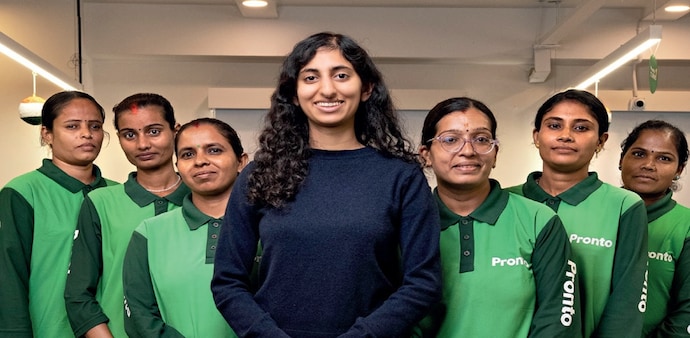
The acquisition of Basilisk Industries by Anjali Sardana’s new venture Provision Labs is part of a larger ambition to build technology for the physical world. Founder and CEO of Pronto, an instant home service platform, Sardana believes India's fragmented blue-collar workforce could be central to that opportunity.
“If you were prepared, you probably wouldn’t do it,” says Sardana speaking with Business Today, reflecting on her decision to build a business in India despite having little familiarity with its market, no experience running an operations-heavy business and no fluency in an Indian language.
That willingness to enter unfamiliar territory is now shaping her next bet. Sardana has taken another step towards building a physical artificial intelligence (AI) business with Provision Labs' acquisition of Basilisk Industries.
The acquisition brings Basilisk founder Shourya Watwani into Provision as head of hardware. Within weeks of joining, the team developed a metric 3D hand-tracking model, redesigned perception hardware and built an early version of a lightweight, high-fidelity tactile glove. The financial details of the deal have not been disclosed.
From domestic help to intelligent machines
For Sardana, the move is an extension of a thesis that goes beyond getting household chores done faster. Pronto, which connects households with professionals for cleaning, laundry, meal preparation, etc, is also creating opportunities to capture real-world human activity that could help train AI systems.
Provision Labs, headquartered in San Francisco, is being built as a data, evaluation and deployment layer for physical AI. Its ambition is to help machines perceive, understand and interact with the physical world. The company is hiring across San Francisco, Toronto and Bengaluru, with a focus on computer vision, perception, tactile data and hardware.
The connection between the two ventures lies in the nature of work itself. Through Pronto's opt-in Verified programme, the company is exploring the use of anonymised recordings of household tasks for AI training. The two companies, however, have not publicly detailed the extent of any data-sharing arrangement.
The move towards building a physical AI data business, however, has not been without controversy. Pronto faced considerable backlash in May after reports emerged that it was piloting camera-based recordings of household tasks to generate training data for robots. The initiative raised concerns around privacy, consent and the use of footage captured inside customers' homes. Defending the programme, Sardana maintained that participation was entirely voluntary, with customers required to opt in while booking the service. She also argued that the initiative was aimed at ensuring India's blue-collar workforce did not get left out of the AI opportunity. Her larger contention was that while billions of dollars are being invested in AI, the workers whose everyday tasks could help train these systems should also have a share in the economic value being created.
The outsider's advantage
Sardana's conviction in Pronto was strong enough to override the competition. Recalling the company's early days, she told Business Today: “I became so obsessed that I couldn’t sleep or eat because I felt I was wasting time not starting.”
By the time Pronto formally launched in 2025, Urban Company was already an established listed player and Snabbit had entered the market. Yet she believed there was room to organise a fragmented labour market through technology.
Her larger ambition is to take that thinking beyond homes and into warehouses, factories, retail and manufacturing. She sees India's blue-collar workforce as a potential beneficiary of AI and robotics, rather than merely a source of cheap labour or training data.
Pronto's growing bookings and rising average order value suggest its core business continues to gain traction. More than half of the professionals enrolled in its Verified programme are already earning over Rs 40,000 a month, Sardana said in her recent LinkedIn post.
The Basilisk acquisition signals that Sardana's ambition is no longer limited to organising human work. She is also positioning herself to build the technology that could shape how machines learn to perform it.
For Unparalleled coverage of India's Businesses and Economy – Subscribe to Business Today Magazine