
World Governments Summit: Technology is becoming as important as defence and finance, says IBM's Arvind Krishna
Arvind Krishna stressed that tech sovereignty does not mean cutting off global ties, but ensuring control over critical systems.
- Feb 3, 2026,
- Updated Feb 3, 2026 5:23 PM IST
Technology is fast emerging as a core pillar of national power, on par with defence and finance, as governments grapple with geopolitics, digital dependence, and the next wave of frontier innovation.
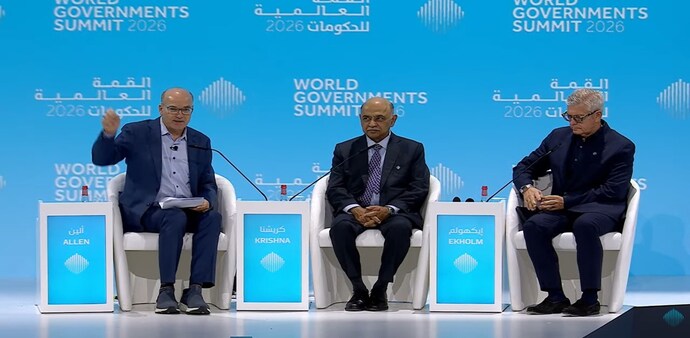
Speaking in a panel session at the World Governments Summit in Dubai, IMB CEO Arvind Krishna said technology now acts as a “force multiplier” for economies and security alike.
“Defence is important, it helps preserve a nation, preserve the boundaries, preserve the security of its citizens. Finance is important, because without liquidity and credit, it’s very hard to invest in infrastructure,” Krishna said. “Technology is a force multiplier. Every nation is waking up to the fact that technology can help amplify the impact of both of those and many other industries.”
That shift, he added, means technology is becoming “as, or perhaps more important, even than finance” in driving future growth.
Krishna stressed that sovereignty does not mean cutting off global ties, but ensuring control over critical systems. “It’s not exclusive. You can use many things from other places, but you do need to run some that you have your control over fully, so that nobody can turn it off, mismanage it, steal data from it, or apply the wrong security to it,” he said.
Börje Ekholm, President and CEO of Ericsson, echoed the importance of technology while cautioning against framing the debate purely around sovereignty.
“I think sovereignty leads the mind the wrong way,” Ekholm said. “Because it actually says that we can be a bit independent. I actually think in technology, we can’t.”
Instead, Ekholm argued for trusted interdependence, noting that most nations rely on foreign technology somewhere in their digital stack. “Technology is the key driver of prosperity in countries in the future,” he said. “So can you depend on somebody else controlling your stack? No. You need to make sure that you work with vendors you can trust, partners you can trust, in building up that whole digital stack.”
Looking ahead, Ekholm said next-generation networks will be fully AI-native and intent-based. “We will start to look at each application and decide what type of connectivity will it need,” he said, adding that with 6G, “everything that can be connected will be connected.”
Krishna also pointed to quantum computing nearing real-world impact. “Engineering, no longer science fiction,” he said, predicting that within two to three years quantum systems will begin delivering “incredible commercial advantages,” particularly in materials science, finance and optimisation.
On artificial intelligence, Krishna rejected an either-or framing between large and small models. “Large models are going to be very useful, and small models are going to do the majority of the work,” he said, forecasting a future dominated by domain-specific AI systems tailored to fields like chemistry, manufacturing and physical infrastructure.
For Unparalleled coverage of India's Businesses and Economy – Subscribe to Business Today Magazine
Technology is fast emerging as a core pillar of national power, on par with defence and finance, as governments grapple with geopolitics, digital dependence, and the next wave of frontier innovation.
Speaking in a panel session at the World Governments Summit in Dubai, IMB CEO Arvind Krishna said technology now acts as a “force multiplier” for economies and security alike.
“Defence is important, it helps preserve a nation, preserve the boundaries, preserve the security of its citizens. Finance is important, because without liquidity and credit, it’s very hard to invest in infrastructure,” Krishna said. “Technology is a force multiplier. Every nation is waking up to the fact that technology can help amplify the impact of both of those and many other industries.”
That shift, he added, means technology is becoming “as, or perhaps more important, even than finance” in driving future growth.
Krishna stressed that sovereignty does not mean cutting off global ties, but ensuring control over critical systems. “It’s not exclusive. You can use many things from other places, but you do need to run some that you have your control over fully, so that nobody can turn it off, mismanage it, steal data from it, or apply the wrong security to it,” he said.
Börje Ekholm, President and CEO of Ericsson, echoed the importance of technology while cautioning against framing the debate purely around sovereignty.
“I think sovereignty leads the mind the wrong way,” Ekholm said. “Because it actually says that we can be a bit independent. I actually think in technology, we can’t.”
Instead, Ekholm argued for trusted interdependence, noting that most nations rely on foreign technology somewhere in their digital stack. “Technology is the key driver of prosperity in countries in the future,” he said. “So can you depend on somebody else controlling your stack? No. You need to make sure that you work with vendors you can trust, partners you can trust, in building up that whole digital stack.”
Looking ahead, Ekholm said next-generation networks will be fully AI-native and intent-based. “We will start to look at each application and decide what type of connectivity will it need,” he said, adding that with 6G, “everything that can be connected will be connected.”
Krishna also pointed to quantum computing nearing real-world impact. “Engineering, no longer science fiction,” he said, predicting that within two to three years quantum systems will begin delivering “incredible commercial advantages,” particularly in materials science, finance and optimisation.
On artificial intelligence, Krishna rejected an either-or framing between large and small models. “Large models are going to be very useful, and small models are going to do the majority of the work,” he said, forecasting a future dominated by domain-specific AI systems tailored to fields like chemistry, manufacturing and physical infrastructure.
For Unparalleled coverage of India's Businesses and Economy – Subscribe to Business Today Magazine