
The 1,000°C milestone in orbit: Space Forge successfully ignites its 'furnace' in 'space mini-factory'
Welsh aerospace pioneer Space Forge has successfully reached a critical operational milestone by activating a high-temperature furnace aboard its orbital mini-factory.
- Dec 31, 2025,
- Updated Dec 31, 2025 5:29 PM IST
A company based in the UK has moved a step closer to making orbital manufacturing a reality after successfully activating a furnace aboard its miniature space factory.
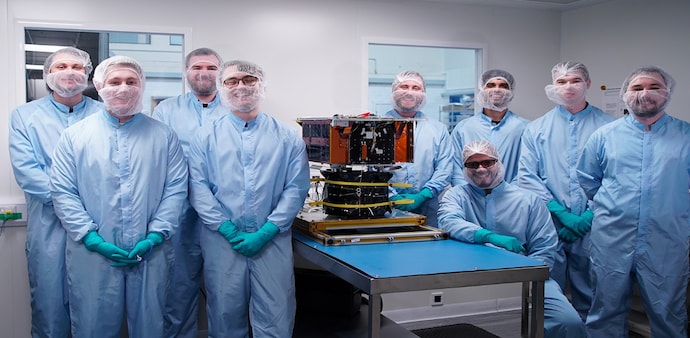
Space Forge has demonstrated that its microwave-sized facility, launched into orbit via a SpaceX rocket this summer, can successfully reach temperatures of approximately 1,000°C. The team, operating from mission control in Wales, confirmed the milestone after receiving an image from inside the furnace showing glowing plasma.
The Semiconductor Advantage
The company intends to manufacture materials for semiconductors, which are essential components for computing, transport, and communications infrastructure. Space provides two distinct environmental advantages for this process:
Microgravity: In a weightless environment, atoms can be arranged into a perfectly ordered 3D structure without the interference of gravity.
Vacuum: The natural vacuum of space prevents contaminants from entering the manufacturing process.
Josh Western, CEO of Space Forge, explained the significance of these conditions: "The work that we're doing now is allowing us to create semiconductors up to 4,000 times purer in space than we can currently make here today." He added that these chips would eventually be used in 5G towers, electric vehicle chargers, and modern aircraft.
Scaling for the Futures
Following this successful test, the team plans to develop a larger space factory capable of producing material for 10,000 chips. However, a significant challenge remains: returning the goods to Earth. Space Forge is developing a heat shield called Pridwen, named after King Arthur’s legendary shield, designed to protect the spacecraft from the intense heat of atmospheric re-entry.
Veronica Viera, the company's payload operations lead, described seeing the plasma image as "one of the most exciting moments of my life", noting that the ability to generate this heat is a "core ingredient" for their process.
A New Industrial Frontier
Space Forge is part of a growing movement of companies looking to manufacture pharmaceuticals and artificial tissues in orbit. Libby Jackson, head of space at the Science Museum, noted that while the industry is in its infancy, the potential is vast.
"In-space manufacturing is something that is happening now," Jackson stated. "But by proving the technology, it really opens the door for an economically viable product, where things can be made in space and return to Earth and have use and benefit to everybody on Earth. And that's really exciting," she added.
For Unparalleled coverage of India's Businesses and Economy – Subscribe to Business Today Magazine
A company based in the UK has moved a step closer to making orbital manufacturing a reality after successfully activating a furnace aboard its miniature space factory.
Space Forge has demonstrated that its microwave-sized facility, launched into orbit via a SpaceX rocket this summer, can successfully reach temperatures of approximately 1,000°C. The team, operating from mission control in Wales, confirmed the milestone after receiving an image from inside the furnace showing glowing plasma.
The Semiconductor Advantage
The company intends to manufacture materials for semiconductors, which are essential components for computing, transport, and communications infrastructure. Space provides two distinct environmental advantages for this process:
Microgravity: In a weightless environment, atoms can be arranged into a perfectly ordered 3D structure without the interference of gravity.
Vacuum: The natural vacuum of space prevents contaminants from entering the manufacturing process.
Josh Western, CEO of Space Forge, explained the significance of these conditions: "The work that we're doing now is allowing us to create semiconductors up to 4,000 times purer in space than we can currently make here today." He added that these chips would eventually be used in 5G towers, electric vehicle chargers, and modern aircraft.
Scaling for the Futures
Following this successful test, the team plans to develop a larger space factory capable of producing material for 10,000 chips. However, a significant challenge remains: returning the goods to Earth. Space Forge is developing a heat shield called Pridwen, named after King Arthur’s legendary shield, designed to protect the spacecraft from the intense heat of atmospheric re-entry.
Veronica Viera, the company's payload operations lead, described seeing the plasma image as "one of the most exciting moments of my life", noting that the ability to generate this heat is a "core ingredient" for their process.
A New Industrial Frontier
Space Forge is part of a growing movement of companies looking to manufacture pharmaceuticals and artificial tissues in orbit. Libby Jackson, head of space at the Science Museum, noted that while the industry is in its infancy, the potential is vast.
"In-space manufacturing is something that is happening now," Jackson stated. "But by proving the technology, it really opens the door for an economically viable product, where things can be made in space and return to Earth and have use and benefit to everybody on Earth. And that's really exciting," she added.
For Unparalleled coverage of India's Businesses and Economy – Subscribe to Business Today Magazine