
Users are clicking less when Google shows AI Overviews on Search
A new study finds that when AI Overviews are displayed on Google Search, users don't click on external links, and it is disrupting web traffic for publishers.
- Jul 23, 2025,
- Updated Jul 23, 2025 11:28 AM IST
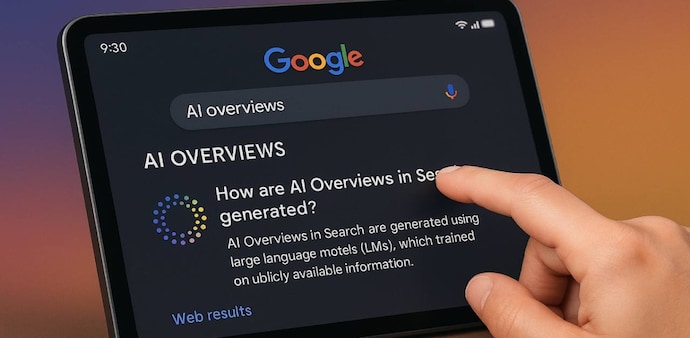
A new study by the Pew Research Center has found that Google’s AI Overviews significantly change user behaviour on the platform, often reducing the likelihood of users clicking through to external websites.
The findings are based on browsing data from 900 US adults in March 2025. Pew analysed 68,879 unique Google searches and found that around 18% displayed an AI Overview (AIO). When an AIO appeared, users clicked on traditional search result links just 8% of the time. By contrast, search pages without an AIO saw users click through at nearly double that rate, at 15%.
Even more striking, users rarely clicked on links within the AI summaries themselves; just 1% of visits included a click on a source cited in the AIO.
“These results provide a snapshot of how real users are interacting with AI-generated summaries in everyday browsing,” said Athena Chapekis, a computational social science analyst at Pew Research, in a statement to CNET. “Our goal was to understand how AI is shaping the search experience.”
The study also found that AI Overviews may be ending browsing sessions altogether. In 26% of visits where an AIO appeared, users left Google without clicking any link, compared to just 16% of sessions with only traditional results. This suggests AI-generated summaries may be satisfying user queries more directly, leaving fewer incentives to explore external content.
Google’s AI Overviews tend to appear more frequently in longer and more complex queries, particularly those phrased as questions or full sentences. While just 8% of one- or two-word searches produced an AIO, that number rose to 53% for queries with ten words or more. Questions beginning with words like “what”, “why”, or “how” were also far more likely to trigger AI-generated content.
When it comes to sources cited in AI Overviews, Wikipedia, Reddit, and YouTube dominate, collectively appearing in 15% of summaries. Government websites made up 6% of sources in AIOs, compared to just 2% in standard search results. News websites, meanwhile, accounted for 5% of links in both categories.
This shift in user behaviour has alarmed many publishers who rely on Google Search traffic for visibility and revenue. Some blame AIOs for recent declines in web traffic, though Google contests this claim.
The impact on the publishing industry has been severe. In the past two to three years, the global journalism industry has faced a significant wave of redundancies, with artificial intelligence increasingly driving job losses. Since 2022, more than 8,000 journalists in the United States alone have been laid off amid broader digital disruption and rapid AI adoption. High-profile outlets such as BuzzFeed News, Business Insider, and Germany's Bild have all undertaken mass layoffs, explicitly citing AI as a key factor in their restructuring or replacement of editorial roles. While automation is not the sole cause, its growing influence is accelerating newsroom cutbacks both in the US and Europe, highlighting AI’s mounting impact on the profession’s future.
Google’s dominance in search, controlling nearly 90% of the global market according to GlobalStats, has made it a crucial channel for publishers. But its increasing reliance on AI-generated content, combined with its lack of transparency around AIO-driven traffic, is drawing criticism.
Google has argued that AI Overviews drive “higher quality clicks” from users with stronger intent, but it has not released any supporting data.
The issue is further complicated by the fact that Google owns YouTube and has recently signed a multi-million-dollar AI data licensing deal with Reddit, two of the top sources frequently cited in AIOs. As AI transforms how users find and consume information, the tension between search platforms and publishers is likely to intensify.
For Unparalleled coverage of India's Businesses and Economy – Subscribe to Business Today Magazine
A new study by the Pew Research Center has found that Google’s AI Overviews significantly change user behaviour on the platform, often reducing the likelihood of users clicking through to external websites.
The findings are based on browsing data from 900 US adults in March 2025. Pew analysed 68,879 unique Google searches and found that around 18% displayed an AI Overview (AIO). When an AIO appeared, users clicked on traditional search result links just 8% of the time. By contrast, search pages without an AIO saw users click through at nearly double that rate, at 15%.
Even more striking, users rarely clicked on links within the AI summaries themselves; just 1% of visits included a click on a source cited in the AIO.
“These results provide a snapshot of how real users are interacting with AI-generated summaries in everyday browsing,” said Athena Chapekis, a computational social science analyst at Pew Research, in a statement to CNET. “Our goal was to understand how AI is shaping the search experience.”
The study also found that AI Overviews may be ending browsing sessions altogether. In 26% of visits where an AIO appeared, users left Google without clicking any link, compared to just 16% of sessions with only traditional results. This suggests AI-generated summaries may be satisfying user queries more directly, leaving fewer incentives to explore external content.
Google’s AI Overviews tend to appear more frequently in longer and more complex queries, particularly those phrased as questions or full sentences. While just 8% of one- or two-word searches produced an AIO, that number rose to 53% for queries with ten words or more. Questions beginning with words like “what”, “why”, or “how” were also far more likely to trigger AI-generated content.
When it comes to sources cited in AI Overviews, Wikipedia, Reddit, and YouTube dominate, collectively appearing in 15% of summaries. Government websites made up 6% of sources in AIOs, compared to just 2% in standard search results. News websites, meanwhile, accounted for 5% of links in both categories.
This shift in user behaviour has alarmed many publishers who rely on Google Search traffic for visibility and revenue. Some blame AIOs for recent declines in web traffic, though Google contests this claim.
The impact on the publishing industry has been severe. In the past two to three years, the global journalism industry has faced a significant wave of redundancies, with artificial intelligence increasingly driving job losses. Since 2022, more than 8,000 journalists in the United States alone have been laid off amid broader digital disruption and rapid AI adoption. High-profile outlets such as BuzzFeed News, Business Insider, and Germany's Bild have all undertaken mass layoffs, explicitly citing AI as a key factor in their restructuring or replacement of editorial roles. While automation is not the sole cause, its growing influence is accelerating newsroom cutbacks both in the US and Europe, highlighting AI’s mounting impact on the profession’s future.
Google’s dominance in search, controlling nearly 90% of the global market according to GlobalStats, has made it a crucial channel for publishers. But its increasing reliance on AI-generated content, combined with its lack of transparency around AIO-driven traffic, is drawing criticism.
Google has argued that AI Overviews drive “higher quality clicks” from users with stronger intent, but it has not released any supporting data.
The issue is further complicated by the fact that Google owns YouTube and has recently signed a multi-million-dollar AI data licensing deal with Reddit, two of the top sources frequently cited in AIOs. As AI transforms how users find and consume information, the tension between search platforms and publishers is likely to intensify.
For Unparalleled coverage of India's Businesses and Economy – Subscribe to Business Today Magazine