
Chennai-based Agnikul Cosmos tests Agnite, the world’s largest single-piece 3D-printed booster engine
The Chennai-based space tech startup says its Inconel engine can be produced in 7 days, cutting turnaround time by up to 97% versus industry norms.
- Mar 25, 2026,
- Updated Mar 25, 2026 1:31 PM IST
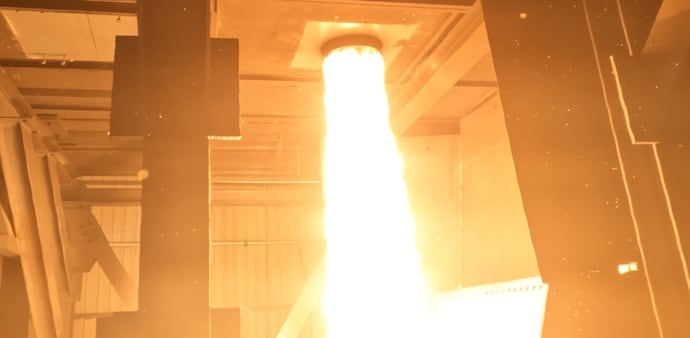
Chennai-based space tech startup Agnikul Cosmos has successfully test-fired Agnite, its booster engine and the world’s largest rocket engine built as a single 3D-printed piece. The company says the test marks a significant leap in propulsion technology, validating an architecture that compresses engine production from months to days.
Agnite is a metre long and is the first engine of its scale to be tested with electric motor-driven pumps. It is constructed from Inconel, a high-performance nickel superalloy used in extreme-temperature aerospace applications. The test was conducted at Agnikul’s in-house facility in Chennai.
Traditional rocket engines are assembled from dozens of machined and welded parts, a process that typically takes several months. Agnikul says its single-piece printed architecture eliminates most of that complexity, enabling a production cycle of just seven days, a 90 to 97% reduction in turnaround time.
“We chose single-piece Inconel construction and electric pump architecture specifically to solve our customers’ schedule problem & enhance automation of engine making. Traditional engines take months to build because you’re machining, welding, and assembling dozens of parts. Ours prints in a few days, which means we can respond to launch demand faster than the industry standard,” Srinath Ravichandran, Co-founder and CEO, Agnikul Cosmos said.
Ravichandran added that the electric pump design also supports the company’s reusability plans. “Electric pumps are simpler than gas generators, with fewer parts to refurbish between flights, which is critical for our reusability roadmap. These aren’t just technical choices but are the reasons why we can commit to low turnaround and actually deliver on it,” he said.
What does it mean for satellite operators?
Agnikul says satellite operators will be able to secure firm launch windows, choose custom orbital trajectories and accommodate payload changes up to 30 days before flight.
The company is targeting mission profiles where schedule certainty is critical, such as constellation deployments, defence and disaster-response satellites, government sovereign launches and space-based compute applications. For operators in these segments, Agnikul says delays have direct operational and financial consequences.
Agnikul positions itself as an end-to-end launch provider, handling everything from vehicle manufacture through mission control, ground stations and on-orbit checkout, with a single commercial counterpart for customers throughout the process.
Building on a run of propulsion milestones
The Agnite test follows a clustered engine firing last month in which Agnikul test-fired three semicryogenic engines simultaneously, the first such synchronised test in India. That milestone demonstrated the company’s ability to scale engine count per vehicle depending on mission requirements.
Agnikul’s propulsion programme traces back to its 2024 controlled ascent flight, India’s first launch from a privately built launchpad. That vehicle flew on single-piece 3D-printed engines designed and manufactured in-house, using in-house autopilot software to track a predefined trajectory.
“This engine test validates that our propulsion systems are ready to operate at the scale required for multiple launches per quarter. Our manufacturing capabilities are enabling us to produce engines in line with customer demand, rather than limiting it,” said Moin SPM, Co-founder and COO, Agnikul Cosmos.
Moin SPM added that with propulsion now largely de-risked, the company’s focus shifts to demonstrating consistent launch cadence and mission reliability.
Infrastructure and financial position
Agnikul has commissioned what it describes as India’s first large-format aerospace manufacturing facility, designed for rapid vehicle production. The company holds patents in the United States, Europe and India covering propulsion systems, convertible upper-stage architecture and orbital platform technologies.
The company is valued at over $500 million following a funding round that included HDFC Bank, Advenza Global Limited, and Artha Select Fund, among others.
The Tamil Nadu government’s industrial development arm, TIDCO, recently made an equity investment of Rs 25 crore in Agnikul under the TIDCO Startup Investment Policy 2025, the first such government equity investment in an Indian space startup.
For Unparalleled coverage of India's Businesses and Economy – Subscribe to Business Today Magazine
Chennai-based space tech startup Agnikul Cosmos has successfully test-fired Agnite, its booster engine and the world’s largest rocket engine built as a single 3D-printed piece. The company says the test marks a significant leap in propulsion technology, validating an architecture that compresses engine production from months to days.
Agnite is a metre long and is the first engine of its scale to be tested with electric motor-driven pumps. It is constructed from Inconel, a high-performance nickel superalloy used in extreme-temperature aerospace applications. The test was conducted at Agnikul’s in-house facility in Chennai.
Traditional rocket engines are assembled from dozens of machined and welded parts, a process that typically takes several months. Agnikul says its single-piece printed architecture eliminates most of that complexity, enabling a production cycle of just seven days, a 90 to 97% reduction in turnaround time.
“We chose single-piece Inconel construction and electric pump architecture specifically to solve our customers’ schedule problem & enhance automation of engine making. Traditional engines take months to build because you’re machining, welding, and assembling dozens of parts. Ours prints in a few days, which means we can respond to launch demand faster than the industry standard,” Srinath Ravichandran, Co-founder and CEO, Agnikul Cosmos said.
Ravichandran added that the electric pump design also supports the company’s reusability plans. “Electric pumps are simpler than gas generators, with fewer parts to refurbish between flights, which is critical for our reusability roadmap. These aren’t just technical choices but are the reasons why we can commit to low turnaround and actually deliver on it,” he said.
What does it mean for satellite operators?
Agnikul says satellite operators will be able to secure firm launch windows, choose custom orbital trajectories and accommodate payload changes up to 30 days before flight.
The company is targeting mission profiles where schedule certainty is critical, such as constellation deployments, defence and disaster-response satellites, government sovereign launches and space-based compute applications. For operators in these segments, Agnikul says delays have direct operational and financial consequences.
Agnikul positions itself as an end-to-end launch provider, handling everything from vehicle manufacture through mission control, ground stations and on-orbit checkout, with a single commercial counterpart for customers throughout the process.
Building on a run of propulsion milestones
The Agnite test follows a clustered engine firing last month in which Agnikul test-fired three semicryogenic engines simultaneously, the first such synchronised test in India. That milestone demonstrated the company’s ability to scale engine count per vehicle depending on mission requirements.
Agnikul’s propulsion programme traces back to its 2024 controlled ascent flight, India’s first launch from a privately built launchpad. That vehicle flew on single-piece 3D-printed engines designed and manufactured in-house, using in-house autopilot software to track a predefined trajectory.
“This engine test validates that our propulsion systems are ready to operate at the scale required for multiple launches per quarter. Our manufacturing capabilities are enabling us to produce engines in line with customer demand, rather than limiting it,” said Moin SPM, Co-founder and COO, Agnikul Cosmos.
Moin SPM added that with propulsion now largely de-risked, the company’s focus shifts to demonstrating consistent launch cadence and mission reliability.
Infrastructure and financial position
Agnikul has commissioned what it describes as India’s first large-format aerospace manufacturing facility, designed for rapid vehicle production. The company holds patents in the United States, Europe and India covering propulsion systems, convertible upper-stage architecture and orbital platform technologies.
The company is valued at over $500 million following a funding round that included HDFC Bank, Advenza Global Limited, and Artha Select Fund, among others.
The Tamil Nadu government’s industrial development arm, TIDCO, recently made an equity investment of Rs 25 crore in Agnikul under the TIDCO Startup Investment Policy 2025, the first such government equity investment in an Indian space startup.
For Unparalleled coverage of India's Businesses and Economy – Subscribe to Business Today Magazine