
India–EU FTA to accelerate IT services and semiconductor growth, industry bodies say
“Indian IT companies could benefit from technology transfer, co-creation and expanded partnerships,” Nasscom added, noting that the FTA also includes dedicated SME chapters with contact points and digital platforms to support smaller firms.
- Jan 27, 2026,
- Updated Jan 27, 2026 10:39 PM IST
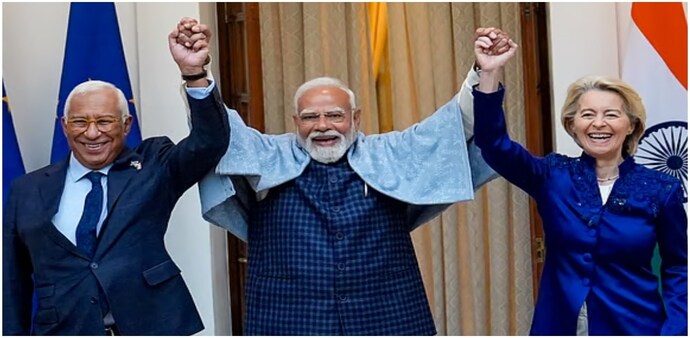
India’s landmark free trade agreement with the European Union is set to accelerate growth across the country’s IT services and semiconductor ecosystem, with industry groups pointing to easier market access, digital trade rules and lower-cost imports of high-end equipment as key tailwinds.
The agreement delivers preferential access across most goods and services trade between the world’s fourth- and second-largest economies. For technology companies, the gains are less about tariff cuts and more about predictability, mobility and integration into European value chains.
Nasscom said that while goods see major duty reductions, services benefits will come from “opening markets and rules-based predictability,” adding that services, already the fastest-growing part of both economies, stand to gain through better EU access for Indian tech firms.
“This could lower non-tariff barriers and ease cross border delivery,” Nasscom said, pointing to digital trade rules designed to support business while protecting “privacy, security and public policy.” Indian IT firms are expected to benefit from greater opportunities in Europe, including easier cross-border provision of services and potentially improved mobility for professionals.
The industry body also highlighted that India and the EU “have agreed on constructive framework to enable Social Security Agreements in 5 years with all the EU Member States,” a move that could reduce double social-security contributions for Indian professionals working in Europe.
Under the agreement, the EU has made broader and deeper commitments across 144 services subsectors, including IT and IT-enabled services, professional services and other business segments, according to a factsheet published by the Ministry of Commerce and Industry.
The framework also covers digitally delivered services and temporary entry for professionals such as business visitors, intra-corporate transferees, contractual service suppliers and independent professionals, measures aimed at strengthening India’s position as a global talent hub.
Nasscom said the deal “fosters deeper EU-India ties in technology, innovation, and digital areas,” building on the India-EU Trade and Technology Council.
“Indian IT companies could benefit from technology transfer, co-creation and expanded partnerships,” Nasscom added, noting that the FTA also includes dedicated SME chapters with contact points and digital platforms to support smaller firms.
For India’s semiconductor ambitions, the agreement could prove equally significant.
“The India–EU FTA is a transformative structural enabler for India’s electronics and semiconductor ecosystem,” said Ashok Chandak, President of the India Electronics and Semiconductor Association (IESA).
By cutting or eliminating duties on European machinery and upstream components, which Chandak said typically account for “nearly 70+% of semiconductor fab capex,” the deal “potentially could lower project costs and improves the global competitiveness of India’s fabs and OSAT units.”
With India’s electronics exports to the EU already at about $12 billion, preferential access to Europe’s nearly $750 billion electronics market opens what Chandak described as “a powerful runway for growth,” aligned with India’s push to scale electronics manufacturing.
He added that the FTA is expected to facilitate cooperation in artificial intelligence, clean technologies and semiconductors, supporting India’s broader technological advancement.
For Unparalleled coverage of India's Businesses and Economy – Subscribe to Business Today Magazine
India’s landmark free trade agreement with the European Union is set to accelerate growth across the country’s IT services and semiconductor ecosystem, with industry groups pointing to easier market access, digital trade rules and lower-cost imports of high-end equipment as key tailwinds.
The agreement delivers preferential access across most goods and services trade between the world’s fourth- and second-largest economies. For technology companies, the gains are less about tariff cuts and more about predictability, mobility and integration into European value chains.
Nasscom said that while goods see major duty reductions, services benefits will come from “opening markets and rules-based predictability,” adding that services, already the fastest-growing part of both economies, stand to gain through better EU access for Indian tech firms.
“This could lower non-tariff barriers and ease cross border delivery,” Nasscom said, pointing to digital trade rules designed to support business while protecting “privacy, security and public policy.” Indian IT firms are expected to benefit from greater opportunities in Europe, including easier cross-border provision of services and potentially improved mobility for professionals.
The industry body also highlighted that India and the EU “have agreed on constructive framework to enable Social Security Agreements in 5 years with all the EU Member States,” a move that could reduce double social-security contributions for Indian professionals working in Europe.
Under the agreement, the EU has made broader and deeper commitments across 144 services subsectors, including IT and IT-enabled services, professional services and other business segments, according to a factsheet published by the Ministry of Commerce and Industry.
The framework also covers digitally delivered services and temporary entry for professionals such as business visitors, intra-corporate transferees, contractual service suppliers and independent professionals, measures aimed at strengthening India’s position as a global talent hub.
Nasscom said the deal “fosters deeper EU-India ties in technology, innovation, and digital areas,” building on the India-EU Trade and Technology Council.
“Indian IT companies could benefit from technology transfer, co-creation and expanded partnerships,” Nasscom added, noting that the FTA also includes dedicated SME chapters with contact points and digital platforms to support smaller firms.
For India’s semiconductor ambitions, the agreement could prove equally significant.
“The India–EU FTA is a transformative structural enabler for India’s electronics and semiconductor ecosystem,” said Ashok Chandak, President of the India Electronics and Semiconductor Association (IESA).
By cutting or eliminating duties on European machinery and upstream components, which Chandak said typically account for “nearly 70+% of semiconductor fab capex,” the deal “potentially could lower project costs and improves the global competitiveness of India’s fabs and OSAT units.”
With India’s electronics exports to the EU already at about $12 billion, preferential access to Europe’s nearly $750 billion electronics market opens what Chandak described as “a powerful runway for growth,” aligned with India’s push to scale electronics manufacturing.
He added that the FTA is expected to facilitate cooperation in artificial intelligence, clean technologies and semiconductors, supporting India’s broader technological advancement.
For Unparalleled coverage of India's Businesses and Economy – Subscribe to Business Today Magazine