
'I got him before he got me': Trump says after Khamenei killed in US-Israel strikes
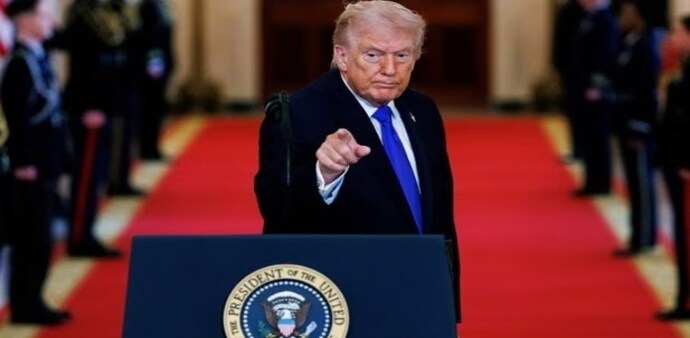
Trump described the offensive as a sustained but limited campaign designed to degrade Iran’s military capabilities. “I once again urge the Revolutionary Guard, the Iranian military police, to lay down your arms and receive full immunity or face certain death,” he said.
- Mar 2, 2026,
- Updated Mar 2, 2026 2:17 PM IST
US President Donald Trump said the military campaign against Iran could last up to four weeks after the killing of Iran’s Supreme Leader Ali Khamenei in joint strikes carried out by the United States and Israel, marking one of the most dramatic escalations in Middle East tensions in decades.
Follow live coverage on US-Israel-Iran war here
In a phone conversation with Jonathan Karl of ABC News, Trump claimed responsibility for the killing, framing it as a pre-emptive move.
“I got him before he got me. They tried twice. Well I got him first,” Trump said, referring to what US intelligence believes was an alleged Iranian plot to assassinate him in 2024.
Iranian state media confirmed early Sunday that Khamenei, who led the Islamic Republic for more than three decades, was killed in the large-scale operation conducted by U.S. and Israeli forces.
Operation Epic Fury expands
Trump said the campaign, dubbed Operation Epic Fury, would continue at “full intensity” for several weeks.
According to the US president, American and allied forces struck hundreds of Iranian military targets within 36 hours, including facilities linked to the Islamic Revolutionary Guard Corps, air-defence systems, naval assets and other strategic infrastructure.
Trump described the offensive as a sustained but limited campaign designed to degrade Iran’s military capabilities.
“I once again urge the Revolutionary Guard, the Iranian military police, to lay down your arms and receive full immunity or face certain death,” he said.
Although diplomatic channels with Tehran technically remain open, Trump signaled skepticism about immediate negotiations.
Regional escalation
The fallout from Khamenei’s death quickly spread across the region. The Israeli military said it launched extensive strikes on positions of Hezbollah across Lebanon after the Iran-backed group fired missiles and drones at Israel in retaliation.
Israeli airstrikes on Beirut’s Hezbollah-controlled southern suburbs and parts of southern Lebanon killed at least 31 people and injured 149, according to Lebanon’s health ministry. The Israeli military also urged residents in nearly 50 villages in southern Lebanon to evacuate.
Gulf on high alert
Security tensions have also risen sharply across Gulf states. Explosions were reported across several regional cities, including Dubai, Abu Dhabi, Doha and Manama, as well as in Jerusalem.
Smoke was seen rising from the US embassy compound in Kuwait City, which warned of a continuing threat of attacks in the country.
A defining moment for Iran
Khamenei, who became Iran’s supreme leader in 1989, consolidated clerical power over the decades while steering Iran through confrontations with Israel and the United States, particularly over its nuclear program.
His leadership also saw repeated crackdowns on domestic protests demanding greater political freedoms. His death now leaves Iran facing one of the most consequential leadership transitions in the history of the Islamic Republic — while the region edges closer to a wider conflict.
US President Donald Trump said the military campaign against Iran could last up to four weeks after the killing of Iran’s Supreme Leader Ali Khamenei in joint strikes carried out by the United States and Israel, marking one of the most dramatic escalations in Middle East tensions in decades.
Follow live coverage on US-Israel-Iran war here
In a phone conversation with Jonathan Karl of ABC News, Trump claimed responsibility for the killing, framing it as a pre-emptive move.
“I got him before he got me. They tried twice. Well I got him first,” Trump said, referring to what US intelligence believes was an alleged Iranian plot to assassinate him in 2024.
Iranian state media confirmed early Sunday that Khamenei, who led the Islamic Republic for more than three decades, was killed in the large-scale operation conducted by U.S. and Israeli forces.
Operation Epic Fury expands
Trump said the campaign, dubbed Operation Epic Fury, would continue at “full intensity” for several weeks.
According to the US president, American and allied forces struck hundreds of Iranian military targets within 36 hours, including facilities linked to the Islamic Revolutionary Guard Corps, air-defence systems, naval assets and other strategic infrastructure.
Trump described the offensive as a sustained but limited campaign designed to degrade Iran’s military capabilities.
“I once again urge the Revolutionary Guard, the Iranian military police, to lay down your arms and receive full immunity or face certain death,” he said.
Although diplomatic channels with Tehran technically remain open, Trump signaled skepticism about immediate negotiations.
Regional escalation
The fallout from Khamenei’s death quickly spread across the region. The Israeli military said it launched extensive strikes on positions of Hezbollah across Lebanon after the Iran-backed group fired missiles and drones at Israel in retaliation.
Israeli airstrikes on Beirut’s Hezbollah-controlled southern suburbs and parts of southern Lebanon killed at least 31 people and injured 149, according to Lebanon’s health ministry. The Israeli military also urged residents in nearly 50 villages in southern Lebanon to evacuate.
Gulf on high alert
Security tensions have also risen sharply across Gulf states. Explosions were reported across several regional cities, including Dubai, Abu Dhabi, Doha and Manama, as well as in Jerusalem.
Smoke was seen rising from the US embassy compound in Kuwait City, which warned of a continuing threat of attacks in the country.
A defining moment for Iran
Khamenei, who became Iran’s supreme leader in 1989, consolidated clerical power over the decades while steering Iran through confrontations with Israel and the United States, particularly over its nuclear program.
His leadership also saw repeated crackdowns on domestic protests demanding greater political freedoms. His death now leaves Iran facing one of the most consequential leadership transitions in the history of the Islamic Republic — while the region edges closer to a wider conflict.