
'America first is not America alone': US State Deputy Secretary Christopher Landau in India
"The purpose of United States foreign policy is to advance our national interests," Landau said. "We are not a charity organisation. We are not the United Nations": U.S. Under Secretary of State Christopher Landau
- Mar 5, 2026,
- Updated Mar 5, 2026 3:44 PM IST
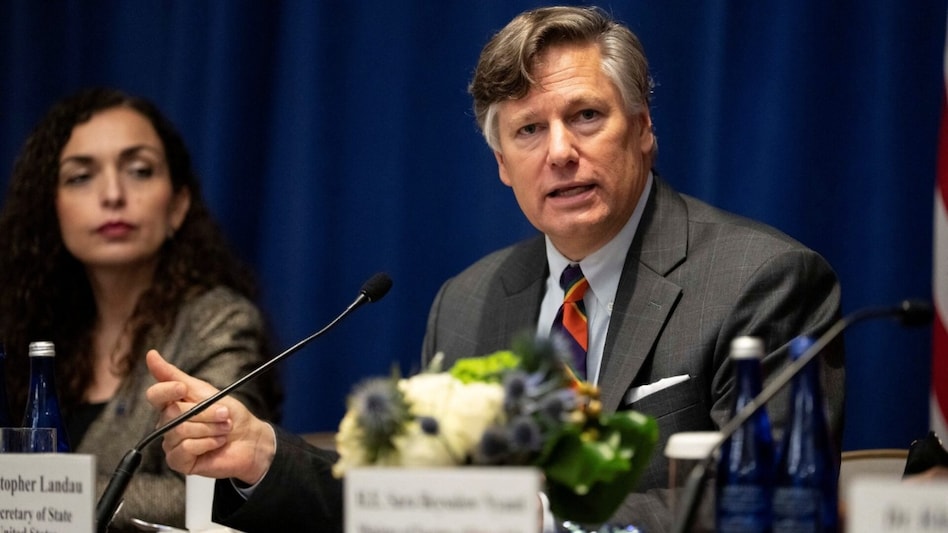
A blunt message on the future of U.S. foreign policy, and Washington’s expectations from partners like India, came from U.S. Under Secretary of State Christopher Landau at the Raisina Dialogue 2026 in New Delhi.
US-Israel-Iran War Live: Abu Dhabi Airports resumes limited flight ops
Speaking in a keynote address, Landau said the Trump administration is fundamentally rethinking decades of American diplomacy. The guiding principle, he said, is simple… foreign policy must advance U.S. national interests.
Also read: US-Israel-Iran conflict: Morgan Stanley lists 7 key risks and market signals investors should watch
“The purpose of United States foreign policy is to advance our national interests,” Landau said. “We are not a charity organisation. We are not the United Nations.”
The remarks reflect the Trump administration’s “America First” doctrine, which Landau described as a corrective to what he called decades of drift after the Cold War. For nearly 50 years during the Cold War, U.S. foreign policy was targeted at containing the Soviet Union. But after its collapse, the American diplomat argues, Washington never clearly defined its strategic purpose.
Under the new approach, Landau said diplomacy must produce tangible results for citizens rather than “dialogues and summits where everyone congratulates each other.”
Within that framework, India has emerged as a critical partner. Landau described India as one with “almost limitless potential” whose rise will shape the 21st century. He said Washington sees vast opportunities for cooperation in trade, energy, advanced technology and artificial intelligence, with a bilateral trade agreement nearing completion.
Security and geopolitical issues also dominated the discussion, particularly the escalating tensions involving Iran and instability in the Gulf. Landau issued one of the strongest warnings of the event, saying a nuclear-armed Iran would pose an unacceptable global threat.
“Could you imagine what a threat it would be if Iran could blackmail the world with a nuclear device?” he asked.
The United States, he said, has made clear that preventing Iran from developing nuclear weapons is a “red line”.
The instability in the Gulf is also deeply relevant for India, given its energy dependence and the millions of Indians living in the region. Landau suggested the United States could become a more reliable energy partner for India, especially as geopolitical tensions threaten traditional supply routes.
At a broader level, Landau argued that the global centre of gravity is shifting from Europe to the Indo-Pacific and the Indian Ocean region. That shift, he said, explains why Washington increasingly views India not as a peripheral partner but as a central pillar of the emerging global order.
A blunt message on the future of U.S. foreign policy, and Washington’s expectations from partners like India, came from U.S. Under Secretary of State Christopher Landau at the Raisina Dialogue 2026 in New Delhi.
US-Israel-Iran War Live: Abu Dhabi Airports resumes limited flight ops
Speaking in a keynote address, Landau said the Trump administration is fundamentally rethinking decades of American diplomacy. The guiding principle, he said, is simple… foreign policy must advance U.S. national interests.
Also read: US-Israel-Iran conflict: Morgan Stanley lists 7 key risks and market signals investors should watch
“The purpose of United States foreign policy is to advance our national interests,” Landau said. “We are not a charity organisation. We are not the United Nations.”
The remarks reflect the Trump administration’s “America First” doctrine, which Landau described as a corrective to what he called decades of drift after the Cold War. For nearly 50 years during the Cold War, U.S. foreign policy was targeted at containing the Soviet Union. But after its collapse, the American diplomat argues, Washington never clearly defined its strategic purpose.
Under the new approach, Landau said diplomacy must produce tangible results for citizens rather than “dialogues and summits where everyone congratulates each other.”
Within that framework, India has emerged as a critical partner. Landau described India as one with “almost limitless potential” whose rise will shape the 21st century. He said Washington sees vast opportunities for cooperation in trade, energy, advanced technology and artificial intelligence, with a bilateral trade agreement nearing completion.
Security and geopolitical issues also dominated the discussion, particularly the escalating tensions involving Iran and instability in the Gulf. Landau issued one of the strongest warnings of the event, saying a nuclear-armed Iran would pose an unacceptable global threat.
“Could you imagine what a threat it would be if Iran could blackmail the world with a nuclear device?” he asked.
The United States, he said, has made clear that preventing Iran from developing nuclear weapons is a “red line”.
The instability in the Gulf is also deeply relevant for India, given its energy dependence and the millions of Indians living in the region. Landau suggested the United States could become a more reliable energy partner for India, especially as geopolitical tensions threaten traditional supply routes.
At a broader level, Landau argued that the global centre of gravity is shifting from Europe to the Indo-Pacific and the Indian Ocean region. That shift, he said, explains why Washington increasingly views India not as a peripheral partner but as a central pillar of the emerging global order.