
‘Must urgently reimagine our partnerships’: EU opens doors to Canada to become first ‘associate member’
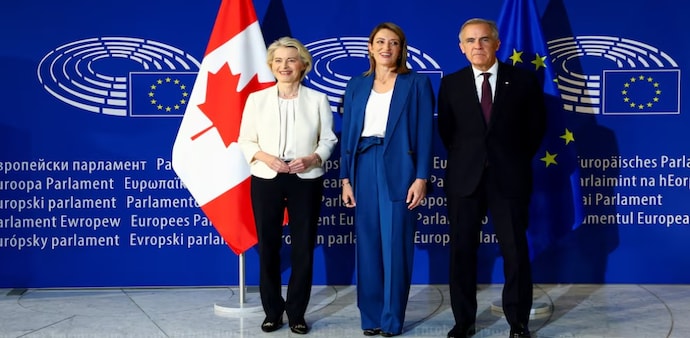
Carney, who has advocated for a "unique alliance" with the EU to reduce Canada’s dependence on US trade, received a standing ovation from European lawmakers and is scheduled to address the European Parliament.
- Sep 16, 2026,
- Updated Sep 16, 2026 4:03 PM IST
Will Canada now become part of the European Union? European Commission President Ursula von der Leyen has expressed her intention to open the door for Canada to become the European Union's first associate member, a status not currently defined in the EU's treaties. She made the announcement during her annual State of the European Union address in Strasbourg while speaking to Canadian Prime Minister Mark Carney.
The proposal aims to deepen economic and security ties between the EU and Canada amid rising US tariffs and repeated suggestions by US President Donald Trump about making Canada the 51st state. Von der Leyen said the EU and Canada would build on their existing free trade agreement, Ceta, by forming a broader alliance covering trade, technology, defence, the Arctic, energy, and economic security.
"I would like to work with you on opening the door for Canada being the first associate member of the EU," von der Leyen told Carney. In the same address, she said: "Partnerships are a strategic choice for Europe. But they also respond to the fracture in the international rules-based system." She added: "I said we must urgently reimagine our partnerships. So, I would like to work with you on opening the door for Canada to be the first associate member of the EU."
Carney, who has advocated for a "unique alliance" with the EU to reduce Canada’s dependence on US trade, received a standing ovation from European lawmakers and is scheduled to address the European Parliament.
She highlighted shared democratic values as the foundation for closer ties, noting that Europe and Canada see the world similarly on issues such as AI, climate change, geopolitics, and defence. Von der Leyen said the partnership would create "a common prosperity and economic security space" and described it as an "alliance for the future".
The expanded partnership would include cooperation in advanced manufacturing, technology, defence production, the Arctic, energy, critical minerals, batteries, AI, quantum computing, cybersecurity, and economic security. Von der Leyen spoke of making the Arctic a flagship joint project and integrating defence industrial bases.
Earlier, Carney clarified that Canada seeks a unique alliance with the EU but not full membership. His visit to Europe follows a breakdown in Canada-US relations after the collapse of trade talks last month, which led to a series of retaliatory tariffs.
Von der Leyen concluded by stating that the partnership is not aimed against any other country but is intended to strengthen common ties. The proposal positions Canada at the centre of the EU’s efforts to deepen strategic partnerships amid global uncertainties.
(With Reuters inputs)
Will Canada now become part of the European Union? European Commission President Ursula von der Leyen has expressed her intention to open the door for Canada to become the European Union's first associate member, a status not currently defined in the EU's treaties. She made the announcement during her annual State of the European Union address in Strasbourg while speaking to Canadian Prime Minister Mark Carney.
The proposal aims to deepen economic and security ties between the EU and Canada amid rising US tariffs and repeated suggestions by US President Donald Trump about making Canada the 51st state. Von der Leyen said the EU and Canada would build on their existing free trade agreement, Ceta, by forming a broader alliance covering trade, technology, defence, the Arctic, energy, and economic security.
"I would like to work with you on opening the door for Canada being the first associate member of the EU," von der Leyen told Carney. In the same address, she said: "Partnerships are a strategic choice for Europe. But they also respond to the fracture in the international rules-based system." She added: "I said we must urgently reimagine our partnerships. So, I would like to work with you on opening the door for Canada to be the first associate member of the EU."
Carney, who has advocated for a "unique alliance" with the EU to reduce Canada’s dependence on US trade, received a standing ovation from European lawmakers and is scheduled to address the European Parliament.
She highlighted shared democratic values as the foundation for closer ties, noting that Europe and Canada see the world similarly on issues such as AI, climate change, geopolitics, and defence. Von der Leyen said the partnership would create "a common prosperity and economic security space" and described it as an "alliance for the future".
The expanded partnership would include cooperation in advanced manufacturing, technology, defence production, the Arctic, energy, critical minerals, batteries, AI, quantum computing, cybersecurity, and economic security. Von der Leyen spoke of making the Arctic a flagship joint project and integrating defence industrial bases.
Earlier, Carney clarified that Canada seeks a unique alliance with the EU but not full membership. His visit to Europe follows a breakdown in Canada-US relations after the collapse of trade talks last month, which led to a series of retaliatory tariffs.
Von der Leyen concluded by stating that the partnership is not aimed against any other country but is intended to strengthen common ties. The proposal positions Canada at the centre of the EU’s efforts to deepen strategic partnerships amid global uncertainties.
(With Reuters inputs)