
Putin pitches 'pragmatic dialogue' as over 130 countries confirm participation at SPIEF 2026
The Roscongress Foundation and the American Chamber of Commerce in Russia (AmCham Russia) will also organise a Russia-US Business Dialogue focused on exploring possible business cooperation and commercial engagement despite continuing geopolitical tensions
- May 31, 2026,
- Updated May 31, 2026 11:08 AM IST
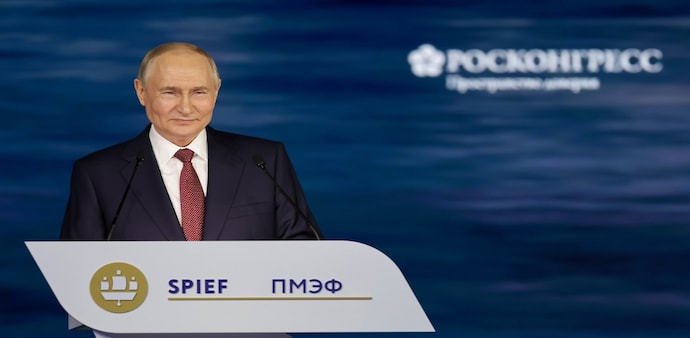
Russian President Vladimir Putin has positioned the St Petersburg International Economic Forum (SPIEF) 2026 as a platform for “pragmatic dialogue” amid what Moscow described as growing fragmentation in global politics and trade.
In a message published ahead of the forum, Putin said the global economy was facing “unprecedented challenges”, including disruptions in supply chains and technological cooperation, while emphasising that Russia remained open to international economic engagement.
“At a time when international relations and economic ties are plagued by unprecedented challenges, fragmentation, and disruption of supply and technological chains, pragmatism and a dialogue based on equality are particularly relevant and needed,” Putin said in his address to participants of SPIEF 2026.
Don't Miss: Amid tensions, Russia and US to sit at the same table again. This time in St Petersburg
The forum, scheduled to be held in St Petersburg under the theme “Pragmatic Dialogue: The Path to a Stable Future,” is expected to become a major platform for discussions around economic sovereignty, BRICS cooperation, alternative financial systems, technology, energy, and shifting global trade alignments.
Putin said Russia continued to view itself as “an integral part of the global economy” and remained open to “constructive cooperation” with countries willing to build “fair and long-term relations”.
He also highlighted Russia’s continued engagement with multilateral institutions, including BRICS, the Shanghai Cooperation Organisation (SCO), the Eurasian Economic Union (EAEU), and the Commonwealth of Independent States (CIS).
Separately, organisers said representatives from more than 130 countries and territories have already confirmed participation at SPIEF 2026, including governments, businesses, academics, and media organisations.
In a notable development, US President Donald Trump has appointed Rodney Mims Cook Jr., Chairman of the US Commission of Fine Arts, as his representative to SPIEF 2026. Cook is expected to participate in a Russia-US cultural dialogue session during the forum.
The Roscongress Foundation and the American Chamber of Commerce in Russia (AmCham Russia) will also organise a Russia-US Business Dialogue focused on exploring possible business cooperation and commercial engagement despite continuing geopolitical tensions.
“The broad international representation at SPIEF 2026 confirms that the Forum retains its significance as a key global space for building partnerships,” said Anton Kobyakov, Adviser to the President of the Russian Federation and Executive Secretary of the SPIEF Organising Committee.
Often described as Russia’s answer to Davos, SPIEF has increasingly become Moscow’s showcase platform for projecting economic resilience, strengthening ties with the Global South, and advancing discussions around a multipolar world order.
Russian President Vladimir Putin has positioned the St Petersburg International Economic Forum (SPIEF) 2026 as a platform for “pragmatic dialogue” amid what Moscow described as growing fragmentation in global politics and trade.
In a message published ahead of the forum, Putin said the global economy was facing “unprecedented challenges”, including disruptions in supply chains and technological cooperation, while emphasising that Russia remained open to international economic engagement.
“At a time when international relations and economic ties are plagued by unprecedented challenges, fragmentation, and disruption of supply and technological chains, pragmatism and a dialogue based on equality are particularly relevant and needed,” Putin said in his address to participants of SPIEF 2026.
Don't Miss: Amid tensions, Russia and US to sit at the same table again. This time in St Petersburg
The forum, scheduled to be held in St Petersburg under the theme “Pragmatic Dialogue: The Path to a Stable Future,” is expected to become a major platform for discussions around economic sovereignty, BRICS cooperation, alternative financial systems, technology, energy, and shifting global trade alignments.
Putin said Russia continued to view itself as “an integral part of the global economy” and remained open to “constructive cooperation” with countries willing to build “fair and long-term relations”.
He also highlighted Russia’s continued engagement with multilateral institutions, including BRICS, the Shanghai Cooperation Organisation (SCO), the Eurasian Economic Union (EAEU), and the Commonwealth of Independent States (CIS).
Separately, organisers said representatives from more than 130 countries and territories have already confirmed participation at SPIEF 2026, including governments, businesses, academics, and media organisations.
In a notable development, US President Donald Trump has appointed Rodney Mims Cook Jr., Chairman of the US Commission of Fine Arts, as his representative to SPIEF 2026. Cook is expected to participate in a Russia-US cultural dialogue session during the forum.
The Roscongress Foundation and the American Chamber of Commerce in Russia (AmCham Russia) will also organise a Russia-US Business Dialogue focused on exploring possible business cooperation and commercial engagement despite continuing geopolitical tensions.
“The broad international representation at SPIEF 2026 confirms that the Forum retains its significance as a key global space for building partnerships,” said Anton Kobyakov, Adviser to the President of the Russian Federation and Executive Secretary of the SPIEF Organising Committee.
Often described as Russia’s answer to Davos, SPIEF has increasingly become Moscow’s showcase platform for projecting economic resilience, strengthening ties with the Global South, and advancing discussions around a multipolar world order.