
From MGR to Vijay: Why Tamil Nadu keeps turning film superstars into political giants
For more than five decades, the state’s voters have repeatedly transformed movie icons into political heavyweights — and in several cases, chief ministers. The relationship between Tamil cinema and politics did not begin with actors. It began with writers.
- May 4, 2026,
- Updated May 5, 2026 10:39 AM IST
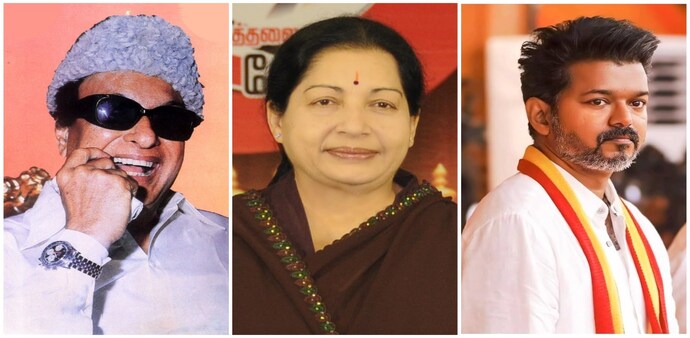
Tamil Nadu Election Results 2026: In most Indian states, cinema and politics occasionally overlap. In Tamil Nadu, they have practically evolved together. For more than five decades, the state’s voters have repeatedly transformed movie icons into political heavyweights — and in several cases, chief ministers.
Now, with actor Vijay’s Tamilaga Vettri Kazhagam (TVK) emerging as a major force in the 2026 Tamil Nadu Assembly elections, the state appears ready to extend that legacy once again.
Don't miss | From mass hero to political Thalapathy: How Vijay broke Tamil Nadu’s old order
Tamil Nadu’s political culture is perhaps the clearest example in India of how cinema can become a pathway to mass political legitimacy. The state has not merely accepted film stars in politics — it has often richly rewarded them with extraordinary electoral success, emotional loyalty and cult-like public support.
Catch live coverage of Assembly Election Results 2026 here
Dravidian movement built the cinema-politics bridge
The relationship between Tamil cinema and politics did not begin with actors. It began with writers.
Dravidian stalwarts such as C N Annadurai and M Karunanidhi used films as ideological vehicles. Screenplays and dialogues became tools for spreading social justice, rationalism and Tamil identity politics across the state.
Long before social media or television saturation, cinema halls became political classrooms. Film dialogues doubled as political messaging, and actors became carriers of ideological narratives.
Don't miss | Tamil Nadu Election Results 2026: Polymarket sees massive ₹209 crore bet on Vijay's TVK
This laid the foundation for Tamil Nadu’s most successful actor-politician experiment: M G Ramachandran, better known as MGR.
MGR: The man who changed Indian politics forever
MGR was not just a superstar — he became a political phenomenon. On screen, he consistently portrayed the protector of the poor, the honest hero and the saviour of ordinary people. Off-screen, he translated that image into welfare politics and grassroots mobilisation.
After splitting from the DMK in 1972, MGR founded the AIADMK and went on to become the first actor in India to serve as chief minister of a state. He ruled Tamil Nadu from 1977 until his death in 1987.
What made MGR unique was that his fan clubs evolved into political cadres. His cinematic image and political brand merged seamlessly. Tamil Nadu voters were not merely electing an actor — they were voting for the heroic persona they had emotionally invested in for years. That template still shapes Tamil Nadu politics today.
Don't miss | Tamil Nadu Election Results: Full list of winners from DMK, TVK, AIADMK, BJP
Jayalalithaa proved the formula could work again
If MGR built the model, J Jayalalithaa perfected it.
A hugely successful actress and MGR’s most famous co-star, Jayalalithaa inherited both political capital and cinematic familiarity. After a bitter succession struggle following MGR’s death, she emerged as the undisputed leader of the AIADMK.
She would go on to become one of India’s most powerful regional leaders, serving multiple terms as chief minister and cultivating an intensely loyal support base that addressed her simply as “Amma”.
Jayalalithaa’s rise demonstrated something crucial: in Tamil Nadu, cinematic recall could survive beyond the screen and evolve into enduring political trust.
Not every superstar succeeded
Tamil Nadu’s film-politics pipeline has also produced mixed results.
Sivaji Ganesan, despite being one of Tamil cinema’s greatest actors, struggled to achieve comparable political success.
Vijayakanth came closest to breaking the DMK-AIADMK duopoly. His party, DMDK, emerged as a significant opposition force in the late 2000s and even became the principal opposition in 2011.
Kamal Haasan entered politics in 2018 with Makkal Needhi Maiam, presenting himself as a governance-focused alternative. While he built urban appeal, he struggled to replicate the mass electoral dominance of MGR or Jayalalithaa.
Meanwhile, Rajinikanth flirted with politics for years before ultimately stepping back, citing health concerns.
The lesson from Tamil Nadu is that stardom alone is not enough. Successful transitions require organisation, emotional connect, welfare politics and a carefully cultivated public image.
Why Tamil Nadu voters embrace film stars
Several factors explain why Tamil Nadu remains uniquely receptive to actor-politicians.
- First, cinema in the state has historically carried political messaging. Tamil audiences are accustomed to seeing films as social commentary rather than mere entertainment.
- Second, fan clubs in Tamil cinema are extraordinarily organised. These networks often function like pre-built political ground machinery.
- Third, many Tamil film heroes consciously cultivate pro-poor, anti-corruption and justice-oriented screen identities. Over time, audiences blur the line between character and celebrity.
Finally, Tamil Nadu’s politics thrives on charisma and personality-driven mobilisation. Film stars enter politics with enormous name recognition and emotional recall that traditional politicians spend decades trying to build.
Vijay may be the latest beneficiary
That brings the story to Vijay. The actor’s political rise has revived memories of MGR’s emergence in the 1970s. His massive fan following, carefully curated public messaging and anti-establishment appeal have already disrupted Tamil Nadu’s traditional political equations.
Some observers argue that Tamil Nadu’s voters continue to romanticise cinematic heroism in politics, while supporters counter that film stars often communicate more effectively with the masses than conventional politicians.
But history suggests one thing clearly: Tamil Nadu does not see cinema and politics as separate worlds.
Tamil Nadu Election Results 2026: In most Indian states, cinema and politics occasionally overlap. In Tamil Nadu, they have practically evolved together. For more than five decades, the state’s voters have repeatedly transformed movie icons into political heavyweights — and in several cases, chief ministers.
Now, with actor Vijay’s Tamilaga Vettri Kazhagam (TVK) emerging as a major force in the 2026 Tamil Nadu Assembly elections, the state appears ready to extend that legacy once again.
Don't miss | From mass hero to political Thalapathy: How Vijay broke Tamil Nadu’s old order
Tamil Nadu’s political culture is perhaps the clearest example in India of how cinema can become a pathway to mass political legitimacy. The state has not merely accepted film stars in politics — it has often richly rewarded them with extraordinary electoral success, emotional loyalty and cult-like public support.
Catch live coverage of Assembly Election Results 2026 here
Dravidian movement built the cinema-politics bridge
The relationship between Tamil cinema and politics did not begin with actors. It began with writers.
Dravidian stalwarts such as C N Annadurai and M Karunanidhi used films as ideological vehicles. Screenplays and dialogues became tools for spreading social justice, rationalism and Tamil identity politics across the state.
Long before social media or television saturation, cinema halls became political classrooms. Film dialogues doubled as political messaging, and actors became carriers of ideological narratives.
Don't miss | Tamil Nadu Election Results 2026: Polymarket sees massive ₹209 crore bet on Vijay's TVK
This laid the foundation for Tamil Nadu’s most successful actor-politician experiment: M G Ramachandran, better known as MGR.
MGR: The man who changed Indian politics forever
MGR was not just a superstar — he became a political phenomenon. On screen, he consistently portrayed the protector of the poor, the honest hero and the saviour of ordinary people. Off-screen, he translated that image into welfare politics and grassroots mobilisation.
After splitting from the DMK in 1972, MGR founded the AIADMK and went on to become the first actor in India to serve as chief minister of a state. He ruled Tamil Nadu from 1977 until his death in 1987.
What made MGR unique was that his fan clubs evolved into political cadres. His cinematic image and political brand merged seamlessly. Tamil Nadu voters were not merely electing an actor — they were voting for the heroic persona they had emotionally invested in for years. That template still shapes Tamil Nadu politics today.
Don't miss | Tamil Nadu Election Results: Full list of winners from DMK, TVK, AIADMK, BJP
Jayalalithaa proved the formula could work again
If MGR built the model, J Jayalalithaa perfected it.
A hugely successful actress and MGR’s most famous co-star, Jayalalithaa inherited both political capital and cinematic familiarity. After a bitter succession struggle following MGR’s death, she emerged as the undisputed leader of the AIADMK.
She would go on to become one of India’s most powerful regional leaders, serving multiple terms as chief minister and cultivating an intensely loyal support base that addressed her simply as “Amma”.
Jayalalithaa’s rise demonstrated something crucial: in Tamil Nadu, cinematic recall could survive beyond the screen and evolve into enduring political trust.
Not every superstar succeeded
Tamil Nadu’s film-politics pipeline has also produced mixed results.
Sivaji Ganesan, despite being one of Tamil cinema’s greatest actors, struggled to achieve comparable political success.
Vijayakanth came closest to breaking the DMK-AIADMK duopoly. His party, DMDK, emerged as a significant opposition force in the late 2000s and even became the principal opposition in 2011.
Kamal Haasan entered politics in 2018 with Makkal Needhi Maiam, presenting himself as a governance-focused alternative. While he built urban appeal, he struggled to replicate the mass electoral dominance of MGR or Jayalalithaa.
Meanwhile, Rajinikanth flirted with politics for years before ultimately stepping back, citing health concerns.
The lesson from Tamil Nadu is that stardom alone is not enough. Successful transitions require organisation, emotional connect, welfare politics and a carefully cultivated public image.
Why Tamil Nadu voters embrace film stars
Several factors explain why Tamil Nadu remains uniquely receptive to actor-politicians.
- First, cinema in the state has historically carried political messaging. Tamil audiences are accustomed to seeing films as social commentary rather than mere entertainment.
- Second, fan clubs in Tamil cinema are extraordinarily organised. These networks often function like pre-built political ground machinery.
- Third, many Tamil film heroes consciously cultivate pro-poor, anti-corruption and justice-oriented screen identities. Over time, audiences blur the line between character and celebrity.
Finally, Tamil Nadu’s politics thrives on charisma and personality-driven mobilisation. Film stars enter politics with enormous name recognition and emotional recall that traditional politicians spend decades trying to build.
Vijay may be the latest beneficiary
That brings the story to Vijay. The actor’s political rise has revived memories of MGR’s emergence in the 1970s. His massive fan following, carefully curated public messaging and anti-establishment appeal have already disrupted Tamil Nadu’s traditional political equations.
Some observers argue that Tamil Nadu’s voters continue to romanticise cinematic heroism in politics, while supporters counter that film stars often communicate more effectively with the masses than conventional politicians.
But history suggests one thing clearly: Tamil Nadu does not see cinema and politics as separate worlds.