
'Era of charismatic leaders is over': Tamil Nadu moving toward Kerala-style politics, says R Kannan
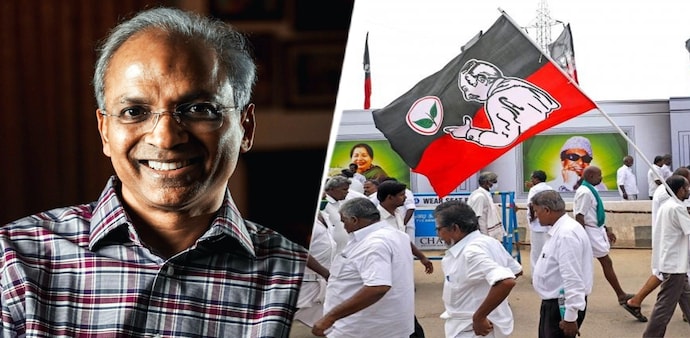
The era of charismatic leaders such as MGR, Karunanidhi, Jayalalitha, Kamaraj, Anna, and Rajaji is over, says R Kannan, author of DMK Years
- Mar 15, 2026,
- Updated Mar 15, 2026 4:37 PM IST
Tamil Nadu's politics has long been dominated by the rivalry between the Dravida Munnetra Kazhagam (DMK) and the All India Anna Dravida Munnetra Kazhagam (AIADMK), but the upcoming assembly election in April could test that duopoly. Actor Vijay's Tamilaga Vettri Kazhagam (TVK) has entered the fray, raising the possibility of a three-way contest.
Also read: 'He threw away a great opportunity': Why Vijay should have followed the Pawan Kalyan model
In this exclusive interview with Business Today, R Kannan, author of DMK Years and a former UN political official, talks about the evolution of the DMK, the leadership style of M K Stalin, and whether new political forces can break the state's long-standing two-party dominance.
Also read: Vijay to enter NDA? BJP offers Deputy CM post, 80 seats to TVK: Sources
Edited Excepts
Your book examines the evolution of DMK over the decades. How has the party's ideological identity changed since the 1990s?
It's become more pragmatic and hands-on. It deals with day-to-day issues. It isn't constrained by an ideological framework beyond a point. For instance, DMK initially opposed the economic reforms, the opening up of the economy, and the entry of multinationals, etc. That stance changed, and then it welcomed it. And then Kalaignar Karunanidhi even justified it, saying that China was opening, Russia was opening, the world has changed, and we have to change. So if economics was an important area where you can test a party's ideology, the DMK, which I consider was originally probably a left-of-centre party, in power moderated its stand and then even became a centrist party. And if you talk to the leftists, they might even say that it is aligned more with the investors and the industrialists than with the workers. So that's a fundamental change.
And then on its other ideological framework on language, it hasn't been able to do much except to occasionally raise its voice against what it terms as Hindi imposition. If you go to the Madurai airport, you will see members of the Industrial Security Police Force greeting and talking to you in Hindi. So, the citadel, the womb of Tamil civilisation, has been breached. They were in power in the centre for more than 17 years, and they did very little about it. Because honestly, very little can be done about it. Being one of the 30 different states and being a regional party, there's only so much that you can do.
So, they've been very pragmatic on the economic front. They've been investor-friendly on language and state rights. They have been vocal at times, but not really that keen on really making a fundamental change for fear of upsetting electoral alliances, calculations and successes.
On the religious front, a few years ago, Mr Stalin claimed that 90% of the DMK folk are Hindus. Now, imagine 50 years ago. Would there have been a need for any such proclamation? I don't think so. So the Hindu right is slowly making its presence felt in Tamil Nadu. Even the DMK, which is supposedly agnostic, is now showcasing ministers who openly profess their faith.
So there have been many changes, and every party moderates itself in power. The DMK has gone through that as well.
How do you rate Stalin's performance as chief minister, and in which direction is DMK headed under him? Have you noticed any noticeable changes under Stalin compared to Karunanidhi's time?
The comparison is relatively unfair to both. Stalin had always said he was not his father, and I don't think we should compare him to his father. His father didn't have certain advantages. He had to fight real titans like MGR and Jayalalitha, and to some extent, Indira Gandhi. Now, if you look at Stalin, he has the advantage of a disunited and dispirited opposition. So the good thing about Stalin is that he has welded a formidable alliance, which is mostly intact, and has kept him with him. His welfare schemes are very popular, like the free bus rides, the monthly honorarium for women, the breakfast scheme in schools, and other welfare-oriented schemes. But then there is a lot of corruption. It has reached new levels. And I'm not so sure that this redistributive justice, the redistribution of wealth, is done in an equanimous or equitable manner.
But is this welfarism even sustainable for the long term?
Only time can tell. I don't think it is sustainable.
Tamil Nadu has been essentially a DMK vs AIADMK contest for decades. How easy or difficult would it be for someone like Vijay to carve out a space in this system? Do you see any prospects for the TVK?
If Vijay had followed the Pawan Kalyan model, he would have had a good chance of becoming an alternative to one of these two parties in the next general election. But now, I think the third alternative that Vijay showcases will be snuffed out after these elections.
What do you mean when you say the Pawan Kalyan model?
For him to have aligned with the AIADMK. AIDMK to be the senior partner, and for him to be a junior partner and to wait his turn five years down the road to flex his muscles against both the regional parties. In those five years, he would have learned his party and his colleagues more deeply; he himself would have learned administration, would have been exposed to governance, would have understood the difficulties of governing a state such as Tamil Nadu, and would have educated himself, his colleagues, and his cadres. He threw away that great opportunity.
Post-Jayalalitha, AIADMK has struggled to project a single authoritative leader. Can the party fight a presidential-style campaign without a mass face? Who realistically fills the space created by Jayalalitha?
Look, when Jayalalitha showed up after MGR, MGR thought that after him, the party wouldn't last. This is what the Director General of Police Mohandas records in his book. So MGR is supposed to have said - 'after me, the deluge'. Jayalalitha was unexpected. And even I, in 1987, when Jayalalitha showed up, thought that she wouldn't last. But she stood her ground. I don't think she really wanted to be there. But for different reasons, she had to stay in, stay put, and fight it out - which she did until she fell badly ill and then passed away.
The era of charismatic leaders such as MGR, Karunanidhi, Jayalalitha, Kamaraj, Anna, and Rajaji is over. We may be embarking on a Kerala-style model. My feeling is that traditional ADMK voters will stay with ADMK, quite a few of them. But the ADMK vote bank is being diluted for want of a very charismatic leader. Compared with the other leaders, Stalin has a pedigree. He has a dynastic halo around his head. He's also been in public life for a very long time and seems adept at this game. He has a bit of an advantage compared with the rest of the leadership, especially the ADMK leadership.
The BJP has increased its vote share and visibility in this state. But does it have a realistic path to power in Tamil Nadu, or is it still far away from power?
They're very far away. I would consider them probably a 5% party. They may not have the 10-11% they polled earlier. They may be on par with the Congress party, except the BJP is more vocal and, because it happens to be in power at the centre, people talk about it. It's been flexing its muscles much more robustly than Congress. We'll only know the true strength of these parties if they all contest without any allies and then contest an equal number of seats. That never happens. So these are guesses that we make. You and I are drawn to these guesses because, unless all the parties contest on their own strength and contest all 234 seats, or an equal number of seats, it's very difficult to really fathom what their strength is. I think the BJP's touted 10% extra strength is a bit exaggerated.
How do you see DMDK's partnership with DMK? Does it materially alter the arithmetic in the coming elections?
Every percentage counts. Maybe the DMDK has a percentage, or half a percentage, of the votes. Those would accrue to the DMK alliance. It's always nice to have a few other leaders on the dias along with you as alliance leaders. Premalatha, having been Vijaykanth's wife, may have some traction among ardent Vijaykanth fans. I would think it may bring in another half a percent or one percent.
You write in the book that under delimitation Tamil Nadu may gain just 10 seats while Uttar Pradesh could rise from 80 to 143. You also argue that representation must be balanced without penalising states that have controlled population growth. What would your advice be to the central government on this issue?
These southern states, especially Kerala and Tamil Nadu, are being punished for their successes in family planning. So it's unfair that they should be punished this way, that their seats and their representation of power should go down. But at the same time, you need to reckon with the growth, spurt, and population figures in places like Bihar, which appear to be underrepresented.
You need a thorough exercise where you project the population share proportionally, and then increase the strength of the Lower House and the Upper House. Or a model where the Upper House will only have equal representation for all states, like the American model, where a state as small as Rhode Island has two senators. A state as big as California or Texas also has two senators. One of those houses should be like the UN General Assembly, where every small country is equal to every major country. Everyone has one vote. So if the Lower House is based on population figures, the Upper House could be tinkered with to balance the Lower House. There could be many other formulas by constitutional experts. I don't think this is a huge issue. It's a formula that has been in existence in places like the US and in other countries. Humankind has confronted these issues long ago. So there is a resolution for most of these issues.
One economist recently warned that this North-South divide is very serious. And if we don't solve it in time, we will face the fate of what the USSR faced. What is your view on this North-South divide, and what is the solution that you want to offer?
I'm actually divided on this. At one level, I see a larger integration. At another level, I see a big division between the two. The integration is due to the economic miracle occurring in certain parts of the country. Workers from less developed places are moving to these places in search of work, setting up families, etc. Under the 2011 census, there are 35 lakh migrant workers in Tamil Nadu. There could be more. I have a help in my place who is actually an Adivasi from West Bengal. And the only thing that she knows is Hindi. My wife knows a bit of Hindi, so she communicates with her in Hindi. If this help lasts for a long time, she will pick up some Tamil. So at one level, there is integration happening. At another level, the cultural differences pose a problem. We have a government that believes in majoritarianism and is not very sensitive about minority sensitivities. Some 20-30 years ago, when leaders from the North used to visit Tamil Nadu, they would speak in English. Today, people from the North, especially from the BJP, just come and speak in Hindi. They don't care if anybody understands this or not.
This is the United States of India. This is the former Soviet Union. This is a much more complex country. This idea of a language spoken all over the country should develop organically. Nobody is against it. Hindi films have done more to spread Hindi in the South than any government program.
How serious is this North-South divide in an economic sense...
You have a similar situation also in the United States. California and Texas are pretty prosperous and very developed. And there are states like Mississippi, Alabama, and less developed and less prosperous states.
So, economically, to balance these, there must be foresight in economic planning, in redistribution of wealth, and in equitable development, where everybody gets equal opportunities, where everybody can equally grow and take advantage of the opportunities available.
Chief Minister Stalin recently wrote to the Prime Minister, asking for citizenship for nearly 89,000 Sri Lankans staying in Tamil Nadu.
This is a very complex issue. At the moment, India offers citizenship only to minorities who face persecution. That policy has to change. I am not sure that India will do that in the near future. As for dual citizenship, which many states offer, such as Pakistan, I don't know when we will reach that stage. This is a pretty tricky issue. Also, if you offer citizenship to these people here, the number of Tamils in Sri Lanka will go down. The best option is to give them the choice to go back or to stay, and then take a call.
The liquor prohibition has dominated for decades. You write that total prohibition has proved impossible, even in Iran. But there are people in the state who argue that liquor has destroyed families, and fertility has gone down. How can we address this problem?
The state should improve education and tackle corruption. These are the two things. We have launched a very strong campaign against smoking. So, people like to have a drink. The difficulty in places like Tamil Nadu is that people don't understand - it's not about just enjoying a drink; people have become addicted to it. I don't think there's anything wrong with having and enjoying a drink. Most Western societies do this. Asian societies do this. Except in the Islamic world, drinking is not considered really that bad. But drinking for fun, drinking at a party once in a while, and then drinking as a need are hugely different. If you come to Tamil Nadu, the state sells liquor. If you see those stores, you will be surprised and saddened. With all these shortcomings, how the state has managed to come this far is anybody's guess.
Tamil Nadu's politics has long been dominated by the rivalry between the Dravida Munnetra Kazhagam (DMK) and the All India Anna Dravida Munnetra Kazhagam (AIADMK), but the upcoming assembly election in April could test that duopoly. Actor Vijay's Tamilaga Vettri Kazhagam (TVK) has entered the fray, raising the possibility of a three-way contest.
Also read: 'He threw away a great opportunity': Why Vijay should have followed the Pawan Kalyan model
In this exclusive interview with Business Today, R Kannan, author of DMK Years and a former UN political official, talks about the evolution of the DMK, the leadership style of M K Stalin, and whether new political forces can break the state's long-standing two-party dominance.
Also read: Vijay to enter NDA? BJP offers Deputy CM post, 80 seats to TVK: Sources
Edited Excepts
Your book examines the evolution of DMK over the decades. How has the party's ideological identity changed since the 1990s?
It's become more pragmatic and hands-on. It deals with day-to-day issues. It isn't constrained by an ideological framework beyond a point. For instance, DMK initially opposed the economic reforms, the opening up of the economy, and the entry of multinationals, etc. That stance changed, and then it welcomed it. And then Kalaignar Karunanidhi even justified it, saying that China was opening, Russia was opening, the world has changed, and we have to change. So if economics was an important area where you can test a party's ideology, the DMK, which I consider was originally probably a left-of-centre party, in power moderated its stand and then even became a centrist party. And if you talk to the leftists, they might even say that it is aligned more with the investors and the industrialists than with the workers. So that's a fundamental change.
And then on its other ideological framework on language, it hasn't been able to do much except to occasionally raise its voice against what it terms as Hindi imposition. If you go to the Madurai airport, you will see members of the Industrial Security Police Force greeting and talking to you in Hindi. So, the citadel, the womb of Tamil civilisation, has been breached. They were in power in the centre for more than 17 years, and they did very little about it. Because honestly, very little can be done about it. Being one of the 30 different states and being a regional party, there's only so much that you can do.
So, they've been very pragmatic on the economic front. They've been investor-friendly on language and state rights. They have been vocal at times, but not really that keen on really making a fundamental change for fear of upsetting electoral alliances, calculations and successes.
On the religious front, a few years ago, Mr Stalin claimed that 90% of the DMK folk are Hindus. Now, imagine 50 years ago. Would there have been a need for any such proclamation? I don't think so. So the Hindu right is slowly making its presence felt in Tamil Nadu. Even the DMK, which is supposedly agnostic, is now showcasing ministers who openly profess their faith.
So there have been many changes, and every party moderates itself in power. The DMK has gone through that as well.
How do you rate Stalin's performance as chief minister, and in which direction is DMK headed under him? Have you noticed any noticeable changes under Stalin compared to Karunanidhi's time?
The comparison is relatively unfair to both. Stalin had always said he was not his father, and I don't think we should compare him to his father. His father didn't have certain advantages. He had to fight real titans like MGR and Jayalalitha, and to some extent, Indira Gandhi. Now, if you look at Stalin, he has the advantage of a disunited and dispirited opposition. So the good thing about Stalin is that he has welded a formidable alliance, which is mostly intact, and has kept him with him. His welfare schemes are very popular, like the free bus rides, the monthly honorarium for women, the breakfast scheme in schools, and other welfare-oriented schemes. But then there is a lot of corruption. It has reached new levels. And I'm not so sure that this redistributive justice, the redistribution of wealth, is done in an equanimous or equitable manner.
But is this welfarism even sustainable for the long term?
Only time can tell. I don't think it is sustainable.
Tamil Nadu has been essentially a DMK vs AIADMK contest for decades. How easy or difficult would it be for someone like Vijay to carve out a space in this system? Do you see any prospects for the TVK?
If Vijay had followed the Pawan Kalyan model, he would have had a good chance of becoming an alternative to one of these two parties in the next general election. But now, I think the third alternative that Vijay showcases will be snuffed out after these elections.
What do you mean when you say the Pawan Kalyan model?
For him to have aligned with the AIADMK. AIDMK to be the senior partner, and for him to be a junior partner and to wait his turn five years down the road to flex his muscles against both the regional parties. In those five years, he would have learned his party and his colleagues more deeply; he himself would have learned administration, would have been exposed to governance, would have understood the difficulties of governing a state such as Tamil Nadu, and would have educated himself, his colleagues, and his cadres. He threw away that great opportunity.
Post-Jayalalitha, AIADMK has struggled to project a single authoritative leader. Can the party fight a presidential-style campaign without a mass face? Who realistically fills the space created by Jayalalitha?
Look, when Jayalalitha showed up after MGR, MGR thought that after him, the party wouldn't last. This is what the Director General of Police Mohandas records in his book. So MGR is supposed to have said - 'after me, the deluge'. Jayalalitha was unexpected. And even I, in 1987, when Jayalalitha showed up, thought that she wouldn't last. But she stood her ground. I don't think she really wanted to be there. But for different reasons, she had to stay in, stay put, and fight it out - which she did until she fell badly ill and then passed away.
The era of charismatic leaders such as MGR, Karunanidhi, Jayalalitha, Kamaraj, Anna, and Rajaji is over. We may be embarking on a Kerala-style model. My feeling is that traditional ADMK voters will stay with ADMK, quite a few of them. But the ADMK vote bank is being diluted for want of a very charismatic leader. Compared with the other leaders, Stalin has a pedigree. He has a dynastic halo around his head. He's also been in public life for a very long time and seems adept at this game. He has a bit of an advantage compared with the rest of the leadership, especially the ADMK leadership.
The BJP has increased its vote share and visibility in this state. But does it have a realistic path to power in Tamil Nadu, or is it still far away from power?
They're very far away. I would consider them probably a 5% party. They may not have the 10-11% they polled earlier. They may be on par with the Congress party, except the BJP is more vocal and, because it happens to be in power at the centre, people talk about it. It's been flexing its muscles much more robustly than Congress. We'll only know the true strength of these parties if they all contest without any allies and then contest an equal number of seats. That never happens. So these are guesses that we make. You and I are drawn to these guesses because, unless all the parties contest on their own strength and contest all 234 seats, or an equal number of seats, it's very difficult to really fathom what their strength is. I think the BJP's touted 10% extra strength is a bit exaggerated.
How do you see DMDK's partnership with DMK? Does it materially alter the arithmetic in the coming elections?
Every percentage counts. Maybe the DMDK has a percentage, or half a percentage, of the votes. Those would accrue to the DMK alliance. It's always nice to have a few other leaders on the dias along with you as alliance leaders. Premalatha, having been Vijaykanth's wife, may have some traction among ardent Vijaykanth fans. I would think it may bring in another half a percent or one percent.
You write in the book that under delimitation Tamil Nadu may gain just 10 seats while Uttar Pradesh could rise from 80 to 143. You also argue that representation must be balanced without penalising states that have controlled population growth. What would your advice be to the central government on this issue?
These southern states, especially Kerala and Tamil Nadu, are being punished for their successes in family planning. So it's unfair that they should be punished this way, that their seats and their representation of power should go down. But at the same time, you need to reckon with the growth, spurt, and population figures in places like Bihar, which appear to be underrepresented.
You need a thorough exercise where you project the population share proportionally, and then increase the strength of the Lower House and the Upper House. Or a model where the Upper House will only have equal representation for all states, like the American model, where a state as small as Rhode Island has two senators. A state as big as California or Texas also has two senators. One of those houses should be like the UN General Assembly, where every small country is equal to every major country. Everyone has one vote. So if the Lower House is based on population figures, the Upper House could be tinkered with to balance the Lower House. There could be many other formulas by constitutional experts. I don't think this is a huge issue. It's a formula that has been in existence in places like the US and in other countries. Humankind has confronted these issues long ago. So there is a resolution for most of these issues.
One economist recently warned that this North-South divide is very serious. And if we don't solve it in time, we will face the fate of what the USSR faced. What is your view on this North-South divide, and what is the solution that you want to offer?
I'm actually divided on this. At one level, I see a larger integration. At another level, I see a big division between the two. The integration is due to the economic miracle occurring in certain parts of the country. Workers from less developed places are moving to these places in search of work, setting up families, etc. Under the 2011 census, there are 35 lakh migrant workers in Tamil Nadu. There could be more. I have a help in my place who is actually an Adivasi from West Bengal. And the only thing that she knows is Hindi. My wife knows a bit of Hindi, so she communicates with her in Hindi. If this help lasts for a long time, she will pick up some Tamil. So at one level, there is integration happening. At another level, the cultural differences pose a problem. We have a government that believes in majoritarianism and is not very sensitive about minority sensitivities. Some 20-30 years ago, when leaders from the North used to visit Tamil Nadu, they would speak in English. Today, people from the North, especially from the BJP, just come and speak in Hindi. They don't care if anybody understands this or not.
This is the United States of India. This is the former Soviet Union. This is a much more complex country. This idea of a language spoken all over the country should develop organically. Nobody is against it. Hindi films have done more to spread Hindi in the South than any government program.
How serious is this North-South divide in an economic sense...
You have a similar situation also in the United States. California and Texas are pretty prosperous and very developed. And there are states like Mississippi, Alabama, and less developed and less prosperous states.
So, economically, to balance these, there must be foresight in economic planning, in redistribution of wealth, and in equitable development, where everybody gets equal opportunities, where everybody can equally grow and take advantage of the opportunities available.
Chief Minister Stalin recently wrote to the Prime Minister, asking for citizenship for nearly 89,000 Sri Lankans staying in Tamil Nadu.
This is a very complex issue. At the moment, India offers citizenship only to minorities who face persecution. That policy has to change. I am not sure that India will do that in the near future. As for dual citizenship, which many states offer, such as Pakistan, I don't know when we will reach that stage. This is a pretty tricky issue. Also, if you offer citizenship to these people here, the number of Tamils in Sri Lanka will go down. The best option is to give them the choice to go back or to stay, and then take a call.
The liquor prohibition has dominated for decades. You write that total prohibition has proved impossible, even in Iran. But there are people in the state who argue that liquor has destroyed families, and fertility has gone down. How can we address this problem?
The state should improve education and tackle corruption. These are the two things. We have launched a very strong campaign against smoking. So, people like to have a drink. The difficulty in places like Tamil Nadu is that people don't understand - it's not about just enjoying a drink; people have become addicted to it. I don't think there's anything wrong with having and enjoying a drink. Most Western societies do this. Asian societies do this. Except in the Islamic world, drinking is not considered really that bad. But drinking for fun, drinking at a party once in a while, and then drinking as a need are hugely different. If you come to Tamil Nadu, the state sells liquor. If you see those stores, you will be surprised and saddened. With all these shortcomings, how the state has managed to come this far is anybody's guess.