
Why do some years have two Akshaya Tritiyas? Explained through the lunar calendar
This phenomenon is not an error but a result of how the Hindu lunar calendar works.
- Apr 11, 2026,
- Updated Apr 11, 2026 8:30 AM IST
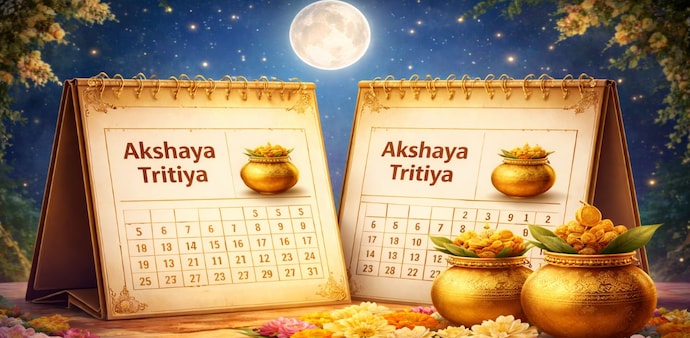
Akshaya Tritiya, one of the most auspicious days in the Hindu calendar, is typically celebrated once a year. However, in some years, it appears to fall on two consecutive days, leaving many people confused about the correct date to observe the festival. This phenomenon is not an error but a result of how the Hindu lunar calendar works.
What causes two Akshaya Tritiyas?
Akshaya Tritiya is observed on the Tritiya Tithi, or the third lunar day of the Shukla Paksha (waxing phase) in the month of Vaishakha. Unlike the Gregorian calendar, which follows fixed dates, the Hindu calendar is based on the movement of the Moon.
A tithi does not follow a strict 24-hour cycle and can begin or end at any time of the day. Because of this, the Tritiya Tithi may start on one day (often in the evening) and continue into the next day.
When this overlap happens, it creates a situation where Akshaya Tritiya appears to fall on two different calendar dates.
Which day is considered the correct one?
In cases where the Tritiya Tithi spans two days, traditional rules are used to determine the more auspicious date.
Generally, the second day is chosen if the Tritiya Tithi is present for a longer duration during the day. Many astrologers follow the "three muhurat rule," which states that if the tithi lasts for more than three muhurats (roughly six hours) on the second day, that day is considered more favourable for rituals and purchases.
Why does this overlap happen?
The overlap occurs because the lunar calendar is not perfectly aligned with the solar day. The timing of tithis depends on the relative positions of the Sun and Moon, which shift slightly each day.
As a result, a tithi can begin at any hour, leading to partial coverage across two dates. This misalignment is what occasionally creates dual dates for festivals like Akshaya Tritiya.
What makes Akshaya Tritiya so special?
The word "Akshaya" means "never diminishing," and the day is believed to bring lasting prosperity and success. It is considered an Abujh Muhurat, meaning the entire day is auspicious without the need to calculate specific timings.
This is why people choose the day to buy gold, start new ventures, invest money, or perform religious rituals. Acts such as charity, temple visits and donations are also commonly observed.
The festival is also known as Akha Teej or Akti and is celebrated by both Hindus and Jains as a spring festival.
Akshaya Tritiya, one of the most auspicious days in the Hindu calendar, is typically celebrated once a year. However, in some years, it appears to fall on two consecutive days, leaving many people confused about the correct date to observe the festival. This phenomenon is not an error but a result of how the Hindu lunar calendar works.
What causes two Akshaya Tritiyas?
Akshaya Tritiya is observed on the Tritiya Tithi, or the third lunar day of the Shukla Paksha (waxing phase) in the month of Vaishakha. Unlike the Gregorian calendar, which follows fixed dates, the Hindu calendar is based on the movement of the Moon.
A tithi does not follow a strict 24-hour cycle and can begin or end at any time of the day. Because of this, the Tritiya Tithi may start on one day (often in the evening) and continue into the next day.
When this overlap happens, it creates a situation where Akshaya Tritiya appears to fall on two different calendar dates.
Which day is considered the correct one?
In cases where the Tritiya Tithi spans two days, traditional rules are used to determine the more auspicious date.
Generally, the second day is chosen if the Tritiya Tithi is present for a longer duration during the day. Many astrologers follow the "three muhurat rule," which states that if the tithi lasts for more than three muhurats (roughly six hours) on the second day, that day is considered more favourable for rituals and purchases.
Why does this overlap happen?
The overlap occurs because the lunar calendar is not perfectly aligned with the solar day. The timing of tithis depends on the relative positions of the Sun and Moon, which shift slightly each day.
As a result, a tithi can begin at any hour, leading to partial coverage across two dates. This misalignment is what occasionally creates dual dates for festivals like Akshaya Tritiya.
What makes Akshaya Tritiya so special?
The word "Akshaya" means "never diminishing," and the day is believed to bring lasting prosperity and success. It is considered an Abujh Muhurat, meaning the entire day is auspicious without the need to calculate specific timings.
This is why people choose the day to buy gold, start new ventures, invest money, or perform religious rituals. Acts such as charity, temple visits and donations are also commonly observed.
The festival is also known as Akha Teej or Akti and is celebrated by both Hindus and Jains as a spring festival.