
Indian banks’ outlook remains stable, but a prolonged conflict in West Asia could throw up challenges: Moody’s
The credit rating agency expects banks’ benign asset quality cycle to sustain and sees credit growth in the financial year 2026-27 in the low-to-mid teens
- Mar 10, 2026,
- Updated Mar 10, 2026 4:37 PM IST
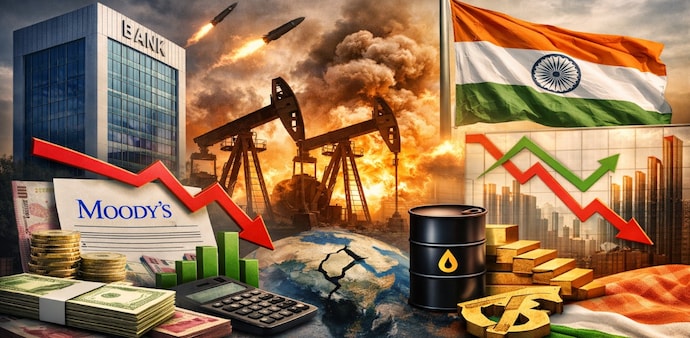
In the past few days, the conflict in West Asia has cast a long shadow on the global economy. With oil prices surging and gas supplies reduced, alarm bells are ringing in economies like India, which imports most of its energy requirements. However, the banking sector continues to provide a glimmer of hope.
Over the past few years, most banks have cleaned up their books, non-performing assets have declined significantly, and the overall growth has been good. The outlook remains stable as of now, according to credit rating agency Moody’s, which is expecting the asset quality cycle to remain benign and credit to grow in the low-to-mid teens range next financial year. But the ongoing conflict will weigh on the road ahead.
Catch US-Israel-Iran war live updates here
Officials at Moody’s and its subsidiary, Icra, hope the West Asia conflict will be resolved sooner rather than later. However, should it get prolonged from a few weeks to months, and oil prices remain elevated, there will be repercussions for the country’s economy and, in turn, banks, they warn.
Elevated energy prices for the long term will increase the cost of doing business for many companies; demand will slow down and, in turn, the economy, noted Amit Pandey, vice-president, financial institutions group, Moody’s Ratings.
Since much of India’s oil and gas requirements are import-dependent, sustained high prices will also put pressure on the current account deficit, and the rupee will remain under pressure (it already breached the 92 level against the US Dollar on Monday). In such a scenario, foreign inflows may also tend to slow further. Interest rates may have to be raised to attract capital, and that will have a bearing on borrowers.
“So, from a very good growth, moderate inflation and interest rate trajectory, you tend to see a slowdown in growth, high inflation and high interest rates. Business will slow down, it has an implication for NPAs' net margins and so on,” noted Pandey.
He also pointed out that India received a lot of remittances from West Asia due to the large diaspora there, and there are companies that have exposure to West Asian markets as well, and all that could also be impacted in case of a prolonged conflict.
However, if the conflict were to be resolved soon, there are several bright spots for India’s banking sector. Not taking the conflict into account, Moody’s has projected India’s GDP to grow 6.4% in FY27 as structural reforms such as the rationalisation of the goods and services tax and income tax cuts announced last year will boost consumption.
Supported by economic growth and low levels of leverage among borrowers, banks’ NPAs are expected to remain low. Corporate asset quality remains strong, and while loan quality to retail and small and medium enterprises is stable, it varies among lenders to some extent depending on underwriting standards. Net interest margins are also expected to improve as last year’s interest rate cuts start reflecting in banks’ deposit rates, noted Moody’s.
From the perspective of non-banking finance companies, the gold loan segment has clocked accelerated growth in the last couple of years, as gold prices have surged amid global uncertainties. After growing 31 per cent in the financial year 2025, gold loan assets under management are expected to surge 60-62 per cent in the current financial year. Icra sees gold loan growth moderating to 17-19 per cent next financial year.
The vehicle loans segment is also expected to report steady growth, clocking 13-15% growth this year and around 14-16% next year. Home loans are also seen growing at a steady 13-15% growth this year and the next, although the loan against property segment is expected to see little moderation from around 20-22% to 19-21%.
“Loan against property (LAP) will still remain one of the faster growing segments, but clearly we would see some moderation, largely driven by the slowdown in the small ticket LAP, given that we are seeing some stress in the last 12-18 months. Some risk averseness, credit underwritings are being tightened across the board, which would result in some slowdown there,” noted Karthik Srinivasan, senior vice-president and group head – financial sector ratings at Icra.
The micro-finance sector, which had a tough 2024-25 financial year, continues to see some challenges, but disbursements have started happening, and the AUMs are expected to largely hold up, noted Srinivasan. After declining 11% in 2024-25, the microfinance sector is expected to see a 0-2% growth this year, and possibly then picking up on a low base to 15-17%.
In the past few days, the conflict in West Asia has cast a long shadow on the global economy. With oil prices surging and gas supplies reduced, alarm bells are ringing in economies like India, which imports most of its energy requirements. However, the banking sector continues to provide a glimmer of hope.
Over the past few years, most banks have cleaned up their books, non-performing assets have declined significantly, and the overall growth has been good. The outlook remains stable as of now, according to credit rating agency Moody’s, which is expecting the asset quality cycle to remain benign and credit to grow in the low-to-mid teens range next financial year. But the ongoing conflict will weigh on the road ahead.
Catch US-Israel-Iran war live updates here
Officials at Moody’s and its subsidiary, Icra, hope the West Asia conflict will be resolved sooner rather than later. However, should it get prolonged from a few weeks to months, and oil prices remain elevated, there will be repercussions for the country’s economy and, in turn, banks, they warn.
Elevated energy prices for the long term will increase the cost of doing business for many companies; demand will slow down and, in turn, the economy, noted Amit Pandey, vice-president, financial institutions group, Moody’s Ratings.
Since much of India’s oil and gas requirements are import-dependent, sustained high prices will also put pressure on the current account deficit, and the rupee will remain under pressure (it already breached the 92 level against the US Dollar on Monday). In such a scenario, foreign inflows may also tend to slow further. Interest rates may have to be raised to attract capital, and that will have a bearing on borrowers.
“So, from a very good growth, moderate inflation and interest rate trajectory, you tend to see a slowdown in growth, high inflation and high interest rates. Business will slow down, it has an implication for NPAs' net margins and so on,” noted Pandey.
He also pointed out that India received a lot of remittances from West Asia due to the large diaspora there, and there are companies that have exposure to West Asian markets as well, and all that could also be impacted in case of a prolonged conflict.
However, if the conflict were to be resolved soon, there are several bright spots for India’s banking sector. Not taking the conflict into account, Moody’s has projected India’s GDP to grow 6.4% in FY27 as structural reforms such as the rationalisation of the goods and services tax and income tax cuts announced last year will boost consumption.
Supported by economic growth and low levels of leverage among borrowers, banks’ NPAs are expected to remain low. Corporate asset quality remains strong, and while loan quality to retail and small and medium enterprises is stable, it varies among lenders to some extent depending on underwriting standards. Net interest margins are also expected to improve as last year’s interest rate cuts start reflecting in banks’ deposit rates, noted Moody’s.
From the perspective of non-banking finance companies, the gold loan segment has clocked accelerated growth in the last couple of years, as gold prices have surged amid global uncertainties. After growing 31 per cent in the financial year 2025, gold loan assets under management are expected to surge 60-62 per cent in the current financial year. Icra sees gold loan growth moderating to 17-19 per cent next financial year.
The vehicle loans segment is also expected to report steady growth, clocking 13-15% growth this year and around 14-16% next year. Home loans are also seen growing at a steady 13-15% growth this year and the next, although the loan against property segment is expected to see little moderation from around 20-22% to 19-21%.
“Loan against property (LAP) will still remain one of the faster growing segments, but clearly we would see some moderation, largely driven by the slowdown in the small ticket LAP, given that we are seeing some stress in the last 12-18 months. Some risk averseness, credit underwritings are being tightened across the board, which would result in some slowdown there,” noted Karthik Srinivasan, senior vice-president and group head – financial sector ratings at Icra.
The micro-finance sector, which had a tough 2024-25 financial year, continues to see some challenges, but disbursements have started happening, and the AUMs are expected to largely hold up, noted Srinivasan. After declining 11% in 2024-25, the microfinance sector is expected to see a 0-2% growth this year, and possibly then picking up on a low base to 15-17%.