
'Abusing people doesn't take the country forward': PM Modi slams critics, cites 7% economic growth
His remarks came after Rahul Gandhi, during his visit to the United States, accused the central government of pushing India towards an economic disaster.
- Nov 20, 2026,
- Updated Nov 20, 2026 9:56 AM IST
Fears over jobs, paper leaks and the future of small businesses stood in sharp contrast to claims of rapid growth and falling poverty as Prime Minister Narendra Modi and Congress MP Rahul Gandhi presented opposing assessments of India’s economy.
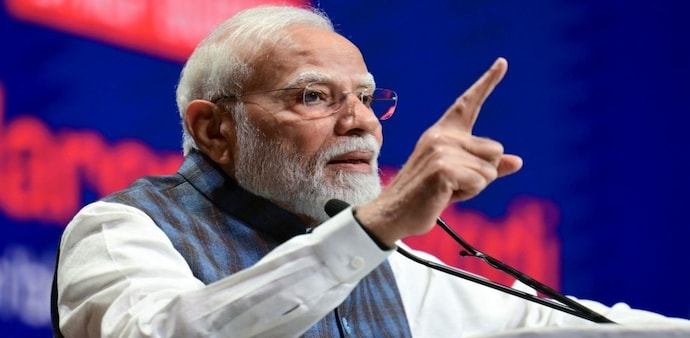
Speaking at FICCI’s centenary convention, Modi said India was the world’s fastest-growing major economy, with growth estimated at around 7 per cent, and that people were emerging from poverty rapidly. His remarks came after Gandhi, during his visit to the United States, accused the central government of pushing India towards an economic disaster.
DON'T MISS | Where are the jobs and higher wages? PM Modi questions India Inc over massive corporate tax cuts
Modi says criticism alone cannot take India forward
At the FICCI event, Modi said, “Abusing people morning and evening does not take the country forward.” He said India’s strong economic performance had prompted Moody’s Ratings, S&P Global Ratings, Fitch Ratings, the World Bank and the Asian Development Bank to raise their growth projections for the country.
The Prime Minister said India’s goods exports stood at nearly $50 billion in October, the highest monthly figure recorded so far. He cited the export figure and revised growth projections to underline the country’s economic performance.
ALSO READ | 'Write to me openly about reforms still needed': PM Modi asks industry leaders
What have ratings agencies said on India's economic growth?
Rating agencies have largely projected India’s economic growth at around 7 per cent to 7.1 per cent for FY27, while expecting some moderation in the second half of the financial year.
Moody’s Ratings raised India’s FY27 growth forecast from 6.5 per cent to 7 per cent in its November 2026 Global Macro Outlook 2027–28. It cited resilient domestic consumption, signs of a recovery in private investment and India’s ability to withstand global energy shocks. The revision followed economic growth of 7.8 per cent in the April-June 2026 quarter.
MUST READ | 'Khao, peeyo, mauj karo' won't do: PM Modi urges Ministers to promote savings, financial discipline
ICRA projected full-year FY27 GDP growth at 7.1 per cent and estimated that growth in the July-September quarter would slow to a five-quarter low of 7.5 per cent from 7.8 per cent in the preceding quarter. It cited a sub-par monsoon, rising inflation, higher input costs and external headwinds.
S&P Global Ratings revised its FY27 projection to 7 per cent, while Fitch Ratings raised its estimate to 6.9 per cent. The agencies cited domestic demand, industrial activity and public investment, while flagging oil prices, inflation and global geopolitical risks. The Japan Credit Rating Agency upgraded India’s long-term foreign and local currency issuer ratings from ‘BBB+’ to ‘A-’ with a stable outlook in September 2026, citing strong GDP growth, a lower fiscal deficit and healthier financial and external buffers.
Rahul Gandhi warns of an economic disaster
In a social media post on November 18, 2026, Gandhi raised concerns about unemployment, paper leaks, pressure on small businesses and widening economic inequality.
Gandhi wrote, “India stands at the doorstep of an economic disaster — this is a bitter truth. Today, a young person is not confident that their degree will help them secure a job. A student fears that a paper leak may ruin their future. Small business owners live under the shadow of government harassment and the monopoly of a few billionaires. Employment opportunities are declining and economic inequality is increasing.”
He added, “Today's India is not the India whose strong economic foundations were built by the Congress through decades of hard work. The media may suppress this truth and the Prime Minister may turn away from it, but reality cannot be changed. And Prime Minister Modi created this economic disaster with his own hands — this is another bitter truth.”
Gandhi claimed that employment opportunities were shrinking and economic inequality was rising. He said the media could suppress these issues and the Prime Minister could ignore them, but the reality would not change.
Modi cites World Bank report on poverty
Referring to poverty, Modi said India’s population was around 50 crore when the “Garibi Hatao” slogan was raised in the 1970s. He said poverty could have been addressed even then, but there was a lack of both appropriate policies and intent at the time.
The Prime Minister said FICCI had witnessed how, when work was carried out with the right intent and the government moved in the right direction, 50 crore people emerged from poverty in just 12 to 13 years.
Citing the World Bank’s latest report, Modi said it showed that 50 crore Indians had overcome poverty over the past 12 to 13 years. According to him, this demonstrated that India was moving in the right direction and offered a guarantee of the country’s success.
Prime Minister traces changes in Indian economy
Modi also referred to different phases of the Indian economy over the past 100 years. He said the country had witnessed the licence-quota raj, an unsuccessful experiment with nationalisation and its inclusion among the “Fragile Five” economies in the 21st century.
However, he said young people, farmers, workers and members of the industrial sector had together changed the situation over the past 12 years.
Marking 100 years since FICCI’s establishment, Modi said it was a major achievement for an institution to remain active for so long and continue to evolve with changing times. He said FICCI had witnessed Indian industry achieve a great deal over the past century.
“The time has now come to decide what Indian industry can achieve over the next 20 years. How can you further increase your contribution to the journey towards a developed India and a self-reliant India?” the Prime Minister said, according to a BJP social media post dated November 19, 2026.
Modi used the FICCI centenary convention to highlight India’s growth projections, record monthly goods exports and the number of people who had emerged from poverty. Gandhi, meanwhile, questioned the government’s record on employment, inequality, education and the conditions faced by small businesses.