
India-EU FTA: Textiles, leather, labour-intensive exports boost for India; machinery, autos win for EU
India-EU FTA: Textiles, leather, labour-intensive exports boost for India; machinery, autos win for EU
For India, the principal benefit lies in preferential access to the European market for more than 99% of its exports. Duties will be eliminated immediately on 90% of Indian exports once the agreement enters into force.
Business Today Desk
- Jan 27, 2026,
- Updated Jan 27, 2026 8:08 PM IST
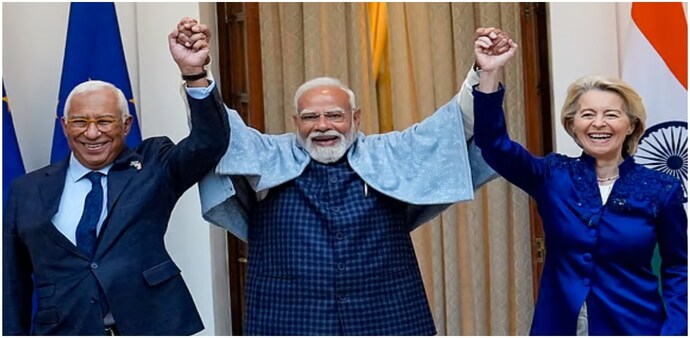
India and the 27-nation European Union (EU) sealed negotiations on a long-pending free trade agreement on January 27, unlocking sweeping market access across goods, services and investment. Described by both sides as the world’s largest bilateral trade pact, the agreement is expected to significantly reshape trade flows once implemented, likely at least a year after signing.
Advertisement
India’s bilateral goods trade with the EU stood at $136.5 billion in 2024–25, with exports of $75.85 billion and imports of $60.68 billion, making the bloc India’s largest trading partner. Under the FTA, India is projected to eventually gain $75 billion in additional exports, while the EU expects its shipments to India to double by 2032 as tariffs are cut or eliminated.
How India will benefit
For India, the principal benefit lies in preferential access to the European market for more than 99 per cent of its exports. Duties will be eliminated immediately on 90 per cent of Indian exports once the agreement enters into force, rising to 93 per cent over seven years. A further 6 per cent of exports will receive tariff reductions or quota-based access.
Advertisement
This broad liberalisation is expected to give a decisive push to India’s labour-intensive and manufacturing sectors, supporting export growth, job creation and MSME participation in global value chains. The FTA also grants India access to 144 EU services sub-sectors, including IT, professional and technical services, alongside improved mobility provisions and uncapped student movement.
Sector-wise benefits: Zero-duty access
Several key sectors are set to benefit from zero-duty access under the India–EU FTA, underscoring the scale of tariff liberalisation India has secured in the European market.
Marine products, which currently face duties of up to 26 per cent, are expected to gain significantly, improving the competitiveness of Indian seafood exports across EU markets. Footwear and leather goods, taxed at around 17 per cent, are likely to see renewed export momentum after years of pressure from Southeast Asian competitors that enjoyed preferential access.
Advertisement
The apparel and textiles sector, facing tariffs of 11–12 per cent, is among the biggest winners. Zero-duty entry could help Indian exporters regain market share from rivals such as Bangladesh and Vietnam in the EU’s $263.5 billion textile import market. Chemicals, which currently attract tariffs of about 12.8 per cent, base metals at 10 per cent, and consumer goods at 10.5 per cent will also see a sharp improvement in price competitiveness.
Lower duties on gems and jewellery (4 per cent), toys and sports goods (4.7 per cent), and rail products and ships (7 per cent) are expected to unlock new demand and longer-term supply contracts with European buyers. Together, these sectors account for roughly $33–35 billion of India’s exports to the EU and are expected to be among the earliest beneficiaries once the pact is implemented.
How the EU will benefit
In return, India has agreed to progressively liberalise tariffs on 92.1 per cent of EU tariff lines, covering 97.5 per cent of EU exports by value. European exporters of machinery, chemicals, pharmaceuticals, medical devices, aircraft components, plastics, iron and steel—many facing Indian duties of 11–44 per cent—stand to gain from reduced costs and deeper market access.
Advertisement
The agreement also opens the door for EU agricultural and consumer products, including fruits such as apples, pears and kiwi, wines and spirits under quota, and processed foods like chocolates and confectionery, benefiting exporters from countries such as France, Italy, Spain and Belgium.
Autos, steel and climate sectors
Automobiles remain one of the most sensitive chapters. EU cars priced below €15,000 are excluded, while higher-end vehicles will see phased tariff cuts under quotas, with duties eventually falling to 10 per cent over five years. Electric vehicles receive limited access only from the fifth year. India, notably, secured a vehicle export quota to the EU that is 2.5 times larger than what it has offered European automakers.
Steel trade will be shaped by the EU’s new quota regime, while climate rules under the EU’s carbon border adjustment mechanism will apply uniformly. Although India did not secure an exemption, it will benefit from technical assistance and any flexibility extended to other partners.
Taken together, the India–EU FTA marks a structural shift in bilateral trade, with India gaining export momentum and jobs, and the EU locking in long-term access to one of the world’s fastest-growing large economies.
India and the 27-nation European Union (EU) sealed negotiations on a long-pending free trade agreement on January 27, unlocking sweeping market access across goods, services and investment. Described by both sides as the world’s largest bilateral trade pact, the agreement is expected to significantly reshape trade flows once implemented, likely at least a year after signing.
Advertisement
India’s bilateral goods trade with the EU stood at $136.5 billion in 2024–25, with exports of $75.85 billion and imports of $60.68 billion, making the bloc India’s largest trading partner. Under the FTA, India is projected to eventually gain $75 billion in additional exports, while the EU expects its shipments to India to double by 2032 as tariffs are cut or eliminated.
How India will benefit
For India, the principal benefit lies in preferential access to the European market for more than 99 per cent of its exports. Duties will be eliminated immediately on 90 per cent of Indian exports once the agreement enters into force, rising to 93 per cent over seven years. A further 6 per cent of exports will receive tariff reductions or quota-based access.
Advertisement
This broad liberalisation is expected to give a decisive push to India’s labour-intensive and manufacturing sectors, supporting export growth, job creation and MSME participation in global value chains. The FTA also grants India access to 144 EU services sub-sectors, including IT, professional and technical services, alongside improved mobility provisions and uncapped student movement.
Sector-wise benefits: Zero-duty access
Several key sectors are set to benefit from zero-duty access under the India–EU FTA, underscoring the scale of tariff liberalisation India has secured in the European market.
Marine products, which currently face duties of up to 26 per cent, are expected to gain significantly, improving the competitiveness of Indian seafood exports across EU markets. Footwear and leather goods, taxed at around 17 per cent, are likely to see renewed export momentum after years of pressure from Southeast Asian competitors that enjoyed preferential access.
Advertisement
The apparel and textiles sector, facing tariffs of 11–12 per cent, is among the biggest winners. Zero-duty entry could help Indian exporters regain market share from rivals such as Bangladesh and Vietnam in the EU’s $263.5 billion textile import market. Chemicals, which currently attract tariffs of about 12.8 per cent, base metals at 10 per cent, and consumer goods at 10.5 per cent will also see a sharp improvement in price competitiveness.
Lower duties on gems and jewellery (4 per cent), toys and sports goods (4.7 per cent), and rail products and ships (7 per cent) are expected to unlock new demand and longer-term supply contracts with European buyers. Together, these sectors account for roughly $33–35 billion of India’s exports to the EU and are expected to be among the earliest beneficiaries once the pact is implemented.
How the EU will benefit
In return, India has agreed to progressively liberalise tariffs on 92.1 per cent of EU tariff lines, covering 97.5 per cent of EU exports by value. European exporters of machinery, chemicals, pharmaceuticals, medical devices, aircraft components, plastics, iron and steel—many facing Indian duties of 11–44 per cent—stand to gain from reduced costs and deeper market access.
Advertisement
The agreement also opens the door for EU agricultural and consumer products, including fruits such as apples, pears and kiwi, wines and spirits under quota, and processed foods like chocolates and confectionery, benefiting exporters from countries such as France, Italy, Spain and Belgium.
Autos, steel and climate sectors
Automobiles remain one of the most sensitive chapters. EU cars priced below €15,000 are excluded, while higher-end vehicles will see phased tariff cuts under quotas, with duties eventually falling to 10 per cent over five years. Electric vehicles receive limited access only from the fifth year. India, notably, secured a vehicle export quota to the EU that is 2.5 times larger than what it has offered European automakers.
Steel trade will be shaped by the EU’s new quota regime, while climate rules under the EU’s carbon border adjustment mechanism will apply uniformly. Although India did not secure an exemption, it will benefit from technical assistance and any flexibility extended to other partners.
Taken together, the India–EU FTA marks a structural shift in bilateral trade, with India gaining export momentum and jobs, and the EU locking in long-term access to one of the world’s fastest-growing large economies.
Read more!