
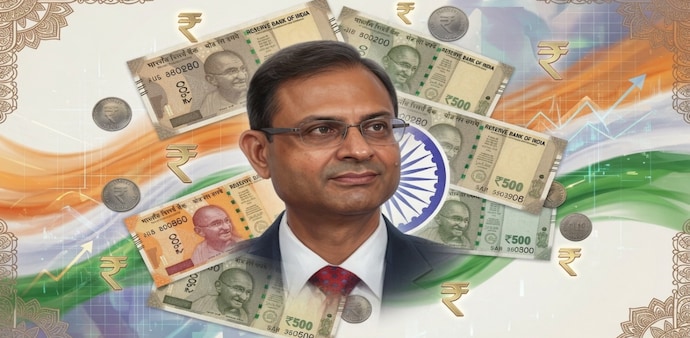
RBI Gov Sanjay Malhotra has a few tricks up his sleeve to attract foreign capital
During 2026-27 so far net FPI to India witnessed outflows of US$ 13.7 billion, primarily in the equity segment, said Gov Sanjay Malhotra.
- Jun 5, 2026,
- Updated Jun 5, 2026 11:24 AM IST
Reserve Bank of India (RBI) Governor Sanjay Malhotra announced a few measures that he said would help attract foreign capital into the country. During 2026-27 so far net FPI to India witnessed outflows of US$ 13.7 billion, primarily in the equity segment, he said.
In order to correct this and attract foreign capital, Gov Malhotra announced certain measures:
What: The central bank expanded the range of "specified securities" under the Fully Accessible Route (FAR) to include all new issuances of 15-year, 30-year and 40-year government securities. It also removed limits on short-term investment, concentration and individual securities for foreign portfolio investor (FPI) investments under the general route.
Why: These steps, along with tax benefits announced by the government earlier, are expected to attract foreign capital for government borrowing.
What: The RBI increased investment limits for Non-Resident Indians (NRIs) and Overseas Citizens of India (OCIs) in equity instruments traded on stock exchanges without requiring registration with the Securities and Exchange Board of India (SEBI). This facility has been extended to all individual Persons Resident Outside India (PROIs) on par with NRIs and OCIs.
Why: This will help in a more proactive mobilisation of foreign portfolio capital.
DON'T MISS | RBI MPC 2026: Gov Malhotra raises FY27 inflation projection by 50 bps to 5.1%
What: Additionally, the central bank introduced a concessional foreign exchange swap facility until September 30, 2026.
Why: This will encourage external commercial borrowings (ECBs) by public sector undertakings (PSUs).
What: A similar facility to cover the full hedging cost will be available until September 30, 2026, to authorised dealer (AD) banks.
Why: This is to raise fresh three-to-five-year Foreign Currency Non-Resident (Bank) [FCNR(B)] deposits.
MUST READ | Govt removes capital gains tax on FIIs, BIS investments in G-Secs
Moreover, Gov Malhotra also said that India’s foreign exchange reserves stood at $682.3 billion on May 29. He said various policy initiatives are expected to strengthen the balance of payments including the recent agreements with major trading partners, opening the insurance sector to 100 per cent FDI, ethanol blending program, push for energy transition, easing of FDI restrictions for land-bordering countries, liberalisation of the ECB framework, and several others.
Reserve Bank of India (RBI) Governor Sanjay Malhotra announced a few measures that he said would help attract foreign capital into the country. During 2026-27 so far net FPI to India witnessed outflows of US$ 13.7 billion, primarily in the equity segment, he said.
In order to correct this and attract foreign capital, Gov Malhotra announced certain measures:
What: The central bank expanded the range of "specified securities" under the Fully Accessible Route (FAR) to include all new issuances of 15-year, 30-year and 40-year government securities. It also removed limits on short-term investment, concentration and individual securities for foreign portfolio investor (FPI) investments under the general route.
Why: These steps, along with tax benefits announced by the government earlier, are expected to attract foreign capital for government borrowing.
What: The RBI increased investment limits for Non-Resident Indians (NRIs) and Overseas Citizens of India (OCIs) in equity instruments traded on stock exchanges without requiring registration with the Securities and Exchange Board of India (SEBI). This facility has been extended to all individual Persons Resident Outside India (PROIs) on par with NRIs and OCIs.
Why: This will help in a more proactive mobilisation of foreign portfolio capital.
DON'T MISS | RBI MPC 2026: Gov Malhotra raises FY27 inflation projection by 50 bps to 5.1%
What: Additionally, the central bank introduced a concessional foreign exchange swap facility until September 30, 2026.
Why: This will encourage external commercial borrowings (ECBs) by public sector undertakings (PSUs).
What: A similar facility to cover the full hedging cost will be available until September 30, 2026, to authorised dealer (AD) banks.
Why: This is to raise fresh three-to-five-year Foreign Currency Non-Resident (Bank) [FCNR(B)] deposits.
MUST READ | Govt removes capital gains tax on FIIs, BIS investments in G-Secs
Moreover, Gov Malhotra also said that India’s foreign exchange reserves stood at $682.3 billion on May 29. He said various policy initiatives are expected to strengthen the balance of payments including the recent agreements with major trading partners, opening the insurance sector to 100 per cent FDI, ethanol blending program, push for energy transition, easing of FDI restrictions for land-bordering countries, liberalisation of the ECB framework, and several others.