
'Surjit Bhalla's views are alarmist': Arvind Panagariya explains why Indian economy is still robust
Arvind Panagariya backed his argument with macroeconomic data, pointing to average GDP growth, stable investment levels, and contained inflation
- May 27, 2026,
- Updated May 27, 2026 6:29 PM IST
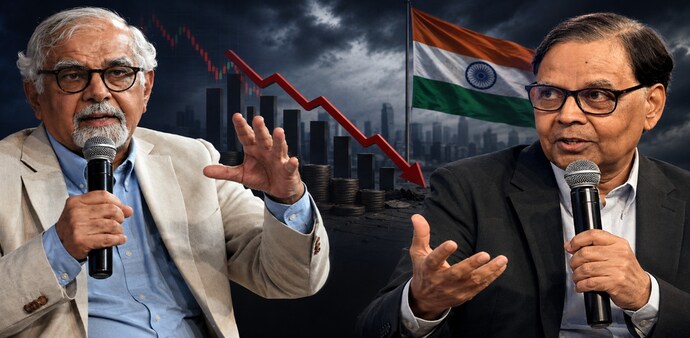
Finance Commission Chairman Arvind Panagariya on Tuesday dismissed economist Surjit Bhalla's warnings on the Indian economy, calling his comparison of India to the "Fragile Five" economies "alarmist". He insisted that the country's macroeconomic fundamentals remained strong despite mounting pressure from the West Asia crisis.
Don't Miss: Crude was cheaper. Why didn't fuel prices drop? Economist Montek Singh explains
Panagariya, however, acknowledged that rising oil prices, a weakening rupee, and swelling subsidy burdens posed a "reasonably severe" external shock. "Well, there is an external shock here. It is a reasonably severe one. Now the question is how long-lasting will it be?" he said while speaking to India Today TV.
The noted economist said all the "three Fs" highlighted earlier by Finance Minister Nirmala Sitharaman - foreign exchange reserves, fertiliser subsidies, and fuel prices - were under pressure. Still, he said the broader economy remained resilient. "But, on the other hand, I personally think the economy is quite robust. I don't see that there is a crisis in the economy as some are saying."
Panagariya backed his argument with macroeconomic data, pointing to average GDP growth of 7.3% over the last three years, stable investment levels, contained inflation, and a manageable current account deficit.
"Fixed investment, or what we call the gross fixed investment, has been very steady for the last three to four years - I have seen the figures between 31% and 32% of the GDP. Inflation has averaged about 4.3% during the last 3 years. Current account deficit has stayed within 1% of the GDP," he said.
Must Read: 'Indian economy is in trouble': Ex-IMF economist Surjit Bhalla on what went wrong
Earlier this week, Bhalla warned that India faced an investment crisis and argued that weak private investment, slowing growth, and declining foreign investor confidence required urgent reforms.
"We've got strange rules which no other country has in terms of FDI. The investment climate in India has really gone negative, and that is well known. The foreigners are not interested in investing in India. Indians are not interested in investing in India," Bhalla told India Today.
Bhalla also said India should stop describing itself as the world's fastest-growing major economy and warned that weak growth could eventually increase poverty.
"What has happened over the last 10 years, we have substituted government investment that is public infrastructure investment for private investment," he said. "While we all welcome the government investment, private and foreign direct investment is a lot more productive for the economy than government investment."
In an opinion piece in The Indian Express, Bhalla wrote that India may have moved from being one of the "Fragile Five" economies in 2013 to "possibly becoming one of just two, along with Turkey". He pointed to the rupee's depreciation and weakening currency performance despite stable inflation and political conditions.
Panagariya, however, rejected the comparison outright.
"The view that Dr Bhalla has presented, I must say, is alarmist. To me, any comparison with the fragile five, which is the kind of analogy he was trying to invoke, that's a bit laughable," he said. "At that time (during Fragile Five), our growth was faltering, inflation was double-digit, current account deficit was about 3 to 4%. So there is no comparison between that situation and today's situation," he added.
Panagariya said if the crisis ends quickly, the economy could lose around half a percentage point in growth because of the oil shock, estimating that growth may slow to 6.5%. "If the crisis continues through the year, then I would say we'll get to about 6%," he said.
Finance Commission Chairman Arvind Panagariya on Tuesday dismissed economist Surjit Bhalla's warnings on the Indian economy, calling his comparison of India to the "Fragile Five" economies "alarmist". He insisted that the country's macroeconomic fundamentals remained strong despite mounting pressure from the West Asia crisis.
Don't Miss: Crude was cheaper. Why didn't fuel prices drop? Economist Montek Singh explains
Panagariya, however, acknowledged that rising oil prices, a weakening rupee, and swelling subsidy burdens posed a "reasonably severe" external shock. "Well, there is an external shock here. It is a reasonably severe one. Now the question is how long-lasting will it be?" he said while speaking to India Today TV.
The noted economist said all the "three Fs" highlighted earlier by Finance Minister Nirmala Sitharaman - foreign exchange reserves, fertiliser subsidies, and fuel prices - were under pressure. Still, he said the broader economy remained resilient. "But, on the other hand, I personally think the economy is quite robust. I don't see that there is a crisis in the economy as some are saying."
Panagariya backed his argument with macroeconomic data, pointing to average GDP growth of 7.3% over the last three years, stable investment levels, contained inflation, and a manageable current account deficit.
"Fixed investment, or what we call the gross fixed investment, has been very steady for the last three to four years - I have seen the figures between 31% and 32% of the GDP. Inflation has averaged about 4.3% during the last 3 years. Current account deficit has stayed within 1% of the GDP," he said.
Must Read: 'Indian economy is in trouble': Ex-IMF economist Surjit Bhalla on what went wrong
Earlier this week, Bhalla warned that India faced an investment crisis and argued that weak private investment, slowing growth, and declining foreign investor confidence required urgent reforms.
"We've got strange rules which no other country has in terms of FDI. The investment climate in India has really gone negative, and that is well known. The foreigners are not interested in investing in India. Indians are not interested in investing in India," Bhalla told India Today.
Bhalla also said India should stop describing itself as the world's fastest-growing major economy and warned that weak growth could eventually increase poverty.
"What has happened over the last 10 years, we have substituted government investment that is public infrastructure investment for private investment," he said. "While we all welcome the government investment, private and foreign direct investment is a lot more productive for the economy than government investment."
In an opinion piece in The Indian Express, Bhalla wrote that India may have moved from being one of the "Fragile Five" economies in 2013 to "possibly becoming one of just two, along with Turkey". He pointed to the rupee's depreciation and weakening currency performance despite stable inflation and political conditions.
Panagariya, however, rejected the comparison outright.
"The view that Dr Bhalla has presented, I must say, is alarmist. To me, any comparison with the fragile five, which is the kind of analogy he was trying to invoke, that's a bit laughable," he said. "At that time (during Fragile Five), our growth was faltering, inflation was double-digit, current account deficit was about 3 to 4%. So there is no comparison between that situation and today's situation," he added.
Panagariya said if the crisis ends quickly, the economy could lose around half a percentage point in growth because of the oil shock, estimating that growth may slow to 6.5%. "If the crisis continues through the year, then I would say we'll get to about 6%," he said.