


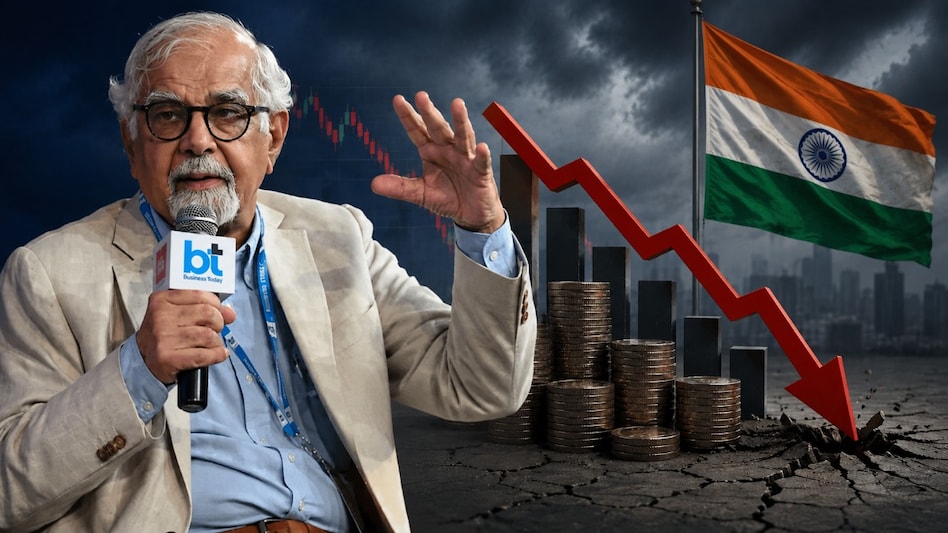
 Surjit Bhalla served as Executive Director for India at the IMF. (AI generated)
Economist Surjit Bhalla has warned that India's economy is facing a deepening investment crisis and said it was "high time for the Modi government to course correct". India's immediate challenge was not poverty, but slowing growth and collapsing investment sentiment, he said while speaking to India Today TV.
"I don't actually," Bhalla said when asked whether he feared a return to mass poverty because of global conflicts and economic disruptions. "But what I do think is that in India's case, something has happened, and we can discuss that about our growth process. Investment is not taking place. Private investment is not taking place, and FDI has really declined into negative territory."
FAQs
Why has Surjit Bhalla said it is high time for the Modi government to course correct?
Surjit Bhalla said India is facing a serious growth and investment problem, with private investment weak and foreign direct investment declining. He argued that the government must act urgently because slowing growth, not poverty alone, is the bigger immediate risk for the economy.
What investment concerns did Surjit Bhalla raise about the Indian economy?
Bhalla said private investment is not picking up and FDI sentiment has turned negative. According to him, both foreign and domestic investors are showing less interest in investing in India, which is hurting the overall growth outlook.
How did Surjit Bhalla link poverty and economic growth in India?
Bhalla said poverty is not India’s main problem at present because food subsidies have prevented a sharp worsening. However, he warned that if economic growth continues to weaken, poverty could become a much bigger issue in the future.
What did Surjit Bhalla say about government spending versus private investment?
He said India has increasingly relied on public infrastructure spending over the last decade while private investment has weakened. Bhalla noted that although government investment is welcome, private and foreign investment are usually more productive for the economy and more important for long-term growth.
Why did Surjit Bhalla criticise India’s 2015 Bilateral Investment Treaty?
Bhalla argued that the 2015 Bilateral Investment Treaty made India less attractive to foreign investors. He said the rules were too restrictive, especially the conditions related to dispute resolution and the requirement to go through Indian courts, which discouraged investment inflows.

 Tata Trusts asks Tata Sons to explore options other than listing, says ‘Tata Model has to be saved’
 Tata Trusts proposes ₹25,000 crore plan for SP Group, says Tata Sons listing is not an option
 'RBI letter does not mention listing': Noel Tata seeks full briefing on Tata Sons-RBI talks
 'We cannot put the cart before...': Noel Tata's argument against N Chandrasekaran's reappointment
 Tata Trusts opposes N Chandrasekaran reappointment, says board resolution is ‘legal nullity’
 How India Changed In 12 Years: PM Modi’s Journey From Economic Reforms To Viksit Bharat
 Modi @76: From Twitter To Instagram, How His Digital Outreach Has Evolved
 Stock Picks To Watch: Shibani Kurian Reveals Kotak AMC’s Market Bets
 Gold ETF vs Physical Gold: Know the Tax Rules, Charges and Key Differences
  PPF vs NPS: Tax Benefits, Returns and Lock-in Period Explained for Retirement Planning
 Hero Motors IPO subscribed 3.37 times on Day 2; retail portion subscribed over 5 times
 NSE IPO: India's largest exchange gets 43% subscription on Day 1; NIIs, retail see strong demand
 Rentomojo shares settle maiden trade nearly 32% above IPO price; what should investors do now?
 Sensex slips, Nifty settles higher; Tata stocks gain after N Chandrasekaran reappointment
 Cochin Shipyard, KRBL, RITES, Ramky Infrastructure among stocks to turn ex-dividend on September 18
 TVS Motor to increase monthly EV capacity to over 50,000 units as sales boom
 'Foreign investors want only returns': Noel Tata explains why he opposes listing Tata SonsTata Trusts proposes ₹25,000 crore plan for SP Group, says Tata Sons listing is not an option'RBI letter does not mention listing': Noel Tata seeks full briefing on Tata Sons-RBI talks
 Want EPFO Updates On WhatsApp? Here’s How To Follow The Official Channel In Just A Few Steps












