
Elon Musk's SpaceX rocket creates a temporary hole in Ionosphere
The pictures from the July 19 launch displayed a faint red glow, which was examined by space physicist Jeff Baumgardner from Boston University.
- Jul 25, 2023,
- Updated Jul 25, 2023 9:52 PM IST
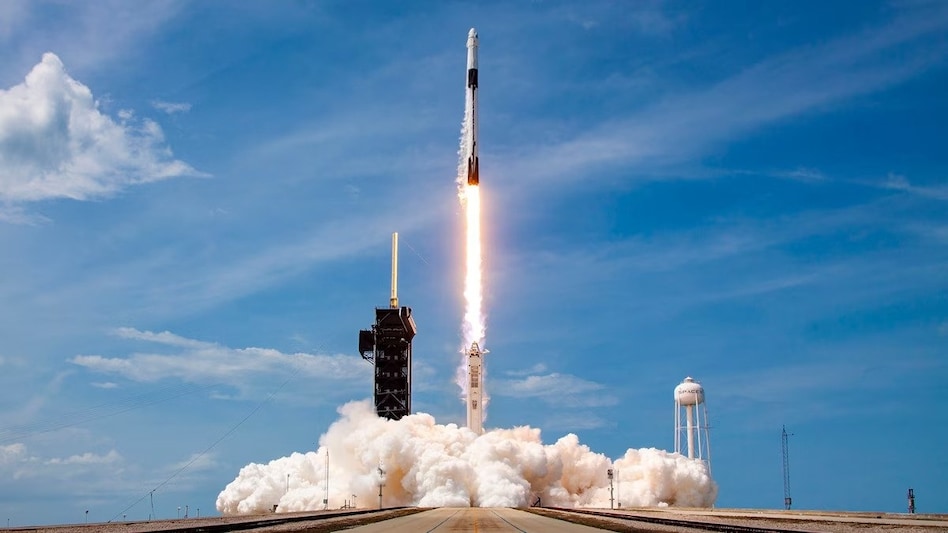
SpaceX, the private space company founded by billionaire Elon Musk, has achieved another remarkable feat. On July 19, a Falcon 9 rocket launched from the Vandenberg Space Force Base in California, creating a temporary hole in the Earth's ionosphere, as reported by spaceweather.com.
The Falcon 9 rocket is the first privately developed liquid-propellant rocket to reach orbit and has been instrumental in launching, orbiting, and recovering spacecrafts. The Falcon 9 has also been used to send astronauts to the International Space Station.
The pictures from the July 19 launch displayed a faint red glow, which was examined by space physicist Jeff Baumgardner from Boston University. After studying the footage of the launch, he said that the red glow shows that a hole was created in the ionosphere.
"This is a well-studied phenomenon when rockets are burning their engines 200 to 300 km above Earth's surface," Baumgardner told spaceweather.com.
"I reviewed footage from the July 19th launch. It shows the second stage engine burning at 286 km near the F-region peak for that time of day. So, it is quite possible that an ionospheric 'hole' was made," he added.
The ionosphere, a dynamic and active part of Earth's atmosphere, is situated on the brink of space, approximately 50 to 400 miles above the Earth's surface. This region is teeming with charged particles known as ions, which are formed when gases in this layer are excited by solar radiation.
NASA's research reveals that the ionosphere plays a crucial role in the creation of auroras, the mesmerizing light displays often seen near Earth's poles. These auroras are the result of geomagnetic storms, during which solar plasma interacts with the ions in the ionosphere, leading to the emission of brilliant colors in the sky.
A hole in the ionosphere can interfere with GPS systems, causing position accuracy to vary by a few feet. According to Newsweek, it was not particularly relevant at the time.
"Human are entering an era that rocket launches are becoming usual and frequent due to reduced cost by reusable rockets. Meanwhile, humans are developing more powerful rockets to send cargoes to other planets. These two factors will gradually affect the middle and upper atmosphere more, and that is worthwhile to pay some attention to," it quoted Charles CH Lin of the National Cheng Kung University in Taiwan as saying.
SpaceX, the private space company founded by billionaire Elon Musk, has achieved another remarkable feat. On July 19, a Falcon 9 rocket launched from the Vandenberg Space Force Base in California, creating a temporary hole in the Earth's ionosphere, as reported by spaceweather.com.
The Falcon 9 rocket is the first privately developed liquid-propellant rocket to reach orbit and has been instrumental in launching, orbiting, and recovering spacecrafts. The Falcon 9 has also been used to send astronauts to the International Space Station.
The pictures from the July 19 launch displayed a faint red glow, which was examined by space physicist Jeff Baumgardner from Boston University. After studying the footage of the launch, he said that the red glow shows that a hole was created in the ionosphere.
"This is a well-studied phenomenon when rockets are burning their engines 200 to 300 km above Earth's surface," Baumgardner told spaceweather.com.
"I reviewed footage from the July 19th launch. It shows the second stage engine burning at 286 km near the F-region peak for that time of day. So, it is quite possible that an ionospheric 'hole' was made," he added.
The ionosphere, a dynamic and active part of Earth's atmosphere, is situated on the brink of space, approximately 50 to 400 miles above the Earth's surface. This region is teeming with charged particles known as ions, which are formed when gases in this layer are excited by solar radiation.
NASA's research reveals that the ionosphere plays a crucial role in the creation of auroras, the mesmerizing light displays often seen near Earth's poles. These auroras are the result of geomagnetic storms, during which solar plasma interacts with the ions in the ionosphere, leading to the emission of brilliant colors in the sky.
A hole in the ionosphere can interfere with GPS systems, causing position accuracy to vary by a few feet. According to Newsweek, it was not particularly relevant at the time.
"Human are entering an era that rocket launches are becoming usual and frequent due to reduced cost by reusable rockets. Meanwhile, humans are developing more powerful rockets to send cargoes to other planets. These two factors will gradually affect the middle and upper atmosphere more, and that is worthwhile to pay some attention to," it quoted Charles CH Lin of the National Cheng Kung University in Taiwan as saying.