
From a school trip to a smart invention: How a teen built an AI trash robot
The innovation is currently being tested in homes, schools and residential societies.
- Jun 26, 2026,
- Updated Jun 26, 2026 8:30 AM IST
In 2023, while visiting Delhi's Sundar Nursery with her classmates, the Class 12 student noticed something many people had learned to ignore: plastic wrappers, bottles and food waste scattered across the ground despite dustbins being just a few steps away. The sight stayed with her long after the trip ended.
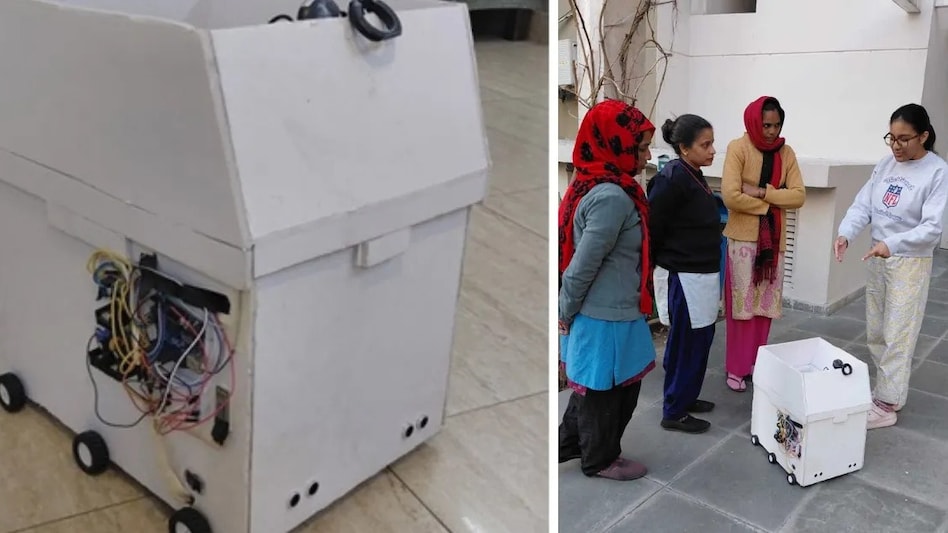
Two years later, Mahi Malhani, a student from Amity International School, Mayur Vihar, has developed TRASHbot, an AI-powered waste collection and segregation robot that can identify, collect and sort garbage with over 90% accuracy. The innovation is currently being tested in homes, schools and residential societies.
READ THIS: Fly in train meal! IRCTC slaps ₹1 lakh fine on caterer, license to be cancelled
"I noticed litter everywhere, even near dustbins," Mahi told The Better India. "People often take the easy route and throw waste wherever they can. I wanted to bridge that gap with technology that helps, rather than just tells people to clean up."
Sketches for a working prototype
What began as rough sketches in a notebook soon evolved into a working prototype. Mahi spent months researching robotics, artificial intelligence and waste management systems before designing a robot capable of autonomously moving towards users, collecting waste and classifying it into biodegradable and non-biodegradable categories.
How TRASHbot works
The robot uses a Raspberry Pi-powered camera system and the YOLOv3 object detection model to recognise different types of waste. Once identified, the trash is automatically directed into the appropriate compartment. A companion mobile application helps users interact with the robot while also gamifying responsible waste disposal habits.
Unlike traditional dustbins that depend entirely on human behaviour, TRASHbot actively engages with users. It can move autonomously using sensors and also operate through Bluetooth control during demonstrations and events. The lightweight modular design allows components to be replaced easily, making the robot practical for everyday use.
ALSO READ: ‘I handed Claude my salary’: Viral X post shares 7 prompts for financial freedom
For Mahi, the project is about more than technology. It is about solving a growing environmental challenge.
Tackling India's growing waste challenge
India generates more than 1.7 lakh tonnes of solid waste every day, yet a significant portion remains untreated, according to data cited by The Better India from the Central Pollution Control Board.
By combining artificial intelligence with environmental responsibility, Mahi hopes to make waste segregation effortless and accessible. Her innovation aligns with the broader global push towards smarter waste management systems, where AI is increasingly being used to improve sorting accuracy and reduce landfill waste.
In 2023, while visiting Delhi's Sundar Nursery with her classmates, the Class 12 student noticed something many people had learned to ignore: plastic wrappers, bottles and food waste scattered across the ground despite dustbins being just a few steps away. The sight stayed with her long after the trip ended.
Two years later, Mahi Malhani, a student from Amity International School, Mayur Vihar, has developed TRASHbot, an AI-powered waste collection and segregation robot that can identify, collect and sort garbage with over 90% accuracy. The innovation is currently being tested in homes, schools and residential societies.
READ THIS: Fly in train meal! IRCTC slaps ₹1 lakh fine on caterer, license to be cancelled
"I noticed litter everywhere, even near dustbins," Mahi told The Better India. "People often take the easy route and throw waste wherever they can. I wanted to bridge that gap with technology that helps, rather than just tells people to clean up."
Sketches for a working prototype
What began as rough sketches in a notebook soon evolved into a working prototype. Mahi spent months researching robotics, artificial intelligence and waste management systems before designing a robot capable of autonomously moving towards users, collecting waste and classifying it into biodegradable and non-biodegradable categories.
How TRASHbot works
The robot uses a Raspberry Pi-powered camera system and the YOLOv3 object detection model to recognise different types of waste. Once identified, the trash is automatically directed into the appropriate compartment. A companion mobile application helps users interact with the robot while also gamifying responsible waste disposal habits.
Unlike traditional dustbins that depend entirely on human behaviour, TRASHbot actively engages with users. It can move autonomously using sensors and also operate through Bluetooth control during demonstrations and events. The lightweight modular design allows components to be replaced easily, making the robot practical for everyday use.
ALSO READ: ‘I handed Claude my salary’: Viral X post shares 7 prompts for financial freedom
For Mahi, the project is about more than technology. It is about solving a growing environmental challenge.
Tackling India's growing waste challenge
India generates more than 1.7 lakh tonnes of solid waste every day, yet a significant portion remains untreated, according to data cited by The Better India from the Central Pollution Control Board.
By combining artificial intelligence with environmental responsibility, Mahi hopes to make waste segregation effortless and accessible. Her innovation aligns with the broader global push towards smarter waste management systems, where AI is increasingly being used to improve sorting accuracy and reduce landfill waste.