
India AI Impact Summit 2026: Sam Altman-Dario Amodei awkward moment sparks 'AI cold war' talk
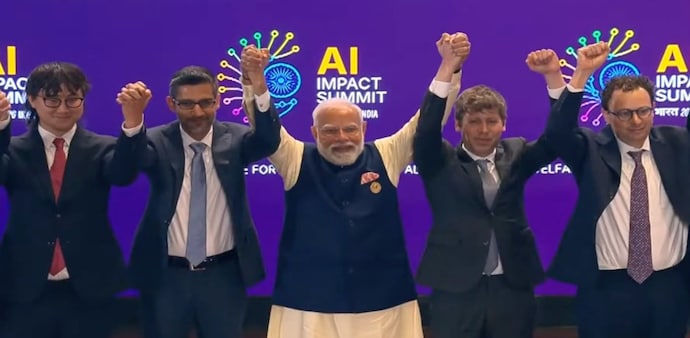
The interaction, captured on camera and widely shared online, showed Sam Altman of OpenAI and Dario Amodei of Anthropic standing side by side but refraining from holding hands as other leaders joined in a raised-hands pose encouraged by PM Modi.
- Feb 19, 2026,
- Updated Feb 19, 2026 3:00 PM IST
A fleeting on-stage moment at the India AI Impact Summit 2026 has ignited outsized global attention, after leaders of rival artificial intelligence firms appeared to sidestep a symbolic gesture during a high-profile photo opportunity with Prime Minister Narendra Modi.
The interaction, captured on camera and widely shared online, showed Sam Altman of OpenAI and Dario Amodei of Anthropic standing side by side but refraining from holding hands as other leaders joined in a raised-hands pose encouraged by PM Modi. Instead, both men lifted their fists, avoiding physical contact — a subtle divergence that quickly became fodder for social media commentary and industry speculation.
Also present on stage were Sundar Pichai and Alexandr Wang, underscoring the geopolitical and commercial weight the summit has assumed as India positions itself as a central arena for the next phase of AI adoption.
The relationship between Altman and Amodei is rooted in collaboration turned rivalry. Amodei, along with several colleagues, left OpenAI earlier this decade amid concerns that the race to commercialise increasingly powerful AI systems risked outpacing safety-focused development. That departure led to the creation of Anthropic, built explicitly around a “safety-first” research framework and governance model.
The split crystallised two contrasting visions for scaling artificial intelligence: one emphasising rapid deployment and broad accessibility, the other advocating measured release aligned with rigorous alignment and risk-mitigation strategies.
The competitive undercurrent resurfaced earlier this month during a public exchange triggered by a US advertising campaign from Anthropic that appeared to take aim at moves by competitors to expand revenue models around generative AI services. Altman responded sharply on social media, defending a strategy he characterised as necessary to make AI tools accessible at global scale rather than limiting them to premium users.
That exchange highlighted not just a business rivalry, but a disagreement over how AI should be funded and distributed: whether through scaled commercial ecosystems designed to subsidise mass adoption, or through more tightly controlled deployments prioritising risk management even if access grows more gradually.
A fleeting on-stage moment at the India AI Impact Summit 2026 has ignited outsized global attention, after leaders of rival artificial intelligence firms appeared to sidestep a symbolic gesture during a high-profile photo opportunity with Prime Minister Narendra Modi.
The interaction, captured on camera and widely shared online, showed Sam Altman of OpenAI and Dario Amodei of Anthropic standing side by side but refraining from holding hands as other leaders joined in a raised-hands pose encouraged by PM Modi. Instead, both men lifted their fists, avoiding physical contact — a subtle divergence that quickly became fodder for social media commentary and industry speculation.
Also present on stage were Sundar Pichai and Alexandr Wang, underscoring the geopolitical and commercial weight the summit has assumed as India positions itself as a central arena for the next phase of AI adoption.
The relationship between Altman and Amodei is rooted in collaboration turned rivalry. Amodei, along with several colleagues, left OpenAI earlier this decade amid concerns that the race to commercialise increasingly powerful AI systems risked outpacing safety-focused development. That departure led to the creation of Anthropic, built explicitly around a “safety-first” research framework and governance model.
The split crystallised two contrasting visions for scaling artificial intelligence: one emphasising rapid deployment and broad accessibility, the other advocating measured release aligned with rigorous alignment and risk-mitigation strategies.
The competitive undercurrent resurfaced earlier this month during a public exchange triggered by a US advertising campaign from Anthropic that appeared to take aim at moves by competitors to expand revenue models around generative AI services. Altman responded sharply on social media, defending a strategy he characterised as necessary to make AI tools accessible at global scale rather than limiting them to premium users.
That exchange highlighted not just a business rivalry, but a disagreement over how AI should be funded and distributed: whether through scaled commercial ecosystems designed to subsidise mass adoption, or through more tightly controlled deployments prioritising risk management even if access grows more gradually.