
'FDs can be useless if...': User says PSU bank froze account over re-KYC issue
After the post went viral, the user shared an update that the bank had reached out.
- May 14, 2026,
- Updated May 14, 2026 12:59 PM IST
A social media post highlighting the difficulties faced by a critically ill customer in accessing fixed deposit funds due to pending KYC formalities has sparked outrage online and drawn a response from Union Bank of India.
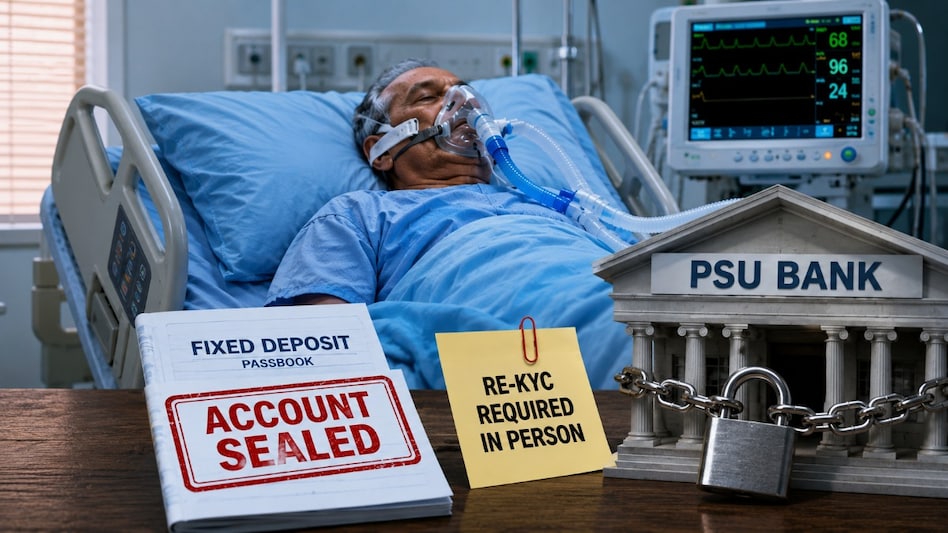
A user named Saurabh Jain claimed that his uncle, who is currently on a ventilator, had all his life savings parked in fixed deposits at a PSU bank. According to the post, the customer’s accounts were allegedly sealed because he could not complete re-KYC formalities in person due to prolonged illness.
DO CHECKOUT | Rs 1 lakh FD monthly payout explained: Which banks offer highest returns?
The family reportedly approached the bank earlier when the man was bedridden and unable to even go to the toilet. They also submitted a doctor’s certificate to support their request. However, the user alleged that the bank insisted on the customer visiting the branch personally before the accounts could be reactivated.
The post criticised the KYC process, calling it “draconian”, and tagged Prime Minister Narendra Modi and the Reserve Bank of India, seeking intervention.
After the post went viral, the user shared an update that the bank had reached out and promised to provide a solution to resolve the issue by Wednesday morning.
MUST READ | Can buying a house be a bad investment? Expert sparks viral real estate investment debate
What happens if you are unable to complete their re-KYC formalities?
In such a scenario, your bank account shall be partially frozen as the bank would allow them to deposit money but block all withdrawals. If KYC is not completed even after 3 months of notice and 3 months of partial freeze, the account becomes completely inoperative.
Furthermore, you might not have access to internet banking, ATM cards and chequebooks may be suspended as well. In case of a frozen account, the payment of interest and pension credits can either be delayed or stopped.
What are the options for senior citizens?
The Reserve Bank of India (RBI) has provided several options for the elderly and those who are incapacitated. These are as follows:
- Self-declaration: If there is no change in KYC information, senior citizens can submit a self-declaration via email, registered post or through a bank's online channel without having to visit the branch.
- Video KYC: Many banks offer the option of Video Re-KYC, allowing a quick digital, live, video-based interaction with a bank official.
- Non-home branch visit: KYC can be completed at any branch of the same bank, not necessarily the home branch.
- Doorstep banking: Some banks also offer doorstep services for senior citizens to submit the re-KYC documents.
- Authorising a representative: In cases of illness or incapacity, senior citizens can authorise a person to withdraw funds on their behalf, which often requires witness identification.
What should you do?
- Don't ignore bank notices: Banks have to send at least 3 warnings before taking any action.
- Contact the bank: You have to call the bank's official helpline to understand whether the process can be done via net banking or video KYC.
- Submit self-declaration: If there is no change in details, you can e-mail the self-declaration to the bank's designated email address.
- Use business correspondents: In rural areas, bank agents can assist with the KYC process at the customer's home.
A social media post highlighting the difficulties faced by a critically ill customer in accessing fixed deposit funds due to pending KYC formalities has sparked outrage online and drawn a response from Union Bank of India.
A user named Saurabh Jain claimed that his uncle, who is currently on a ventilator, had all his life savings parked in fixed deposits at a PSU bank. According to the post, the customer’s accounts were allegedly sealed because he could not complete re-KYC formalities in person due to prolonged illness.
DO CHECKOUT | Rs 1 lakh FD monthly payout explained: Which banks offer highest returns?
The family reportedly approached the bank earlier when the man was bedridden and unable to even go to the toilet. They also submitted a doctor’s certificate to support their request. However, the user alleged that the bank insisted on the customer visiting the branch personally before the accounts could be reactivated.
The post criticised the KYC process, calling it “draconian”, and tagged Prime Minister Narendra Modi and the Reserve Bank of India, seeking intervention.
After the post went viral, the user shared an update that the bank had reached out and promised to provide a solution to resolve the issue by Wednesday morning.
MUST READ | Can buying a house be a bad investment? Expert sparks viral real estate investment debate
What happens if you are unable to complete their re-KYC formalities?
In such a scenario, your bank account shall be partially frozen as the bank would allow them to deposit money but block all withdrawals. If KYC is not completed even after 3 months of notice and 3 months of partial freeze, the account becomes completely inoperative.
Furthermore, you might not have access to internet banking, ATM cards and chequebooks may be suspended as well. In case of a frozen account, the payment of interest and pension credits can either be delayed or stopped.
What are the options for senior citizens?
The Reserve Bank of India (RBI) has provided several options for the elderly and those who are incapacitated. These are as follows:
- Self-declaration: If there is no change in KYC information, senior citizens can submit a self-declaration via email, registered post or through a bank's online channel without having to visit the branch.
- Video KYC: Many banks offer the option of Video Re-KYC, allowing a quick digital, live, video-based interaction with a bank official.
- Non-home branch visit: KYC can be completed at any branch of the same bank, not necessarily the home branch.
- Doorstep banking: Some banks also offer doorstep services for senior citizens to submit the re-KYC documents.
- Authorising a representative: In cases of illness or incapacity, senior citizens can authorise a person to withdraw funds on their behalf, which often requires witness identification.
What should you do?
- Don't ignore bank notices: Banks have to send at least 3 warnings before taking any action.
- Contact the bank: You have to call the bank's official helpline to understand whether the process can be done via net banking or video KYC.
- Submit self-declaration: If there is no change in details, you can e-mail the self-declaration to the bank's designated email address.
- Use business correspondents: In rural areas, bank agents can assist with the KYC process at the customer's home.