












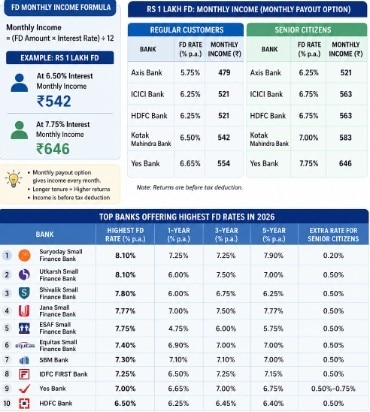



 If investors choose the monthly payout option, the interest earned is credited every month instead of being compounded till maturity.
Many investors continue to prefer fixed income instruments over market-linked products such as equities and mutual funds, especially during periods of volatility and economic uncertainty. Among these, fixed deposits (FDs) remain one of the most popular low-risk investment options for individuals seeking stable returns, capital protection, and predictable monthly income.
In 2026, interest in fixed deposits has increased again as banks and financial institutions offer FD rates ranging between 5.75% and 7.75%, while some small finance banks are providing rates of up to 8.10% for select tenures. Senior citizens continue to receive additional interest benefits ranging from 0.25% to 0.75%, making FDs particularly attractive for retirees and conservative investors.

 GST Council to take up proposal of MDR on UPI
 Tata Sons rejects Noel Tata objections over N. Chandrasekaran reappointment
 SEBI rewrites PMS rulebook, allows IPO, foreign securities and unlisted debt investments
 BT Big Story: Is 66% = zero? The Tata Sons question on everyone’s minds
  Govt, IBA to work on mechanism to ensure UPI MDR isn't passed on to consumers
 Meta’s New Gadgets: Camera-Free Glasses, VR Eyewear And AI Handheld Device Unveiled
  MDR Levy: Will Retail Trading Volumes Take A Hit? | NSE Chairman Srinivas Injeti
 NSE Lists At ₹1,800: Exclusive Post-Listing Interview With India's Largest Exchange
 From Mobile Trading To AI: How NSE Plans To Protect Market Integrity
 NSE On India’s Capital Markets Growth | IPOs, REITs, InvITs And More
 SEBI rewrites PMS rulebook, allows IPO, foreign securities and unlisted debt investments
 HSBC plans India equity broking return amid IPO boom, says report
 Whirlpool of India clarifies on promoter stake sale report; stock slips
 From Azim Premji to DMart’s Radhakishan Damani: The famous investors sitting on thousands of crores in NSE shares
 Solar Industries stock gets 'Buy' call on defence push and global explosives growth
 Gold, silver ETFs get a new vaulting framework: SEBI raises vault managers' net worth requirement
 India Inc has 5–10 years of AI implementation runway even if innovation stops today: Nasscom chief
 SEBI's new settlement rules: 90-day window, fast-track route and new penalty formula explained
 'Self-contained civilisation': Indian co-founder visits Shenzhen, returns with a lesson for India
 Actor Mushtaq Khan passes away at 56: His 'Meri ek taang nakli hai' scene in 'Welcome' remains unforgettable


